

27 August 2026
Insights


New York City has announced the policy The harder legal question is what appropriations, contracts,...

New York City’s municipal grocery initiative may properly face scrutiny over public money, public...

Regulatory change can make a product less commercially secure without making it unlawful to own or...

SaaS Style Gaming and the Legal Erosion of...
New York City has announced the policy The harder legal question is what appropriations, contracts,...
New York City’s municipal grocery initiative may properly face scrutiny over public money, public...
Regulatory change can make a product less commercially secure without making it unlawful to own or...
SaaS Style Gaming and the Legal Erosion of...
June 24, 2026
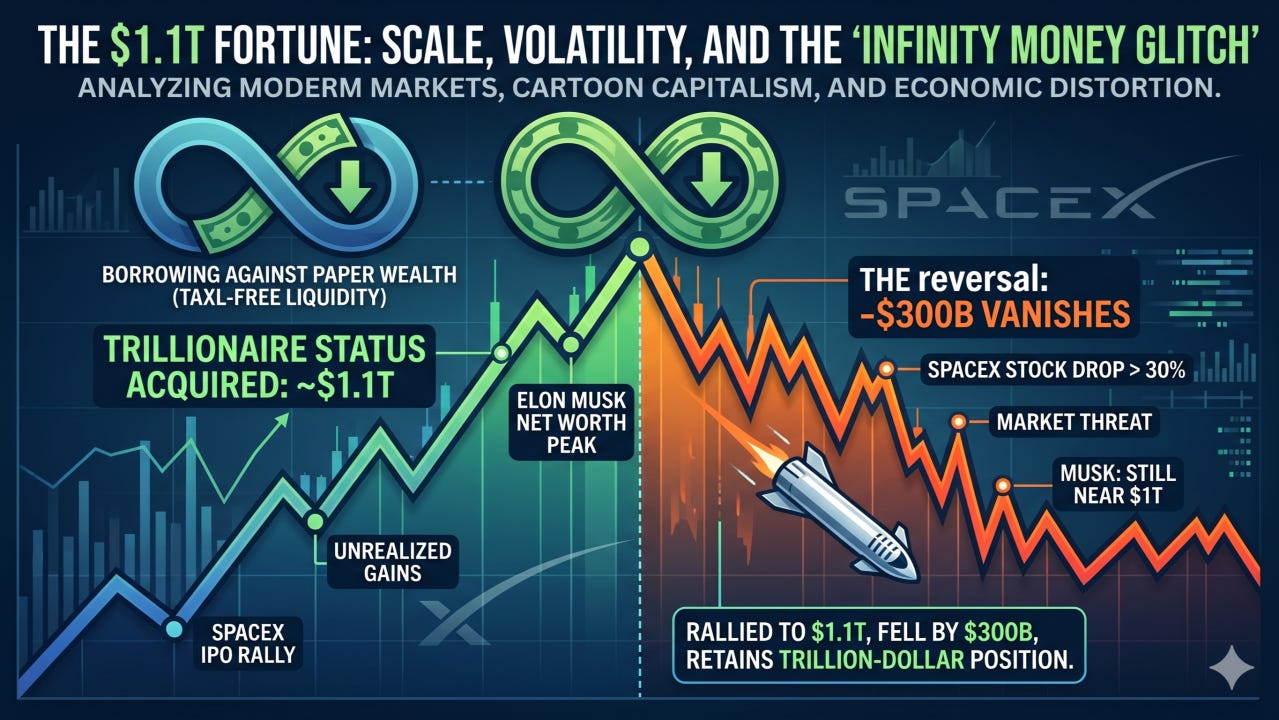
Elon Musk’s brief status as the world’s first “trillionaire” was more than a headline. When SpaceX’s IPO and subsequent rally pushed his marked‑to‑market net worth above $1.1T, and the ensuing selloff erased roughly $300B while leaving him still near $1T, the episode illustrated how modern markets allow a single individual’s wealth to swing by amounts larger than the lifetime earnings of millions of workers. This is not unique to technology. Earlier industrial fortunes amassed by figures such as Rockefeller and Carnegie prompted similar debates about taxation, philanthropy, and economic concentration. Today, that debate resurfaces in a system that enables cartoonishly large fortunes to grow, be leveraged, and often be preserved through what can be called an infinity money glitch, while ordinary households and even entire countries operate at completely different scales.
At the peak of SpaceX’s post‑IPO rally, Musk’s net worth was reported at about $1.1T, giving him a lead of hundreds of billions over the next richest individuals and making him the first person recorded at that level of wealth.
As SpaceX’s stock fell more than 30% from its high and broader tech markets sold off, estimates suggest Musk’s net worth dropped by around $300B, but he remained the richest person in the world with wealth near $1T.
Federal Reserve data summarized by consumer finance outlets indicate average U.S. household net worth around $1.06M and median net worth near $192,700, meaning half of American households have less than that.
World Bank classifications show low‑income countries with GNI per capita under about $1,135, and data on the poorest economies, such as South Sudan and Burundi, place GDP per capita below $1,500, while the global average GDP per capita (PPP) is roughly $25,000.
Historically, the U.S. top marginal federal income tax rate reached 94% in 1944 and remained above 90% through much of the 1940s and 1950s; under President Reagan, the top rate was 50% for part of the 1980s before later reforms reduced it further.
Very wealthy individuals can, as a matter of law and practice, borrow against appreciated assets, use credit, trusts, and estate planning vehicles, and time realization of gains, thereby often achieving lower effective tax burdens on their economic income than wage earners or small investors.
To understand why a $1T personal fortune is economically grotesque, you have to place it against ordinary reference points. If a person held $1T at age 40 and lived to 100, they could, in theory, spend about $16.7B per year for 60 years and exhaust only the principal at the end, ignoring investment returns. The annual spending capacity alone rivals or exceeds the budgets of large public systems: statewide school networks, major hospital systems, or national infrastructure agencies.
By contrast, the median U.S. household’s net worth of roughly $192,700 represents a lifetime of work and saving for many families. In low‑income countries, individuals live on an annual economic output below $1,500 per person, and even lower‑middle‑income economies often sit in the range of a few thousand dollars per capita. Most governments manage public finances on scales far below $1T in net worth for a single individual. Against those benchmarks, a personal fortune on the order of $1T is not merely large. It is distorted beyond what most people can reasonably relate to.
The word grotesque here does not mean criminal or immoral by itself. It describes the extreme degree of concentration. When one person’s net worth can move by $300B in a few days while their position at the top of the global rich list remains largely unchanged, ordinary households and citizens are justified in asking whether the system is producing outcomes consistent with any intuitively fair distribution of economic power.
The infinity money glitch is not a conspiracy. It is a description of how existing tax rules, financial instruments, and market practices interact in the presence of very large, volatile portfolios.
When the price of assets such as SpaceX or Tesla stock rises, Musk’s net worth increases on paper. Those gains are unrealized. For tax purposes, no income is recognized until a sale occurs. However, modern finance allows him to borrow against this appreciated stock, using it as collateral for lines of credit, margin loans, or structured facilities. From a practical perspective, the borrowed funds serve many of the same functions as income. They can be used to purchase homes, fund projects, make investments, or finance consumption. From a tax perspective, they are treated as debt, not taxable income.
Estate and trust planning structures can be arranged to transfer ownership of assets, manage the timing of realization, and take advantage of rules such as step‑up in basis, which can reduce or eliminate tax on gains at death. For someone with a very large, concentrated portfolio, this combination makes it possible to live off the economic power of unrealized gains while paying relatively modest current tax compared to what a wage earner pays on salary or a small investor pays on realized gains.
For ordinary households, none of this is available at comparable scale. Their primary income is wages and small investment returns; it is taxed annually. Their borrowing capacity is anchored to income and conventional credit metrics. Their retirement savings are constrained by statutory caps and volatility. The infinity money glitch operates only when someone has enough appreciated assets to support substantial borrowing and complex planning.
Musk’s brief rise above $1.1T and fall to just under $1T is an unusually visible illustration, but the mechanism is shared across many large fortunes. Rockefeller and Carnegie, in earlier eras, prompted questions about whether philanthropy and voluntary giving were sufficient responses to extreme wealth concentration. Today, founders like Musk, Bezos, and others whose wealth is tied to highly valued stock can borrow against holdings, manage realization, and pass wealth on through structures that minimize tax. The infinity money glitch is systemic.
The United States once acknowledged, in law, that very high incomes should be treated differently from ordinary earnings. During World War II and the postwar era, top marginal federal income tax rates reached 94% and remained above 90% for extended periods, applying only to income above very high thresholds. These rates reflected a view that beyond a certain point, additional income should contribute heavily to public needs.
Under Reagan, the top statutory rate was reduced to 50%, and later to 28%, as part of broader tax reforms aimed at lowering rates and changing the base. These changes were grounded in arguments about efficiency and incentives. They did not abolish progressivity, but they materially changed its intensity.
The mid‑20th‑century period with very high top marginal rates coexisted with strong growth, expansion of the American middle class, and substantial investments in infrastructure, education, and research. That history does not prove causation, but it demonstrates that a modern, innovative economy can function with much more aggressive taxation of extreme incomes than exists today.
Advocates of greater progressivity argue that, in an era of trillion‑dollar fortunes and sophisticated avoidance mechanisms, returning to a more robust treatment of extreme wealth could fund universal or near‑universal healthcare, stronger veteran support, childcare, public education, and climate or infrastructure initiatives without undermining overall growth. Critics emphasize that realized gains are eventually taxed, estate taxes still exist, and borrowing has costs. Those points are important. They do not negate the observation that current rules often allow extreme fortunes to be consumed and compounded with lower effective tax burdens than wage income or modest investments.
Cartoon capitalism is a way of naming what happens when the infinity money glitch operates inside an economy that still relies heavily on wage‑based taxation and modest assets for most of its revenue. A single individual’s net worth can exceed $1T, fall by hundreds of billions, and remain near $1T. Average U.S. households sit around $200K in net worth, and billions of people live in countries where per capita output is under $5K. The market can add and subtract hundreds of billions from a founder’s paper fortune in a week, while ordinary families contend with rising costs for housing, healthcare, and education.
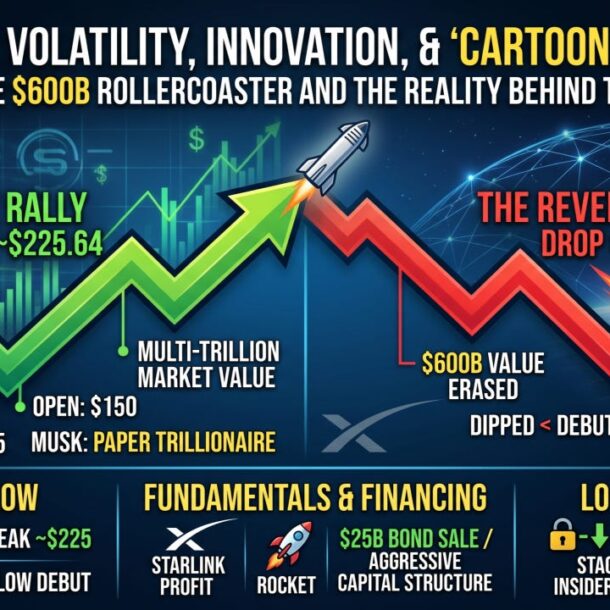
SpaceX’s IPO is one case study. The company raised tens of billions in equity, added $25B in debt, and continues to report substantial losses outside its principal profit‑generating segment. Its founder’s net worth moved by roughly $300B in the process, while retail investors who bought late now hold volatile shares that may live inside retirement accounts and index funds. None of this is illegal. Much of it is celebrated.
Cartoon capitalism is the name for this structural imbalance. It is not a personal attack on Musk, Rockefeller, Carnegie, Buffett, Bezos, or any other individual. It is an acknowledgment that a system which enables the infinity money glitch at the top, while subjecting ordinary incomes to full current taxation and exposing small investors to the downside of speculative episodes, may be misaligned with the basic intuition of fairness that underpins long‑term legitimacy.
This is not a call for socialism or communism. Markets remain powerful tools for organizing capital and innovation. It is a call to recognize that there is a point where a reasonable person can look at $1T fortunes, $300B daily swings, and persistent underinvestment in public goods and say, without envy, that enough is enough.
Musk’s net worth briefly exceeded $1.1T during the SpaceX rally, then fell by about $300B as the stock slumped, yet he remains near $1T, highlighting the extreme scale and volatility of modern personal fortunes.
Median U.S. household net worth is under $200K, and citizens of low‑income countries often live on less than $1,500 of annual output, making $1T personal wealth economically grotesque in relative terms.
Historically, U.S. top marginal tax rates reached 94% and remained very high for decades, and even under Reagan the top rate was 50%, showing that strong growth can coexist with much more progressive treatment of extreme incomes than exists today.
The infinity money glitch arises when large holders borrow against appreciated assets, defer recognition of gains, and use estate planning to preserve wealth, allowing extreme fortunes to often be consumed and compounded with lower effective tax burdens than wage income or modest investments.
Cartoon capitalism is best understood as a structural diagnosis: a system in which trillion‑dollar fortunes and sophisticated tax and financing tools coexist with widespread economic insecurity, raising serious questions about whether current rules still reflect a defensible balance between private gain and public welfare.
This article is published by JJTP Law PLLC as a general-interest news and information service for clients and friends of the firm. Nothing in it is legal advice, and reading it does not create an attorney-client relationship. If you have a question about how this topic applies to your own situation, please reach out to the attorney you normally work with, or schedule a consultation. This is not a solicitation for legal work in any jurisdiction where JJTP Law is not authorized to practice. See our Attorney Advertising & Terms of Use.