27 August 2026
Insights

New York City has announced the policy The harder legal question is what appropriations, contracts,...
New York City’s municipal grocery initiative may properly face scrutiny over public money, public...
Regulatory change can make a product less commercially secure without making it unlawful to own or...
SaaS Style Gaming and the Legal Erosion of...
New York City has announced the policy The harder legal question is what appropriations, contracts,...
New York City’s municipal grocery initiative may properly face scrutiny over public money, public...
Regulatory change can make a product less commercially secure without making it unlawful to own or...
SaaS Style Gaming and the Legal Erosion of...
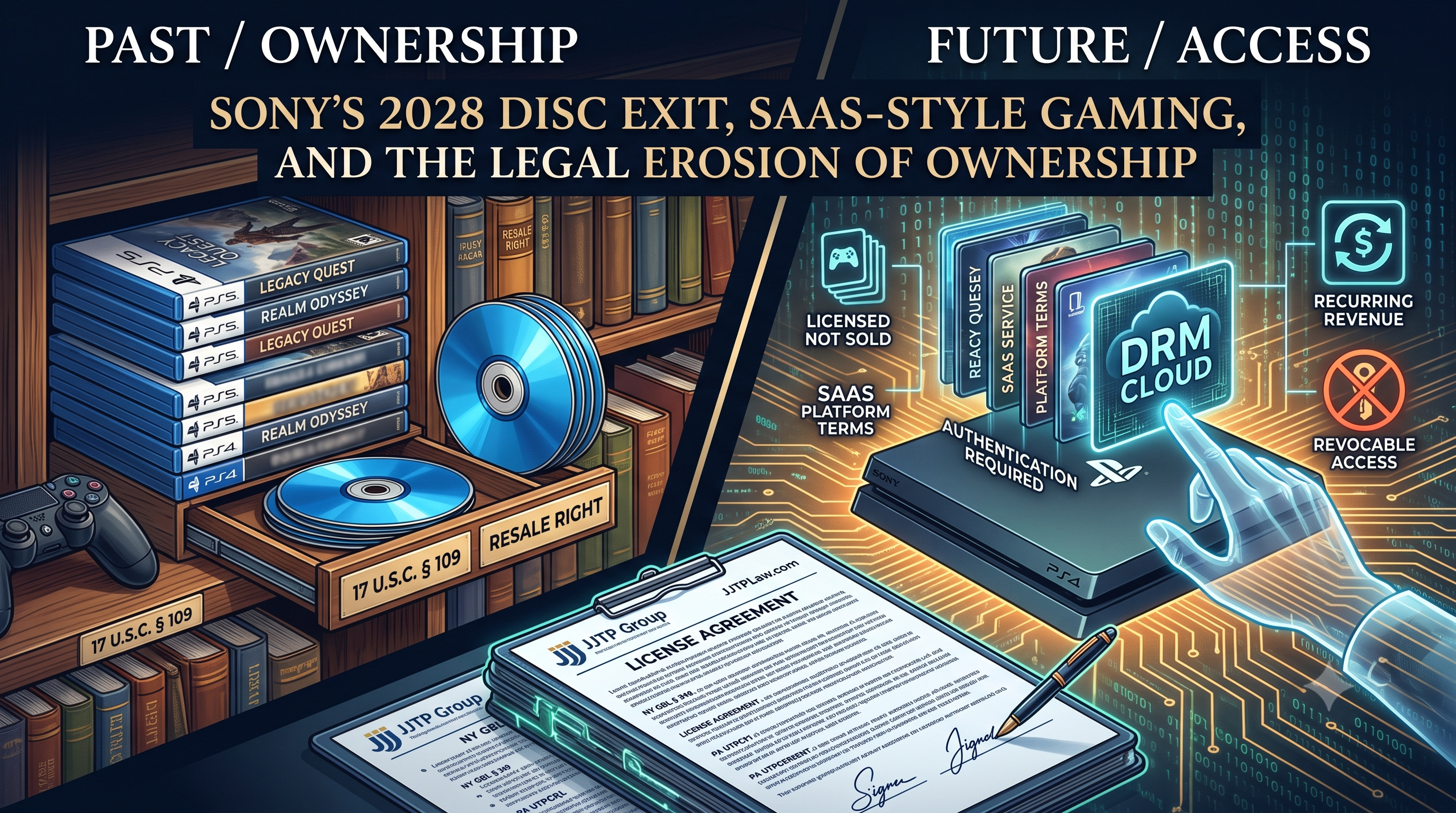
Sony’s decision to discontinue physical disc production for all new PlayStation games beginning in January 2028 is not just a gaming industry development. It is a revealing case study in how digital commerce increasingly separates price from ownership, asks consumers to pay premium rates for licensed access rather than title to a copy, and generally gives rights holders greater practical control over how their intellectual property is monetized over time while retaining control over the underlying work.
The timing makes the story more striking. Sony is now embracing the same digital first trajectory that once helped fuel backlash when Microsoft pushed Xbox toward a more always online, platform controlled future. What once drew criticism as overreach is now becoming ordinary market structure, largely because digital distribution, recurring revenue, and direct platform control are commercially attractive.
Sony’s PlayStation Blog states that “physical game disc production for all new games releasing on PlayStation consoles will be discontinued starting January 2028.”
Sony also states that the transition does not affect games that already released, or that will be released, in disc format before January 2028.
PlayStation Store refunds for games and DLC generally require that the request be made within 14 days and that the content has not been downloaded or streamed, subject to local law and other limited exceptions.
Steam states that its content and services are licensed, not sold, and that the license confers no title or ownership in the content and services.
Microsoft states that digital goods such as games, video, books, and apps are licensed, not sold, and that access depends on compliance with Microsoft’s terms and continuing service support.
The first sale doctrine under 17 U.S.C. § 109 gives owners of lawful physical copies stronger resale and lending rights than most consumers receive in license based digital storefront transactions.
New York and Pennsylvania consumer protection law may become important where ownership style marketing does not match the restricted rights actually delivered through license terms.
Reuters reported that Grand Theft Auto VI was priced at $79.99 for the standard edition and $99.99 for the Ultimate Edition, making the economic consequences of diminished copy based rights much easier to see.
Sony’s wording should be stated precisely, because the entire analysis rests on getting that fact right. Sony did not announce that all PlayStation discs immediately disappear. It said that “physical game disc production for all new games releasing on PlayStation consoles will be discontinued starting January 2028,” and it separately clarified that games already released, or scheduled for disc release before that date, are not affected.
That narrower and more accurate framing is still enormously significant. It means that future PlayStation buyers will increasingly enter a market where access is delivered through digital storefronts and account based entitlements rather than through ownership of a physical copy. That, in turn, means the rights that consumers receive will more often be defined by contracts, platform rules, and access controls than by the traditional attributes of copy based ownership.
The real story, then, is not simply that discs are disappearing. It is that one of the world’s largest entertainment platforms is accelerating the shift from product ownership toward controlled digital access, and that shift has consequences in copyright law, contract law, consumer protection law, and business strategy.
When consumers see the word “buy,” they usually assume a familiar transaction. They expect that paying for a game means they can keep it, lend it, resell it, preserve it, or pass it on just as they could with a disc, a book, or a DVD. That assumption is not irrational. It reflects centuries of ordinary commerce built around ownership of tangible copies.
Digital storefront transactions often look exactly like that kind of sale. The checkout experience is frictionless, the price can equal or exceed the physical version, and the platform may use ownership oriented language in a way that feels natural to the buyer. Yet the governing terms frequently define the transaction as a limited license to access content under rules the provider writes, enforces, and can sometimes modify later.
That difference is what makes the issue legally important. The question is not whether consumers are paying. They clearly are. The question is what bundle of rights they actually receive in exchange for that payment, and whether the transaction is presented clearly enough that ordinary consumers understand the gap between a purchase in everyday language and a license in legal reality.
The starting point is federal copyright law. Under 17 U.S.C. § 109, the owner of a lawfully made copy may generally sell or otherwise dispose of that particular copy without obtaining further permission from the copyright owner. That rule is commonly known as the first sale doctrine.
In plain English, first sale is what allows a physical copy to move through ordinary secondary markets. A buyer can finish a game and sell the disc, lend it to a friend, donate it, or store it for later. The copyright owner still owns the work, but not perpetual control over that specific physical copy once it has been lawfully sold.
The Supreme Court’s decision in Kirtsaeng v. John Wiley & Sons reinforced the breadth of the doctrine by holding that first sale applies to copies lawfully made abroad as well as those manufactured in the United States, underscoring that lawful physical copy ownership carries robust resale consequences once a sale has occurred.
That doctrine is central to understanding why discs matter. Physical copy ownership does not transfer copyright, but it does transfer meaningful copy based rights. The loss consumers increasingly feel in digital commerce is not ownership of the intellectual property itself. It is ownership of a copy and the traditional incidents of ownership that followed from having one.
Courts have repeatedly recognized that software publishers can structure transactions to avoid traditional ownership consequences. In the Ninth Circuit’s decision in Vernor v. Autodesk, the court treated software users as licensees rather than owners when the publisher specified that the transaction was a license, imposed substantial transfer restrictions, and placed notable limits on use.
That case matters because it shows why form and drafting can determine legal outcome. If a rights holder carefully frames access as a license, retains title, restricts transfer, and limits use, the user may not be treated as the owner of the copy for first sale purposes. That is a powerful doctrinal foundation for today’s digital storefront model and a major reason why copy based resale rights are so much weaker in software and game ecosystems than consumers expect.
For a modern gaming article, Vernor is a useful reminder that the erosion of copy based rights is not just a policy trend. It is also the product of case law recognizing the force of carefully structured software licenses.
Digital rights management, or DRM, is the technological mechanism that makes this contractual structure function in practice. DRM can require account authentication, platform verification, device matching, network checks, or other technical controls that determine when and how content can be accessed.
The legal significance of DRM is heightened by the DMCA. Section 1201 protects access control systems by restricting circumvention of technological measures that effectively control access to copyrighted works. In practical terms, DRM is not merely a technical obstacle. It is often a legally protected one.
That matters because digital access can remain conditional long after the consumer has paid. A title may depend on the continued operation of servers, the persistence of account credentials, the platform’s willingness to support the game, or the rights holder’s continuing authority to distribute it. Where those elements change, access can become fragile even though the consumer already paid the purchase price.
Preservation risks should also be described carefully. In many cases, preservation becomes more difficult where DRM, authentication requirements, or online dependencies are built into the product design. DRM free titles and certain standalone downloads may remain more durable. But much of the modern AAA ecosystem is tightly bound to platform architecture and live service functionality, which can make long term access and preservation meaningfully less secure.
The practical difference between a disc and a digital entitlement is easiest to understand through resale. Under the traditional physical model, a player could buy a game, finish it, and trade it in to a retailer like GameStop, then use that value toward the next title. That secondary market was not incidental. It was a regular part of how many consumers managed the cost of gaming.
Public financial reporting and industry analysis have estimated that used games and consoles can generate gross profit margins nearing 50 percent for GameStop’s pre owned business, roughly doubling the margin on new software. That profitability existed only because ownership of a physical copy carried resale consequences that copyright law generally respected under the first sale doctrine.
Digital storefront transactions usually do not permit that kind of downstream transfer. Once resale disappears, consumers lose more than a nostalgic ritual. They lose a practical economic release valve that once reduced the effective cost of premium titles and helped support a lawful secondary market in games.
Lending follows the same pattern. A disc can be handed to a friend or family member in a way that is both simple and legally intuitive. A digital entitlement is commonly tied to an account, license terms, and platform rules. What used to be a basic feature of owning a copy becomes a limited permission question, if it exists at all.
Preservation is one of the most important long term consequences of the shift away from physical media. A disc may continue to exist and function years after a retailer closes or a publisher changes strategy. A digital title may depend on store access, authentication systems, patches, or infrastructure that the consumer does not control. When those systems change, the practical value of the transaction can diminish sharply.
The same copy ownership problem appears in questions of inheritance. A physical game collection can ordinarily pass to heirs as part of an estate. A digital library tied to a nontransferable account and license based ecosystem may be subject to contractual restrictions that complicate transfer through an estate. That creates a difficult real world question: whether decades of paid digital acquisitions truly function as property that can be handed down, or whether they effectively vanish with the original account holder.
That issue is not merely theoretical. It highlights the extent to which digital markets can preserve the revenue advantages of a sale while withholding many of the traditional ownership attributes that buyers still assume are present.
The strongest proof of the copy ownership versus license problem often comes from the platforms themselves. Steam’s Subscriber Agreement states that its content and services are licensed, not sold, and that the license confers no title or ownership in that content and services.
Microsoft’s digital goods rules are similarly direct. Microsoft states that digital goods, including games, music, video, books, apps, and associated content, are licensed, not sold. It also states that rights to access or use digital goods may be lost if the service is cancelled or suspended, if Microsoft stops supporting or distributing the digital good, or if the user fails to comply with the applicable terms.
Sony’s own policy structure illustrates the same point through remedies. Its PlayStation Store refund policy generally requires that the refund request be made within 14 days and that the game or DLC not have been downloaded or streamed, unless local law or faulty content rules provide a different result. That is a narrow and conditional form of relief when compared to the ordinary expectations many consumers associate with a purchase.
Taken together, these policies show that modern gaming platforms are built around contractual entitlements rather than robust copy based rights. The transaction may feel like a sale at checkout, but the rights ultimately received are defined by license language, compliance obligations, and platform controlled remedies.
The commercial logic behind this shift closely resembles software as a service, even if video games are not always described that way in formal legal terms. The better formulation is that modern gaming increasingly operates like games as a service: a persistent, managed, update driven environment in which the provider maintains ongoing control over access, features, user behavior, and monetization channels.
In the older retail model, the publisher sold a product, recognized the sale, and largely surrendered downstream control over a physical copy. In the service style model, the publisher can sell access to the base game, maintain control through licensing terms, update the environment over time, and continue monetizing the user through content drops, digital currency, seasonal offerings, subscriptions, or other recurring spending mechanisms.
That does not mean every game is identical, nor that every monetization system is abusive. It does mean the business model has changed in a way that matters for both lawyers and management consultants. The consumer is increasingly entering a managed revenue ecosystem rather than simply buying a discrete good.
Modern rights holders are not limited to monetizing intellectual property once. They can monetize the initial storefront transaction, the premium edition, the online environment, the expansion cycle, the cosmetic marketplace, the convenience marketplace, the digital currency system, and in some cases the subscription or network layer surrounding the title.
That business reality sharpens the fairness question. A company can reserve ownership and control over the intellectual property, characterize the user’s rights as licensed access, constrain refunds, restrict transfer, and still continue to earn revenue from the consumer well after the original transaction. For major franchises, the economic relationship can begin with the base game and continue indefinitely through service architecture and post purchase monetization.
Grand Theft Auto is a useful example of why this matters, even without reducing the analysis to one mechanic. Reuters reported premium pricing for Grand Theft Auto VI, and the franchise’s broader online ecosystem illustrates how a single intellectual property asset can support multiple layers of monetization over time. The more that model expands, the more important it becomes to ask whether the consumer is paying premium rates for robust ownership interests or for a narrower contractual entitlement inside a controlled commercial environment.
This is where state consumer protection law becomes particularly important. New York General Business Law § 349 prohibits deceptive acts and practices, and the statute is highly relevant where the overall presentation of a transaction suggests one set of consumer expectations while the operative terms quietly deliver another.
That point should not be overstated. New York law does not ban license based commerce, and it does not automatically invalidate digital terms merely because a transaction is restrictive. The stronger and more defensible point is that a seller may face exposure where ownership style language, checkout design, or marketing presentation materially misleads consumers about the rights they are actually receiving.
That concern has grown significant enough to prompt legislative attention. New York Assembly Bill A8471 and related proposals focus on disclosures by sellers of digital goods and address whether companies should be allowed to use words like “buy” and “purchase” where the consumer receives only a limited right of use unless that limitation is clearly disclosed.
The business implication is obvious. If a company wants the doctrinal benefits of a license rather than a sale, it should not rely on consumer facing language that implies unrestricted ownership while relegating the real limits to fine print. That is not just a drafting issue. It is a disclosure, compliance, and litigation risk issue.
Pennsylvania’s Unfair Trade Practices and Consumer Protection Law operates in a similar space. It broadly prohibits unfair or deceptive acts or practices and reaches conduct that creates a likelihood of confusion or misunderstanding.
For digital goods, that matters because the problem often lies in context rather than a single sentence. A transaction may never expressly promise full ownership, yet still be presented in a way that leads ordinary consumers to believe they are receiving something functionally equivalent to traditional copy based rights. That kind of mismatch can create exposure under consumer protection principles even where the underlying license remains facially enforceable.
Pennsylvania also matters because the statute carries real enforcement consequences. Public enforcement, private claims, and the possibility of meaningful remedies give companies strong reason to align their marketing, contracting, and support practices before disputes arise.
A serious legal article should also be candid about the limits of federal law. The first sale doctrine remains powerful where a consumer truly owns a lawful physical copy, but it is far less useful when the transaction has been structured as a restricted digital license.
The DMCA likewise tends to reinforce rights holder control over access systems rather than consumer claims of indefinite usability. That is one reason digital commerce can preserve seller power even after payment has been made.
The practical result is that many of the best consumer arguments do not arise from a broad federal right to perpetual digital access. They arise from contract interpretation, deceptive practices law, disclosure failures, refund disputes, or other state law and transaction specific theories. That is one reason accuracy in marketing and checkout design matters so much.
As long as digital prices were modest, some consumers may have been willing to treat reduced rights as a tradeoff for convenience. Premium pricing changes that analysis. Reuters reported that Grand Theft Auto VI was priced at $79.99 for the standard edition and $99.99 for the Ultimate Edition.
Those figures make the issue much easier for readers to feel in concrete terms. If the consumer is paying close to $80 or $100 for a marquee game, cannot resell it, may face narrow refund rights, may be subject to continuing access controls, and may later be drawn into additional post purchase spending, the difference between a physical copy and a licensed digital entitlement becomes economically significant rather than abstract.
That is the larger fairness point. The industry increasingly asks consumers to pay more while receiving a thinner bundle of copy based rights than earlier generations associated with buying a game. That is precisely why clear disclosures, careful drafting, and honest transaction design matter.
From a business and consulting perspective, the shift is easy to understand. All digital distribution can reduce manufacturing and logistics costs, tighten pricing control, reduce leakage to the used market, expand direct customer relationships, and support recurring monetization tied to a single intellectual property asset.
But those benefits come with risk. Businesses that rely on license based distribution should ensure that checkout pages, marketing materials, refund policies, receipts, account notices, and post purchase communications consistently describe the transaction. When consumer facing messaging implies ownership but the operative documents and support practices describe only licensed access, the inconsistency can create avoidable litigation and regulatory risk even where the underlying license is enforceable.
The strongest long term strategy is not simply to maximize recurring revenue. It is to align monetization strategy with transparent disclosure, coherent platform governance, disciplined contract drafting, and a customer relationship that can withstand legal scrutiny as well as commercial pressure.
Consumers should save screenshots of product pages, refund rules, promotional claims, and purchase confirmations at the time of the transaction. Those materials can matter later if a dispute turns on what the platform represented, what limits were disclosed, or what terms applied at checkout.
They should also pay close attention to format. A disc, a code in a box, a downloadable license, and an always online title may all look similar in casual conversation, but they can involve very different copy based rights and very different levels of long term control by the seller.
Businesses should draft digital terms and point of sale disclosures as if a skeptical court, regulator, and customer will all read them side by side. If the product is licensed, say so clearly. If access depends on continued service support, subscription status, online authentication, or platform compliance, disclose that before checkout in plain English rather than after the transaction in a buried terms page.
That approach is not anti business. It is disciplined business. It reduces the chance that a profitable monetization model becomes harder to defend because the company failed to explain candidly what the customer was receiving in the first place.
Sony’s January 2028 change applies to new PlayStation releases going forward, not to all existing disc based games.
The relevant issue is not ownership of copyright, which stays with the rights holder, but ownership of a copy and the traditional incidents of ownership that once came with it.
Software and game transactions can be structured as licenses rather than sales, and cases such as Vernor v. Autodesk and Kirtsaeng v. John Wiley & Sons help explain how first sale interacts with those structures.
DRM and the DMCA make digital access conditional in many platforms, which can affect resale, preservation, inheritance, and long term usability.
Steam, Microsoft, and PlayStation each demonstrate in different ways that storefront relationships are contractual and often more restrictive than ordinary consumers expect.
The rise of games as a service shows that rights holders increasingly monetize not only the initial transaction, but also the online environment, premium content, and the continuing user relationship.
New York and Pennsylvania consumer protection law may provide some of the strongest real world remedies where ownership style presentation obscures license based reality.
Premium AAA pricing makes reduced copy based rights far more important to consumers and far more sensitive for businesses.
Sony’s disc phaseout is therefore not merely a story about one console platform changing distribution methods. It is a case study in the broader transformation of software and entertainment markets, where rights holders preserve control over intellectual property, monetize access repeatedly over time, and rely on contracts plus technology to narrow the copy based rights that once came with buying a physical disc.
For consumers, the lesson is to understand that a digital storefront transaction may deliver something materially different from what the word “buy” suggests. For businesses, the lesson is that the future belongs not simply to better monetization, but to monetization paired with accuracy, transparency, sound drafting, and commercial judgment that can survive both market backlash and legal scrutiny.
JJTPLaw.com can assist with digital-goods disputes, consumer-protection claims, technology-licensing issues, and intellectual-property-driven commercial conflicts. JJTP Law PLLC also advises businesses on digital monetization strategies, recurring-revenue models, platform governance, disclosure design, and the operational risks that arise when companies transition from product sales to controlled service ecosystems.
Enjoyed this article? Subscribe to Jabari-Jason Tyson-Phipps — it’s free, and you’ll get future articles by email via Substack.
This article is published by JJTP Law PLLC as a general-interest news and information service for clients and friends of the firm. Nothing in it is legal advice, and reading it does not create an attorney-client relationship. If you have a question about how this topic applies to your own situation, please reach out to the attorney you normally work with, or schedule a consultation. This is not a solicitation for legal work in any jurisdiction where JJTP Law is not authorized to practice. See our Attorney Advertising & Terms of Use.