

27 August 2026
Insights

New York City has announced the policy The harder legal question is what appropriations, contracts,...

New York City’s municipal grocery initiative may properly face scrutiny over public money, public...

Regulatory change can make a product less commercially secure without making it unlawful to own or...
SaaS Style Gaming and the Legal Erosion of...
New York City has announced the policy The harder legal question is what appropriations, contracts,...
New York City’s municipal grocery initiative may properly face scrutiny over public money, public...
Regulatory change can make a product less commercially secure without making it unlawful to own or...
SaaS Style Gaming and the Legal Erosion of...
June 24, 2026
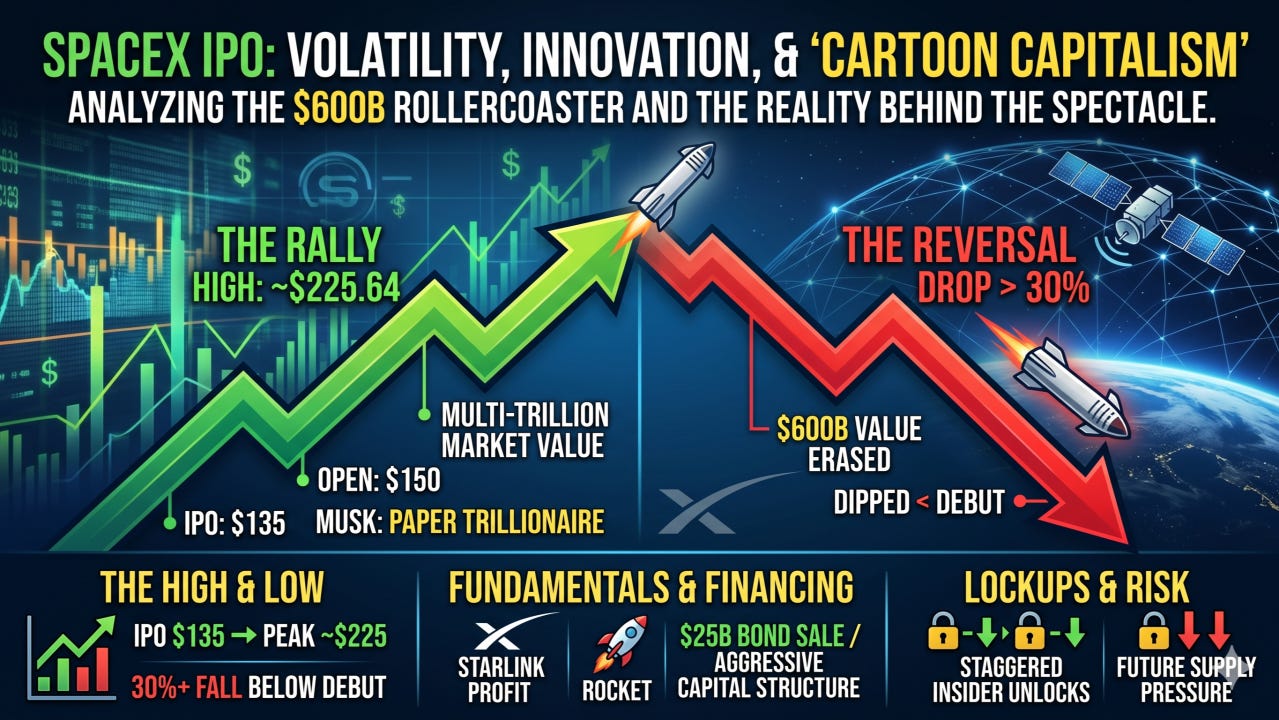
SpaceX’s IPO was sold as the ultimate proof that public markets still reward visionary growth stories. The stock priced at $135, opened at $150, ran above $200, and briefly touched about $225.64, pushing the company’s market value into the multi‑trillion range and elevating Elon Musk to “trillionaire” status on paper. Less than two weeks later, the shares had fallen more than 30%, erased roughly $600B in value, dipped below their debut price, and exposed the reality behind the spectacle: this is a capital‑intensive, loss‑making company, still dependent on aggressive external financing and government contracts, whose early trading was driven at least as much by market theater as by fundamentals.
SpaceX’s IPO priced at $135 per share; the stock opened at $150 and closed the first day around $160.90.
In subsequent sessions, SpaceX rallied to an intraday high near $225.64, more than 60% above the IPO price, briefly placing its market cap in the multi‑trillion dollar range.
The shares then fell more than 30% from that peak, including a 16.4% single‑day drop and a cumulative slump of about 23% that took the price back near $155 and even below the $150 debut level, wiping out roughly $600B in value.
SpaceX disclosed a cash balance of about $100.8B shortly after the IPO, then launched a debut bond sale that ultimately raised $25B in senior unsecured notes to refinance a $20B bridge loan and fund general corporate purposes.
Public reporting indicates that Starlink is currently the principal profit‑generating business line, while other segments remain heavily capital‑intensive and contribute to substantial losses.
The opening of trading followed the usual script for a blockbuster technology offering, but at an unusual scale. The offering price was set at $135. On Nasdaq, the first trade crossed at $150, and the stock closed the first day near $160.90. Early coverage from Reuters and others noted that the shares were already more than 30% above the IPO price after the first wave of buying, as demand from retail investors and momentum‑driven funds pushed the name higher.
Over the next several sessions, the story became an example of stock pumped by market enthusiasm. NBC and Forbes document an intraday high around $225.64, more than 60% above the IPO price, and a market value that, at least briefly, placed SpaceX alongside the largest diversified technology firms in the world. At those levels, buyers were not simply paying for launch dominance and Starlink’s growth. They were paying for a narrative that assumed ambitious projects like Starship, orbital AI infrastructure, and expanded defense applications would justify multi‑trillion dollar valuations before full commercial proof.
When global tech stocks sold off, SpaceX’s rally reversed quickly. Reuters, CNBC, and others reported a series of declines: roughly 5% in one session, more than 6% in the next, then a 16.4% drop, and additional selling that ultimately left the shares more than 30% below their peak. NBC and Al Jazeera estimated that approximately $600B in market value was erased in this reversal, with the shares briefly dipping below the $150 debut price before recovering slightly. For investors who bought near the highs, these moves represent material paper losses in brokerage accounts, retirement plans, and funds that had treated the early surge as evidence of durable value rather than speculative theater.
To fairly assess the situation, you have to acknowledge the bullish case sophisticated investors embraced. SpaceX’s underlying business has real strengths. The company is widely reported to dominate the commercial launch market by volume, with reusable rockets that have materially reduced cost per launch and secured long‑term relationships across NASA, the Department of Defense, and the intelligence community. In key areas of government‑backed space and defense infrastructure, SpaceX functions almost like a monopoly‑like provider.
Starlink, its satellite broadband network, has scaled rapidly. Reporting on the company’s finances describes strong revenue growth and identifies Starlink as the principal profit‑generating engine within the broader corporate structure, supporting operations and investment in new projects. For investors, this looks like a cash‑flow base beneath a larger ecosystem of launch, connectivity, and services.
On top of that, there is genuine upside. Starship, if successfully commercialized, could expand heavy‑lift capabilities dramatically. Speculative initiatives around AI and orbital data centers could, if realized, create new categories of high‑margin infrastructure and secure additional government and private contracts. The bull thesis is not trivial: an existing dominant infrastructure provider with profitable broadband, plus long‑dated call options on transformative technology.
The tension is not between optimism and pessimism. It is between paying a disciplined price for that thesis and paying a cartoonish price when the story outruns the cash flows.
SpaceX’s rapid move into the bond market is a factual indication of its capital needs. Reuters reports that, as of June 19, SpaceX held about $100.8B in cash and cash equivalents, bolstered by the IPO. Despite that substantial cash position, the company announced on June 22 that it would launch a senior unsecured notes offering, initially targeting around $20B to refinance a $20B bridge loan and support capital expenditures.
Investor demand pushed the final size of the offering to $25B across five tranches, with maturities from 2031 to 2056 and coupons in the mid‑5% to mid‑6% range, according to CNBC and related bond market reporting. The deal attracted nearly $90B in orders. Ratings agencies granted investment‑grade marks (Baa1/BBB+/BBB), but bond analysts note that spreads were wider than those on comparable Intel notes, reflecting market recognition of leverage and business risk.
These facts show an aggressive capital raising strategy rather than a self‑funded profit engine. SpaceX is rolling a $20B bridge facility into long‑dated notes while committing to multi‑year, capital‑intensive programs in launch, AI, and Starship. Equity holders are financing, and sharing the risk of, continued experimentation and expansion. That is consistent with a high‑growth technology company, but less consistent with the early multi‑trillion dollar valuations briefly assigned during the IPO surge.
The IPO’s lockup design adds further risk. SpaceX did not adopt a simple six‑month blanket lockup. Instead, it used staggered insider and employee lockups. Reuters and related coverage describe a schedule in which some insider shares become eligible for resale after specified quarterly earnings and time milestones, while others remain restricted longer; Musk is reportedly subject to a more extended lockup that prevents near‑term selling.
This regime has two consequences. It lets SpaceX influence the timing of insider supply. It also creates future dates when meaningful insider and employee positions can be sold. The New York Times and Business Insider have both highlighted upcoming lockup expirations as critical tests for the stock, noting that many insiders will have rational incentives to diversify or realize gains once permitted.
Current volatility is unfolding before those larger pools of insider shares have fully unlocked. Investors who bought after the first few sessions face earnings uncertainty, broader market risk, and an eventual supply overhang from people with deeper involvement in the company. That is a familiar pattern in hot IPOs, and it is one reason the early trading in SpaceX should be viewed with caution.
When you assemble these facts, the picture is clear. A company with authentic technological achievements and entrenched government relationships offered shares at $135, watched them rally above $220, and saw them slump back near $150 within days. It carries a capital structure that includes a $25B bond issue, a recently refinanced $20B bridge loan, and substantial losses outside its principal profit‑generating segment. Its founder’s net worth moved by hundreds of billions in a short window, while late‑stage investors now hold volatile positions that may sit inside 401(k)s and index funds.
Cartoon capitalism is a way of naming that structural disconnect. It is not a claim of fraud. It is a recognition that valuations, fortunes, and capital flows can become so outsized and volatile that they resemble speculative theater more than disciplined capital allocation. SpaceX’s IPO is a case study in that phenomenon: a mix of genuine innovation, pumped‑up market enthusiasm, and aggressive financing that rewards those closest to the center and tests the judgment of everyone else.
SpaceX’s stock moved from a $135 offering price to an intraday high near $225.64, then fell more than 30% and briefly traded below its $150 debut, erasing roughly $600B in market value and leaving late buyers with substantial paper losses.
The bullish thesis, launch dominance, Starlink as the principal profit‑generating business line, deep NASA/DoD/intelligence ties, and upside from Starship and AI initiatives, is real, but the early multi-trillion dollar valuations priced in very optimistic versions of that future.
SpaceX’s decision to follow a record IPO with a $25B bond sale, despite holding about $100.8B in cash, underscores continued reliance on external financing to service bridge debt and fund capital‑intensive projects, rather than a transition to self‑funded stability.
Staggered lockups mean large insider and employee holdings will become sellable over time; many of those holders will have incentives to diversify or realize gains, which could add supply and further pressure prices in an already volatile post‑IPO environment.
SpaceX’s first weeks as a public company are best understood as cartoon capitalism in practice: genuine innovation wrapped in market theater, producing spectacular numbers that demand skepticism and risk management from any investor whose savings or retirement is tied to the stock.
For investors and policymakers alike, the key question is whether the current price reflects a fair balance between ambition, leverage, and risk or whether the crowd is still paying for the performance rather than for the underlying business.
This article is published by JJTP Law PLLC as a general-interest news and information service for clients and friends of the firm. Nothing in it is legal advice, and reading it does not create an attorney-client relationship. If you have a question about how this topic applies to your own situation, please reach out to the attorney you normally work with, or schedule a consultation. This is not a solicitation for legal work in any jurisdiction where JJTP Law is not authorized to practice. See our Attorney Advertising & Terms of Use.