
27 August 2026
Insights


New York City has announced the policy The harder legal question is what appropriations, contracts,...

New York City’s municipal grocery initiative may properly face scrutiny over public money, public...

Regulatory change can make a product less commercially secure without making it unlawful to own or...
SaaS Style Gaming and the Legal Erosion of...
New York City has announced the policy The harder legal question is what appropriations, contracts,...
New York City’s municipal grocery initiative may properly face scrutiny over public money, public...
Regulatory change can make a product less commercially secure without making it unlawful to own or...
SaaS Style Gaming and the Legal Erosion of...
As of June 7, 2026
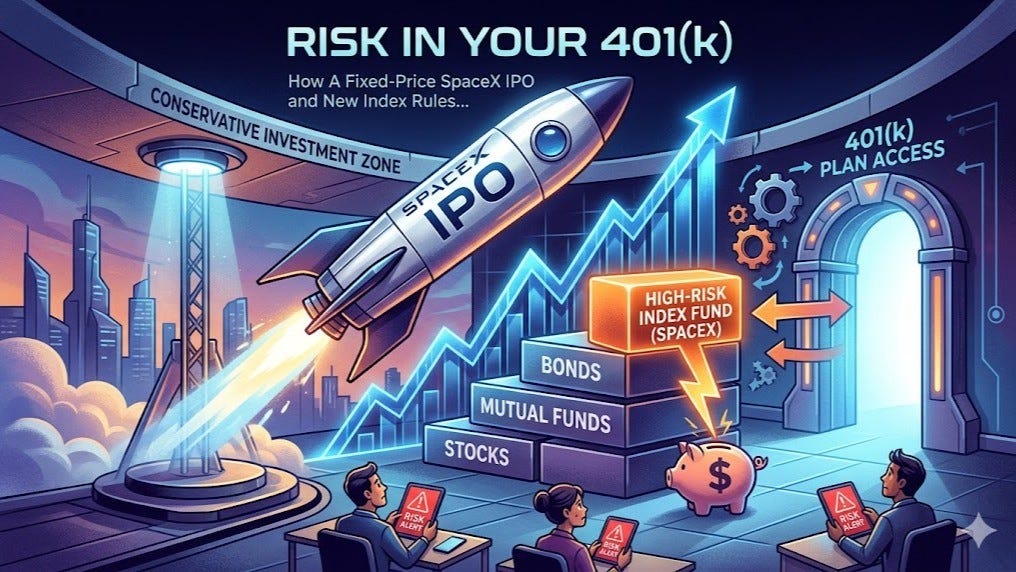
When a company goes public, most investors assume the valuation will be hammered out between underwriters and buyers during the roadshow. With SpaceX, that balance has shifted. The company has told its banks it will not move off a fixed $135 IPO price, even for what is expected to be the largest equity offering in history. At the same time, index methodologies have changed so that some benchmarks can absorb a megacap IPO within days, while others, like the S&P 500, are holding the line on slower, committee‑driven inclusion. The central issue is less whether SpaceX ultimately succeeds and more whether changes in index construction now push retirement savers into implicit valuation decisions that earlier generations of investors could avoid.
SpaceX has set a fixed IPO price of $135 per share in amended filings and has told underwriting banks it will not change that price during the roadshow, despite the planned size of the deal.
At $135 per share, SpaceX expects to raise roughly $75B, implying an equity valuation around $1.75T, with some estimates putting the fully diluted value closer to $1.8T–$2T.
Reporting on the S‑1 indicates SpaceX generated about $18.7B of revenue in 2025, with Starlink contributing roughly $11.4B (around 61%) and delivering most of the profit, while other segments remained loss‑making or heavily investment‑driven.
Using the IPO’s implied equity valuation, a $1.75T–$1.8T market cap on approximately $18.7B of revenue produces a price‑to‑sales ratio in the neighborhood of 90x–100x, far above the single‑digit to low‑teens P/S multiples seen at Nvidia, Microsoft, or Apple.
FTSE Russell and Nasdaq have adopted fast‑entry rules that could place SpaceX into the Russell 1000 and Nasdaq‑100 within 5–15 trading days, while S&P Dow Jones has decided not to fast‑track the S&P 500, which will still require at least 12 months of trading and positive GAAP earnings for eligibility.
In a typical IPO, the company and its banks publish a range, canvass demand during the roadshow, and then adjust both price and size as investor feedback comes in. SpaceX has short‑circuited that process. Reuters reports that the company has “reaffirmed the $135‑per‑share price” in a revised filing and “told banks in its $75 billion initial public offering that it is set on the $135‑a‑share price” and will not move.
For a routine mid‑cap IPO, a hard line on pricing might not attract much comment. For a $75B offer at a $1.75T‑plus valuation, it is unusual. It signals that SpaceX is treating the valuation level as a non‑negotiable objective, rather than as a point to be discovered through investor bids. Barron’s frames the risk bluntly, arguing that a fixed‑price, multi‑trillion‑dollar deal is “too big to succeed” smoothly because there may not be enough natural demand at that price without concessions. If demand is weaker than expected, there is less flexibility to let the range drift down; if it is stronger, the issuer has chosen not to capture additional upside through a higher price. Either way, the company—not the book‑building process—is anchoring what will become the starting point for index inclusion.
According to summaries of SpaceX’s financials, the company generated about $18.7B in revenue in 2025, with Starlink contributing roughly $11.4B and showing solid profitability, while launch and AI‑related efforts generated losses. Using the equity valuation implied by the fixed IPO price, a $1.75T–$1.8T market cap divided by roughly $18.7B of revenue yields a P/S ratio approaching 90x–100x.
For context, recent data show:
Nvidia with about $130.5B of fiscal‑year 2025 revenue and a market cap in the multi‑trillion range, translating to a P/S in roughly the low‑ to mid‑teens.
Microsoft with around $280B of annual revenue and a market cap near $3.2T at points, implying a P/S around 11x–12x.
Apple trading at a trailing P/S of about 9x–10x on top of massive, recurring cash flows.
One syndicated analysis that applies a simple historical screen to IPOs notes that offerings priced at P/S ratios in this extreme range have underperformed in the majority of cases, citing a hit rate on the order of 80%–90% for post‑IPO disappointment when companies came public at similar multiples. That is a probabilistic warning, not a certainty, but it illustrates how much future perfection the current SpaceX pricing assumes.
FTSE Russell, Nasdaq, and other index providers have not changed their rules simply to accommodate SpaceX. They argue that in a world where private companies can reach $1T valuations before listing, waiting a full year to add a megacap IPO can create a disconnect between benchmarks and the market they are supposed to represent. If a company immediately accounts for a meaningful share of the investable universe, delaying inclusion creates tracking error: the index no longer matches the actual distribution of market capitalization.
Fast‑entry rules were designed to reduce that gap. Under current Russell methodology, a new listing can join the Russell 1000 after 5 trading days if its float‑adjusted market cap and liquidity exceed defined cutoffs. Nasdaq’s approach for the Nasdaq‑100 is similar: a newly listed stock that would rank among the top constituents by market cap can be added after 15 days instead of waiting until the next annual rebalance. Index providers emphasize that these rules are transparent and rules‑based; any issuer that meets the tests qualifies. Critics respond that the cost of reducing tracking error this way is that retirement savers end up exposed to high‑multiple, unseasoned IPOs much sooner than in the past.
S&P Dow Jones has drawn a different line for its flagship S&P 500. After a consultation, it decided not to introduce a fast track for megacap IPOs, keeping the requirements of at least 12 months of trading and positive GAAP earnings before a company can be considered. S&P’s total‑market indexes remain more mechanical, but the committee‑governed 500 preserves a more traditional gatekeeping role for the core U.S. large‑cap benchmark.
On most current estimates, once added, SpaceX might carry a weight of roughly 0.1%–0.2% in a broad benchmark such as the Russell 1000 or a float‑weighted total‑U.S.‑market index. That would make it smaller than giants like Apple or Microsoft, which each sit at several percent, but still larger than hundreds of other constituents that have been public for years.
For individual investors, this translates into modest dollar amounts. A saver with $100K in a Russell‑tracked equity fund might see $100–$200 indirectly allocated to SpaceX once it is included. The more important angle is structural: without the investor ever typing the ticker, a small slice of each contribution into a Russell‑tracked or total‑market index product will be buying a near‑100x‑sales IPO with only a few days of trading history.
S&P 500 index funds, by contrast, will not add SpaceX for some time, if at all. But many default target‑date funds in 401(k) plans blend exposures: for example, a TDF could be 60% S&P 500 and 40% total‑market or Russell‑type equity. In that structure, participants still get some SpaceX exposure through the non‑S&P sleeve even while the 500 itself stays on the sidelines.
One of the most important shifts here is who actually decides whether $135 a share is a reasonable price. In a world dominated by active managers, institutions could simply decline to buy an IPO they believed was mispriced, and index funds would only absorb the stock years later, after earnings and market behavior had been tested. Today, rules‑based indexes and the funds that track them embed the market’s implied valuation into portfolios much earlier.
Index providers defend this by stressing that they are not valuation arbiters. Their mandate is to measure the market as it is, not as it should be. If a company clears the size and float screens, it belongs in a cap‑weighted index regardless of whether its multiple looks rich. That framework pushes more valuation risk onto passive investors. When a megacap IPO like SpaceX is added to a Russell or total‑market index after 5–15 days, index funds tracking those benchmarks will generally buy around the IPO‑era price simply to keep their tracking error low. The decision has effectively moved from “Should we buy at this valuation?” to “We own the index; the index owns the stock.”
Earlier index rules created a buffer: companies needed to demonstrate sustained profitability in public markets and accumulate a track record before they were allowed into the core of passive portfolios. Fast‑entry rules shorten that buffer significantly for some benchmarks, which is why SpaceX’s IPO has become a test case for how much valuation risk a passive investor implicitly accepts when they buy “the market.”
Large index managers worry about more than just valuation. Fast entry into a thin float creates trading and implementation challenges. When a stock is added to an index on a specific date, funds that track the index need to adjust their holdings by then. For a megacap IPO with only a small fraction of shares available for trading, that means multiple multi‑$B funds all trying to buy the same stock at roughly the same time.
That concentration of demand tends to push prices up and expand bid‑ask spreads. Managers call the difference between the index level and the actual trade prices “implementation shortfall” or “tracking error.” It is a cost that falls on investors even if they never see it broken out. Over years, a series of such events can erode returns by more than headline expense ratios would suggest. Fast‑entry rules do not create this dynamic, but they pull it forward into the very earliest, least liquid phase of a stock’s public life.
For a typical 401(k) participant or IRA investor, the SpaceX IPO is unlikely to dominate their portfolio, but it will find its way into many accounts indirectly. Someone holding only an S&P 500 index fund will not see SpaceX in that fund for at least a year and only if the company meets S&P’s profitability and committee‑judgment tests. Someone invested in a total‑market index, a Russell‑tracked fund, or a target‑date fund that uses those building blocks will likely get a small exposure within weeks of listing.
The key questions for savers and fiduciaries are:
Do you understand which benchmarks your core funds track and how quickly they add megacap IPOs?
Are you comfortable with cap‑weighted exposure that can include near‑100x‑sales IPOs at fixed prices, or do you want to complement that with strategies that are more selective, such as equal‑weight, value‑tilted, or active funds?
Are you rebalancing periodically so that no single theme, sector, or issuer can grow to a size that exceeds your risk tolerance?
None of this means index investing has stopped working. It does mean that “owning the market” now includes owning very large, very expensive stories at a much earlier stage than before. For investors and plan sponsors who view their role as stewards of retirement capital, the SpaceX IPO is less a verdict on Elon Musk and more a reminder to revisit how index rules, pricing conventions, and product design interact to shape risk.
SpaceX has taken the unusual step of fixing its IPO price at $135 per share on a record‑sized deal, targeting roughly $75B raised at about a $1.75T valuation, rather than letting the price adjust during the roadshow.
At that valuation and with approximately $18.7B of 2025 revenue, the IPO implies a price‑to‑sales multiple near 90x–100x, many times the P/S ratios investors pay for Nvidia, Microsoft, or Apple, and in a range where historical IPO data show a high rate of later underperformance.
FTSE Russell and Nasdaq have introduced fast‑entry rules that can bring SpaceX into the Russell 1000 and Nasdaq‑100 within 5–15 trading days if float and liquidity thresholds are met, while S&P Dow Jones has decided not to fast‑track the S&P 500, preserving a longer seasoning period and profitability requirements for that index.
Even at a 0.1%–0.2% index weight, SpaceX would immediately be larger than hundreds of Russell 1000 constituents, and large index funds would have to buy into a thin float at a high, fixed valuation, bearing liquidity and execution costs on behalf of long‑term investors.
The broader structural shift is that changes in index methodology move valuation decisions from active stock‑pickers into the passive system much faster than before, giving retirement savers earlier exposure to high‑multiple, unseasoned IPOs and making it more important than ever to understand which benchmarks your funds track and how they treat mega‑deals like SpaceX.
This article is published by JJTP Law PLLC as a general-interest news and information service for clients and friends of the firm. Nothing in it is legal advice, and reading it does not create an attorney-client relationship. If you have a question about how this topic applies to your own situation, please reach out to the attorney you normally work with, or schedule a consultation. This is not a solicitation for legal work in any jurisdiction where JJTP Law is not authorized to practice. See our Attorney Advertising & Terms of Use.