27 August 2026
Insights

New York City has announced the policy The harder legal question is what appropriations, contracts,...

New York City’s municipal grocery initiative may properly face scrutiny over public money, public...
Regulatory change can make a product less commercially secure without making it unlawful to own or...
SaaS Style Gaming and the Legal Erosion of...
New York City has announced the policy The harder legal question is what appropriations, contracts,...
New York City’s municipal grocery initiative may properly face scrutiny over public money, public...
Regulatory change can make a product less commercially secure without making it unlawful to own or...
SaaS Style Gaming and the Legal Erosion of...
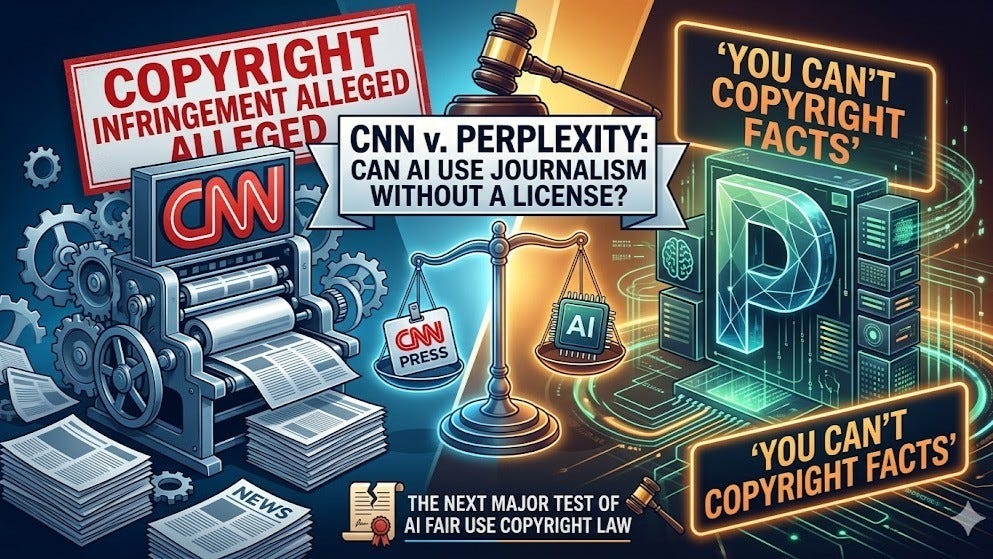
CNN’s lawsuit against Perplexity is important because it tests a question that will shape the economics of AI and journalism for years: can an AI company use copyrighted reporting to power its product, then rely on the principle that facts themselves are not copyrightable? CNN says Perplexity copied and distributed its work without permission, while Perplexity responds that “You can’t copyright facts”. The ruling will matter not just to CNN and Perplexity, but to every publisher, platform, and AI developer deciding whether the future of AI will rest on licensing, permission, and tighter sourcing rules, or on broader claims of fair use.
CNN filed suit against Perplexity in the Southern District of New York on May 28, 2026.
The complaint alleges Perplexity unlawfully copied more than 17,000 CNN stories, videos, images, and other works.
CNN says Perplexity used that material to build and operate its search and answer generation systems and to generate outputs that were “verbatim or substantially similar” to CNN works.
CNN also alleges trademark infringement, including a false suggestion of affiliation tied to Perplexity’s “Comet Plus” offering.
CNN seeks damages, disgorgement of profits, and injunctive relief.
CNN says licensing discussions failed and that Perplexity continued the challenged conduct after CNN’s objections.
Perplexity’s public response was simple: “You can’t copyright facts”.
CNN responded that “commercial entities must pay to access this valuable information”.
The case is still in its earliest stage, and CNN’s allegations have not yet been proven in court.
CNN’s complaint is not limited to one theory of copying. It alleges that Perplexity crawled and scraped CNN content, including material behind paywall protections, then used that content in its search and answer generation systems. Viewed another way, the complaint raises two separate issues: how CNN’s content was acquired and how it was ultimately delivered to users.
CNN also alleges that Perplexity continued using its material after licensing talks failed and after CNN objected to the continued use of its content and trademarks. Continued conduct after notice can be relevant to a willfulness analysis and the availability of enhanced remedies. That does not establish liability by itself, but it does raise the stakes if CNN can prove infringement.
The central copyright question is whether Perplexity copied protected expression and whether its use is fair use under the Copyright Act. Facts are not protected, but the selection, arrangement, wording, and presentation of those facts can be. Perplexity is likely to argue that it is doing something closer to search or summarization than piracy, while CNN will try to show that the product functions as a substitute for reading CNN itself.
Fair use is usually analyzed through the familiar four factors: the purpose and character of the use, the nature of the copyrighted work, the amount used, and the effect on the market for the original. CNN’s strongest argument is not simply that its content was used, but that the use was commercial, extensive, and market replacing. If a court concludes that Perplexity’s system delivers CNN style output instead of sending readers to CNN, the fair use defense becomes much harder to maintain.
The trademark allegations give CNN another path to liability. According to the complaint and reporting, Perplexity is accused of suggesting a false connection with CNN through its “Comet Plus” offering and related marketing. A trademark claim is about consumer confusion, not about whether a sentence or image is itself copyrighted, so this theory gives CNN a cleaner way to argue that users were misled about affiliation or authorization.
The willfulness issue also deserves attention. CNN alleges that licensing talks broke down and that Perplexity kept going anyway. From a liability standpoint, continued conduct after notice may support CNN’s argument that the challenged conduct was intentional rather than inadvertent. If CNN proves infringement and willfulness, the damages picture becomes more serious.
This case also forces a distinction between model training, retrieval, and output reproduction. CNN’s allegations appear to focus heavily on the way Perplexity scraped, indexed, retrieved, and then reproduced CNN material in responses, while the exact role of training will likely become a discovery issue. The distinction becomes important when evaluating retrieval augmented generation systems, because a RAG architecture may be technically different from traditional model training, but the legal analysis does not stop at the architecture label.
If the system serves as a functional substitute for the source material, the court will still ask the same copyright questions: how much was copied, whether the use transformed the original, whether the output competes with the publisher, and whether the market for the original was harmed. Some AI companies frame RAG as different from traditional model training, and in a technical sense that is true. But if the output reproduces protected content or replaces the need to visit the original publication, that technical distinction may matter less than the practical effect.
CNN’s suit belongs to a broader wave of publisher versus AI litigation. The New York Times sued OpenAI and Microsoft, and News Corp related entities sued Perplexity as well. That trend suggests the industry is moving from a period of informal scraping toward one where licensing, permission, and source controls may define the next generation of AI products.
Publishers are advancing a fundamental economic argument: if AI entities are permitted to ingest and reproduce proprietary journalism without compensation, the financial incentives that underpin original reporting will erode. AI companies, by contrast, argue that broad access to information is essential to product development and that facts must remain free to use. The court’s answer will matter far beyond this one case because it will influence how AI systems are built, what they cost, and how much publishers can charge for access to their work.
What makes this case important is not only who wins. It is what the ruling would say about the future of AI itself. A victory for CNN could push the industry toward licensed content, tighter sourcing rules, and more expensive systems. A victory for Perplexity could strengthen arguments for broader fair use protection when AI systems use online content to generate answers.
CNN’s case is about more than facts. It is about whether AI companies can commercially reuse protected journalism without permission.
The complaint alleges both copyright infringement and trademark infringement, including a false affiliation theory tied to Comet Plus.
The fair use analysis will likely turn on market substitution, not just technical architecture.
Continued use after CNN’s objections may support a willfulness argument if CNN proves infringement.
CNN seeks damages, disgorgement of profits, and injunctive relief.
This lawsuit is part of a wider litigation trend that could push AI toward licensing based development and higher operating costs.
Case reference: Cable News Network, Inc. v. Perplexity AI, Inc., No. 1:26 cv 04427 (S.D.N.Y. May 28, 2026).
This article is published by JJTP Law PLLC as a general-interest news and information service for clients and friends of the firm. Nothing in it is legal advice, and reading it does not create an attorney-client relationship. If you have a question about how this topic applies to your own situation, please reach out to the attorney you normally work with, or schedule a consultation. This is not a solicitation for legal work in any jurisdiction where JJTP Law is not authorized to practice. See our Attorney Advertising & Terms of Use.