27 August 2026
Insights


New York City has announced the policy The harder legal question is what appropriations, contracts,...

New York City’s municipal grocery initiative may properly face scrutiny over public money, public...

Regulatory change can make a product less commercially secure without making it unlawful to own or...

SaaS Style Gaming and the Legal Erosion of...
New York City has announced the policy The harder legal question is what appropriations, contracts,...
New York City’s municipal grocery initiative may properly face scrutiny over public money, public...
Regulatory change can make a product less commercially secure without making it unlawful to own or...
SaaS Style Gaming and the Legal Erosion of...
The International Criminal Court’s arrest warrant for Israeli Prime Minister Benjamin Netanyahu has moved from legal journals into New York City politics, as Zohran Mamdani has pledged that, as mayor, he would direct the NYPD to “honor” that warrant if Netanyahu visits the city. That pledge is not just a campaign soundbite. It exposes how ICC arrest warrants, U.S. federal supremacy, diplomatic and consular immunity, and the United States’ non‑membership in the Rome Statute collide when a foreign leader’s potential arrest is discussed on American soil.
On 21 November 2024, the ICC’s Pre‑Trial Chamber issued arrest warrants for Netanyahu and Gallant in the Situation in the State of Palestine. The Court grounded jurisdiction in Palestine’s accession to the Rome Statute and earlier declarations accepting ICC jurisdiction over crimes committed in Gaza, the West Bank, and East Jerusalem since 2014.
As the warrants became public, debate intensified over whether Netanyahu could safely travel to ICC States Parties, which generally have cooperation obligations under Part 9, and to non‑member states such as the United States. In New York, candidate Mamdani pledged he would instruct the NYPD to arrest Netanyahu if the Prime Minister appeared in the city, citing the ICC warrant as his legal basis. That pledge drew immediate criticism and prompted federal proposals aimed at clarifying that state and local governments may not enforce ICC warrants without federal authorization, highlighting the constitutional boundary between municipal rhetoric and federal foreign‑affairs power.
The ICC is a permanent international criminal court created by the Rome Statute to prosecute individuals for genocide, crimes against humanity, war crimes, and the crime of aggression when jurisdictional conditions are met. The Rome Statute is the treaty framework that governs the Court. It defines jurisdiction, sets procedural rules, and codifies the obligations of States Parties.
Part 9 of the Statute addresses “International Cooperation and Judicial Assistance.” It provides that States Parties shall comply with ICC requests for cooperation, including arrest and surrender, in accordance with their national procedures. In theory, this creates a clear obligation: when the ICC issues an arrest warrant, States Parties are expected to act. In reality, enforcement has been uneven. Some States Parties, such as South Africa and others, have declined to arrest individuals like former Sudanese President Omar al‑Bashir despite ICC warrants and cooperation requests, leading to litigation and political controversy.
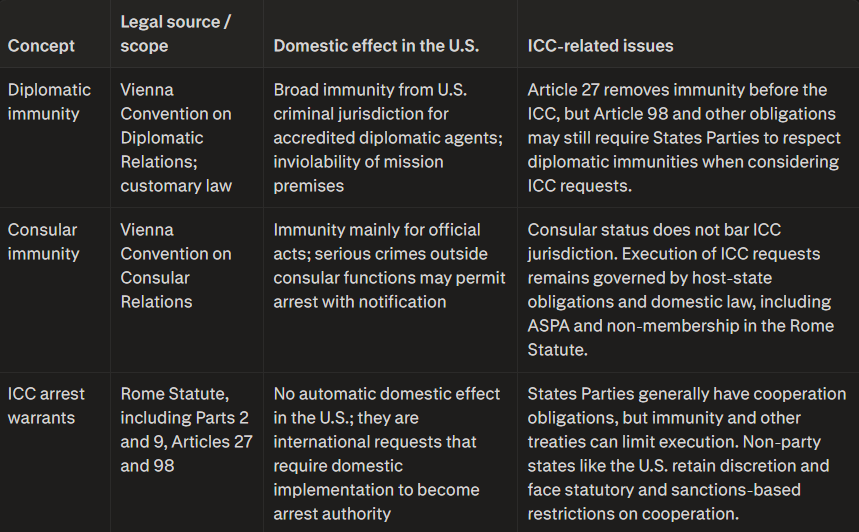
Two Rome Statute provisions are central to the current debate. Article 27 provides that official capacity, including as a Head of State or Government, does not exempt a person from criminal responsibility under the Statute and does not bar the Court’s jurisdiction. In other words, the ICC may issue arrest warrants for sitting prime ministers and presidents and proceed with cases against them. Article 27 governs proceedings before the ICC itself; it does not automatically alter the separate domestic immunity obligations of non‑party states.
Article 98 tempers that principle in the realm of state cooperation. It provides that the Court may not proceed with a request for surrender or assistance that would require a State Party to act inconsistently with its obligations regarding state or diplomatic immunity under international law, or with obligations under agreements requiring consent before surrendering certain persons. This provision acknowledges that States Parties may be bound by other treaties and customary rules that protect certain officials, and it pulls back the Court’s ability to demand cooperation that would breach those obligations.
The relationship between Article 27 and Article 98 has become one of the ICC’s most debated legal questions. Some courts and scholars read Article 27 as displacing personal immunity once ICC jurisdiction exists, at least among States Parties. Others emphasize Article 98 and argue that, even where the ICC has jurisdiction, States Parties may still owe immunity obligations to non‑party states and must resolve those before executing arrest requests. That tension helps explain why ICC arrest warrants are not always executed when a sitting leader travels, even in member states.
ICC arrest warrants are powerful within the Rome Statute system, but they are not self‑executing in domestic law. They do not function as U.S. arrest warrants, and American judges do not issue them. For an ICC warrant to result in a lawful arrest in the United States, there would need to be domestic legal authority: a federal statute incorporating ICC cooperation obligations, a federal indictment, a federal arrest warrant, or an extradition proceeding initiated by the federal government under an applicable treaty.
The United States signed the Rome Statute but did not ratify it and later notified the UN that it does not intend to become a party. Congress then enacted ASPA, which substantially limits many forms of government assistance to the ICC, including cooperation related to arrests, surrender, and investigations that could expose U.S. personnel, subject to defined exceptions and possible presidential waivers. ASPA prohibits extradition or other transfer of U.S. citizens and permanent residents to the ICC and restricts U.S. agencies, courts, and state and local entities from supporting ICC proceedings in ways inconsistent with U.S. policy.
In 2025, President Trump’s executive order under IEEPA reinforced this restrictive posture. The order declared certain ICC activities involving “protected persons” to be an unusual and extraordinary threat to U.S. national security and foreign policy interests and authorized sanctions against ICC officials and others who materially support those activities. Assets of designated persons can be blocked, and their entry into the United States can be barred, which signals a strong federal policy against supporting specific ICC investigations, including those involving Israel.
In that legal environment, ICC warrants are requests that face both statutory limits and sanctions‑based consequences if U.S. officials were to assist in ways the federal government has condemned.
To understand why a sitting Prime Minister is treated differently when visiting New York, it helps to separate diplomatic immunity, consular immunity, and broader immunity doctrines. Diplomatic immunity derives from the Vienna Convention on Diplomatic Relations and customary international law. Accredited diplomatic agents enjoy broad immunity from the host state’s criminal jurisdiction while in post, inviolability of mission premises, and protection from certain civil measures. The host state is legally obligated to recognize those immunities to ensure diplomats can perform their functions without harassment.
Consular immunity, under the Vienna Convention on Consular Relations, is narrower. Consular officers primarily perform administrative and assistance functions, and they generally have immunity only for acts performed in the exercise of consular functions. For serious crimes outside those functions, arrest or detention may be permissible, with appropriate notification to the sending state.
Beyond these treaties, customary international law recognizes personal immunity (ratione personae) and functional immunity (ratione materiae). Under widely accepted doctrine, sitting heads of state and generally heads of government enjoy personal immunity from the criminal jurisdiction of foreign domestic courts while in office, subject to recognized exceptions. Functional immunity protects officials, even after leaving office, for certain acts performed in an official capacity.
A sitting Prime Minister traveling for UN General Assembly sessions may be treated under these personal and functional immunity doctrines, as well as any specific bilateral understandings, even if that same person is subject to ICC proceedings where Article 27 removes official capacity as a bar to the Court’s jurisdiction. Domestic treatment of the Prime Minister in New York therefore depends on U.S. obligations under diplomatic and customary law, not solely on the ICC’s view of his status.
New York’s role as host of the United Nations Headquarters means it is the annual gathering point for heads of state, prime ministers, foreign ministers, and ambassadors from almost every UN member state. Under the UN Headquarters Agreement, the United States facilitates the entry and access of representatives attending UN meetings in New York. Those obligations focus on admission and transit, while protective security for visiting leaders is provided under U.S. domestic law and diplomatic practice.
In practice, federal authorities such as the State Department’s Diplomatic Security Service and the U.S. Secret Service coordinate security operations for visiting leaders, working with local law enforcement to manage risks. This protective posture extends even to leaders of governments with which the United States has serious disagreements or adversarial relations. The rationale is practical: harm to a visiting head of government on U.S. soil can produce serious diplomatic and security consequences, so risk mitigation becomes a priority.
Past UNGA sessions have illustrated this dynamic in striking ways, like Muammar Gaddafi’s use of a private tent and separate accommodations, which symbolized political distance but did not change the host state’s obligations to protect visiting dignitaries and facilitate their participation. If Netanyahu travels to New York as sitting Prime Minister, he would likely receive a protective security plan shaped by both his status and the ICC warrant, but that plan will be driven by U.S. law, treaties with the UN, and federal practice, not by a mayor’s independent decision.
The key legal question is straightforward: can a New York mayor order the NYPD to arrest Netanyahu based solely on the ICC warrant. Under current U.S. law, the answer is no.
Foreign affairs and treaty implementation are federal responsibilities. The Supremacy Clause gives federal statutes and self‑executing treaties priority over conflicting state or local law, and Article I, section 10 restricts states from entering treaties or agreements with foreign powers. Supreme Court decisions such as Zschernig v. Miller and American Insurance Ass’n v. Garamendi have invalidated state laws that intruded into foreign relations, reinforcing that foreign affairs are matters of national concern entrusted to the federal government.
Within that constitutional framework:
Any attempt by New York City to arrest a sitting Prime Minister based only on an ICC warrant would almost certainly provoke immediate federal intervention and constitutional litigation over federal preemption and foreign‑affairs authority. Local police powers must be exercised within the bounds of state and federal law; a mayor cannot unilaterally elevate an ICC request into binding arrest authority when federal policy and statutes point the other way.
The Rome Statute binds its States Parties, not every country in the world. Palestine’s accession brought the Situation in the State of Palestine under the ICC’s territorial jurisdiction, allowing the Court to act on alleged crimes in Gaza, the West Bank, and East Jerusalem even when the accused are nationals of non‑party states. That is why Netanyahu and Gallant could be the subjects of ICC arrest warrants grounded in Palestinian territory, despite Israel’s non‑membership.
For States Parties, the Statute imposes cooperation obligations and provides a framework for arrests and surrender. For non‑parties such as the United States and Israel, the Court can still open investigations and issue warrants, but enforcement depends entirely on whether other states choose to cooperate and whether non‑party states voluntarily assist despite lacking treaty obligations. This enforcement gap is why ICC observers emphasize that the Court’s effectiveness hinges on political decision‑making and state cooperation, not just on the issuance of warrants.
Debate over U.S. membership in the ICC has persisted since the Rome Statute negotiations. Supporters argue that joining would strengthen accountability for atrocity crimes and align U.S. practice with its broader human rights commitments. Opponents highlight concerns about sovereignty, exposure of U.S. personnel and close allies to prosecutions, and the ICC’s assertion of jurisdiction over nationals of non‑consenting states.
Legally, joining would require Senate ratification of the Rome Statute and implementing legislation. That legislation would need to address how ICC obligations would be integrated into U.S. law, whether and how to modify ASPA, how to reconcile Article 27 and Article 98 with existing immunity doctrines, and the status of ICC warrants in domestic courts. Only after such steps could ICC arrest requests be systematically translated into domestic arrest authority in the United States.
For now, the combination of non‑membership, statutory limitations, and sanctions signals a deliberate federal choice to keep ICC warrants from operating as ordinary arrest warrants in U.S. law, especially in cases involving Israel and U.S. nationals.
The Netanyahu ICC warrant, and the promise by a New York mayor to arrest a sitting Prime Minister, has transformed what was once largely an academic debate into a high‑stakes practical question. At bottom, it reveals that ICC arrest warrants operate within a treaty framework that the United States has chosen not to join, and that domestic constitutional limits, immunity doctrines, and federal statutes sharply constrain what state and local officials can do with those warrants on U.S. soil.
This article is for general information purposes and does not constitute legal advice. If you have questions about a specific matter involving international law, immunity, or federal preemption, consult an attorney.
Enjoyed this article? Subscribe to Jabari-Jason Tyson-Phipps — it’s free, and you’ll get future articles by email via Substack.
This article is published by JJTP Law PLLC as a general-interest news and information service for clients and friends of the firm. Nothing in it is legal advice, and reading it does not create an attorney-client relationship. If you have a question about how this topic applies to your own situation, please reach out to the attorney you normally work with, or schedule a consultation. This is not a solicitation for legal work in any jurisdiction where JJTP Law is not authorized to practice. See our Attorney Advertising & Terms of Use.