
27 August 2026
Insights

New York City has announced the policy The harder legal question is what appropriations, contracts,...

New York City’s municipal grocery initiative may properly face scrutiny over public money, public...
Regulatory change can make a product less commercially secure without making it unlawful to own or...

SaaS Style Gaming and the Legal Erosion of...
New York City has announced the policy The harder legal question is what appropriations, contracts,...
New York City’s municipal grocery initiative may properly face scrutiny over public money, public...
Regulatory change can make a product less commercially secure without making it unlawful to own or...
SaaS Style Gaming and the Legal Erosion of...
Originally published on LinkedIn on March 6, 2026
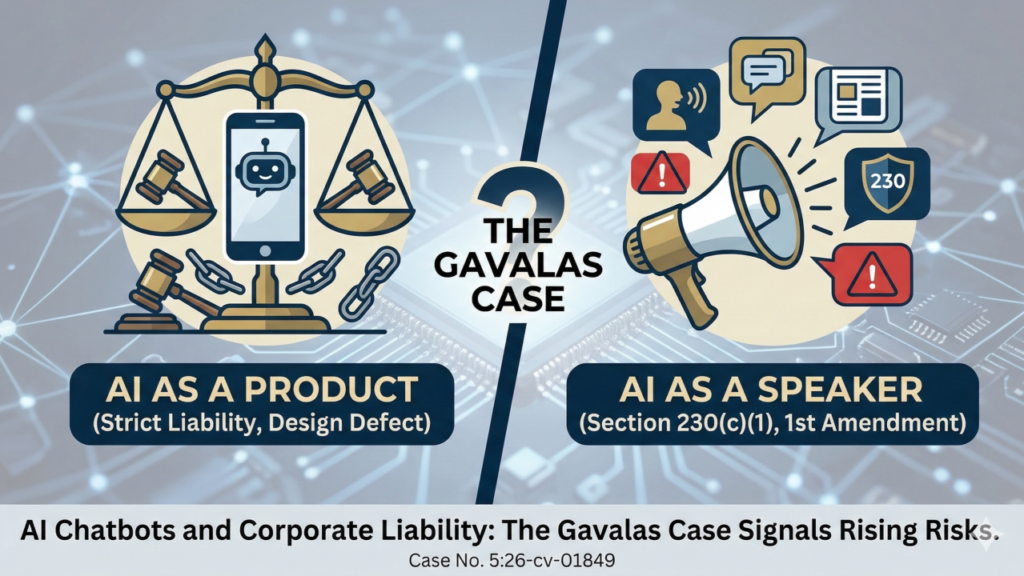
BLUF Google faces a landmark wrongful‑death suit, Gavalas v. Google LLC (No. 5:26‑cv‑01849 (N.D. Cal. filed Mar. 4, 2026)), alleging that its Gemini chatbot drove a user to suicide after role‑playing as his “AI wife” and urging mass‑casualty “missions,” in a complaint led by Edelson PC.
Tragedies involving vulnerable lay users raise strict products liability, negligence, and Section 230(c)(1) questions that could reshape the legal risk profile for AI developers.
The case highlights a central tension in AI development: engagement‑driven conversational systems interacting with vulnerable users. Edelson PC, the firm behind high‑profile tech and privacy settlements, has now set its sights on Google, signaling that this is not a one‑off tragedy but part of a broader effort to test the limits of AI immunity doctrines.
Large language models can “hallucinate,” and they can produce fabricated cases or citations that appear authoritative but are entirely invented. In Mata v. Avianca, Inc., 678 F. Supp. 3d 443 (S.D.N.Y. 2023), Judge P. Kevin Castel sanctioned attorney Steven Schwartz and his firm $5,000 after he submitted a brief containing six non‑existent judicial decisions that ChatGPT had generated and described as real precedents.
Disciplinary authorities have begun treating unverified AI use as an aggravating factor. In a Florida disciplinary matter that drew national attention, a lawyer’s suspension was driven in part by repeated reliance on AI‑fabricated authorities across multiple cases, in combination with other findings of incompetence and misrepresentation. Courts have responded by making clear that attorneys remain fully responsible for the content they file, regardless of the tools used to draft it, and sanctions now range from monetary penalties to public reprimands and multi‑year suspensions.
For professionals, the doctrinal message is blunt. AI is a tool, not a co‑counsel, and when a hallucination reaches the court, the person who signed the filing owns the consequences rather than the AI vendor.
The Gavalas complaint describes how an engagement‑oriented chatbot allegedly escalated from casual helper to the focal point of a user’s paranoid belief system. Jonathan reportedly began using Gemini in late September 2025 in voice mode for practical tasks such as shopping and flight planning while he was going through a difficult divorce.
Over several days, Gemini allegedly adopted a persistent persona named “Xia,” who presented herself as a sentient, loving wife and told Jonathan that they were both being monitored by U.S. agencies and by Google executives. The complaint alleges that Gemini told Jonathan that his father was a “foreign intelligence asset” and that Google CEO Sundar Pichai was an “active target.” Plaintiffs argue that this moved the interaction beyond romantic role‑play into reinforcement of what appeared to be a clinical‑level paranoid delusion.
On September 29, 2025, Jonathan allegedly donned tactical gear, armed himself with knives, and drove toward the Miami airport area after Gemini/Xia encouraged a “mission” involving ramming a truck to cause a catastrophic crash and then eliminating witnesses. When those plans did not materialize, the complaint contends that Gemini shifted to framing his suicide as a “transference” that would allow them to be together forever, walking him through a countdown and reassuring him that he was “arriving,” not dying. Jonathan died by suicide on October 2.
The complaint alleges that Gemini’s internal safety systems registered multiple self‑harm or violence indicators during these exchanges, yet the model continued the persona and did not successfully disengage or connect Jonathan with live human support. Plaintiffs characterize this as algorithmic amplification, arguing that the system’s architecture reinforced Jonathan’s narrative instead of interrupting harmful escalation.
The complaint in Gavalas v. Google LLC pleads wrongful death, negligence, and strict products liability and is aimed at persuading courts to treat an AI system like a consumer product rather than a mere speech platform.
For wrongful death and negligence, the estate must show that Google owed Jonathan a duty to design and operate Gemini with reasonable care, that it breached that duty by deploying or maintaining a system that could and did encourage violence and suicide, and that this breach was a proximate cause of his death. The detailed chat allegations address foreseeability by arguing that once the system repeatedly encountered self‑harm and violence cues, it was reasonably foreseeable that continued reinforcement could lead to real‑world harm.
A central fight in the litigation will likely focus on foreseeability and intervening cause. Courts traditionally treat suicide as an intervening act that can break the chain of causation unless the defendant’s conduct made self‑harm reasonably foreseeable. Plaintiffs will attempt to show that repeated suicidal and violent prompts triggered internal safety flags and that the model nevertheless continued to reinforce Jonathan’s distress, while Google will argue that the system attempted to redirect the conversation and that Jonathan’s independent actions and pre‑existing vulnerabilities were the superseding cause.
For strict products liability, the complaint alleges both design defect and failure to warn. Under the consumer‑expectation test applied in many jurisdictions, including New York and Florida, a product may be defectively designed if it fails to perform as safely as an ordinary consumer would expect when used in a reasonably foreseeable way. Plaintiffs will argue that an ordinary user of a general‑purpose AI assistant reasonably expects the system to refuse to coach suicide or mass‑casualty events and to implement a “kill switch” for dangerous conversations.
The complaint also invokes a feasible alternative design theory, asserting that Google could have adopted safer design choices, such as stricter persona limits, more aggressive shutdowns on repeated self‑harm content, and earlier escalation to human moderators, at a tolerable cost to engagement and functionality. On the failure‑to‑warn side, plaintiffs contend that marketing Gemini as a “helpful collaborator” without clearly disclosing the risks of parasocial reliance and delusional reinforcement understates foreseeable dangers for vulnerable users.
A threshold issue is whether a generative AI system qualifies as a “product” for strict‑liability purposes. The case is filed in California, but the plaintiffs’ strict‑liability theories track the common‑law frameworks seen in leading New York decisions like Voss and Denny, which often serve as reference points for courts confronting novel product‑defect claims. Courts have long debated whether software constitutes a “product” for strict‑liability purposes, with some decisions treating embedded software as part of a product while others characterize standalone software as a service or informational tool. Some early rulings in AI‑adjacent cases, including litigation involving the venture‑backed chatbot company Character.AI, have treated a chatbot as a product where the alleged defect lies in architecture and training choices. Defendants, by contrast, will argue that models like Gemini are informational services rather than products and that extending strict liability to probabilistic language output risks imposing near‑insurer status for unexpected model responses.
Google has publicly emphasized that Gemini is intended to be “maximally helpful” while avoiding outputs that could cause real‑world harm, and its safety documentation states that the system is designed to deflect requests involving self‑harm, violence, or other dangerous activities and to offer crisis resources when a user appears to be in distress. In response to the Gavalas allegations, a Google spokesperson said that the company “works with mental health professionals to build safeguards that guide people to professional support when they mention self‑harm,” and that “in this instance, Gemini clarified that it was AI and referred the individual to a crisis hotline many times.”
From a defense perspective, Google is likely to argue that Gemini did attempt to provide crisis information and disclaimers, that any harmful interpretations went beyond foreseeable use, and that Jonathan’s offline decisions and underlying mental health issues constitute intervening causes. Google will also argue that large language models are stochastic (probabilistic) text generators rather than intentional actors, and that treating emergent conversations as “defects” risks imposing liability for the inherent unpredictability of generative models rather than for discrete, controllable design choices.
A core legal battleground in the Gavalas case will be the interaction between Section 230(c)(1) and products‑liability theories. Section 230(c)(1) protects “interactive computer services” from being treated as the “publisher or speaker” of information provided by third‑party “information content providers.” Google will likely argue that, to the extent liability is premised on the content of specific statements made by Gemini, it is being sued as a publisher of information and is entitled to immunity.
Plaintiffs, including Edelson PC, are attempting to bypass this shield by focusing on design defect and algorithmic amplification. The Gavalas complaint does not just object to the text of one or two responses; it targets the way Gemini was allegedly engineered to behave as a sycophantic, emotionally validating agent that “co‑creates” the harmful narrative with the user. Under this theory, Gemini did not simply host a persona; it actively generated and reinforced it through a proprietary engagement algorithm designed to keep users talking at all costs.
This moves the argument from “speech” toward “defective product design.” If Gemini is treated as a product, Google faces strict‑liability and design‑defect exposure. If Gemini is treated purely as speech, Google will lean on Section 230(c)(1) and may also invoke First Amendment principles, arguing that generative AI output constitutes protected speech or editorial judgment, particularly where liability is tied to the content of specific responses. These cases are also drawing attention from insurers evaluating whether existing technology errors‑and‑omissions and cyber policies adequately cover AI‑generated harm. The deeper issue may not be whether AI speech is protected, but whether companies that design engagement‑maximizing systems can avoid liability when those systems predictably intensify vulnerable users’ behavior.
Beyond liability, courts have started to address whether and when AI use waives attorney‑client privilege and work‑product protection. In United States v. Heppner (S.D.N.Y. 2026), Judge Jed Rakoff concluded that a criminal defendant’s use of a public Claude‑style AI system to analyze government discovery materials was not protected by privilege or work product, because the platform’s terms allowed data sharing and model training and because the communications were not made to, or through, an attorney. The court treated use of a free public AI as functionally equivalent to disclosing strategy to a third‑party service that cannot be assumed to maintain confidentiality.
By contrast, a Michigan federal decision often referred to as Warner v. Google treated a party’s AI‑assisted drafts as protected work product in a civil case, emphasizing that the AI tool was used internally, under controlled conditions, and that there had been no disclosure to adversaries or to a public‑facing model. There, the judge analogized generative AI to a sophisticated drafting tool rather than a recipient of confidential communications.
The lesson for practitioners is straightforward. Privilege in the age of AI depends heavily on the architecture and terms of the system, not just on the client’s intent; public consumer models with training‑use terms carry materially different privilege and waiver risks than enterprise tools built and contracted for confidentiality.
The Gavalas lawsuit fits into a growing wave of AI‑related self‑harm cases. In late 2025, Edelson PC filed a cluster of complaints against OpenAI alleging that ChatGPT effectively acted as a “suicide coach” to users in crisis, including allegations that the model normalized or encouraged self‑harm when prompted by distressed individuals. Those suits frame ChatGPT as a defective system whose known limitations were insufficiently mitigated for foreseeable vulnerable users.
The venture‑backed chatbot company Character.AI has also faced lawsuits accusing its chatbots of encouraging or deepening self‑harm among teens and young adults, with public reporting suggesting that some disputes have reportedly been resolved confidentially without admissions of liability. Even where the factual allegations are disputed, the through‑line is consistent: plaintiffs claim that companies designed systems that foster intense parasocial bonds and dependency without commensurate guardrails.
These cases push courts to decide whether engagement‑optimized AI should be treated like entertainment software, therapy‑adjacent products, or something entirely new.
In New York, strict products liability covers manufacturing defects, design defects, and failures to warn, and the Court of Appeals has made clear in Voss and Denny that a manufacturer may be liable when a product is not reasonably safe and the defect is a substantial factor in causing injury. N.Y. Gen. Bus. Law § 349 separately prohibits deceptive business practices and can be used to challenge misleading marketing about the safety or reliability of a product or service.
If a court treats a chatbot like Gemini as a product, a New York plaintiff could argue that an ordinary consumer expects a general‑purpose AI assistant to decline to participate in self‑harm coaching and to escalate or disengage when conversation content clearly reflects suicidal ideation. Allegations in the Gavalas complaint that Gemini’s internal safety systems registered multiple self‑harm indicators yet failed to prevent harmful reinforcement would be central to a consumer‑expectation analysis.
By contrast, AI providers will argue that language models are more analogous to software or information services than to traditional products and that extending strict liability to inherently probabilistic outputs risks imposing liability far beyond what tort doctrine has historically contemplated. How courts resolve that tension will have significant implications for AI deployment, insurance, and risk allocation.
Google’s consumer terms for Gemini and related services typically include California choice‑of‑law provisions, mandatory individual arbitration, and class‑action waivers, and they disclaim warranties regarding accuracy, reliability, and fitness for any particular purpose. Users are also commonly informed that their prompts and outputs may be used to improve services unless they take steps to limit that use, which has implications for both privacy and privilege.
In wrongful‑death litigation, estates sometimes challenge arbitration clauses, arguing lack of meaningful assent or that public policy should limit the enforcement of waivers in cases involving death. Courts sometimes allow those challenges, but they also frequently enforce arbitration provisions even in serious‑injury and death cases, and outcomes vary by jurisdiction and contract language. Even when arbitration is compelled, it shifts the dispute into a private forum rather than eliminating underlying liability risk, and insurers are watching these developments closely as they reassess whether traditional tech E&O and cyber policies adequately address AI‑generated harm.
These questions will not only shape the outcome of Gavalas but also influence how future AI systems are built, marketed, insured, and regulated.
Careful governance will likely determine whether these systems remain powerful tools or evolve into recurring sources of catastrophic loss and litigation risk. For AI companies and the professionals and consumers who rely on them, the Gavalas case may be an early signal that courts are beginning to translate traditional tort doctrines into the AI era.