
27 August 2026
Insights

New York City has announced the policy The harder legal question is what appropriations, contracts,...

New York City’s municipal grocery initiative may properly face scrutiny over public money, public...
Regulatory change can make a product less commercially secure without making it unlawful to own or...

SaaS Style Gaming and the Legal Erosion of...
New York City has announced the policy The harder legal question is what appropriations, contracts,...
New York City’s municipal grocery initiative may properly face scrutiny over public money, public...
Regulatory change can make a product less commercially secure without making it unlawful to own or...
SaaS Style Gaming and the Legal Erosion of...
March 11, 2026

BLUF (Bottom Line Up Front): For decades, high resource parties could weaponize “lawfare” – the strategic use of legal process itself as pressure, not just a forum for resolving disputes – by driving up costs with massive discovery, motion practice, and billable hours that most opponents could not survive. Empirical work from the Federal Judicial Center and IAALS shows discovery often accounts for roughly 20 to 50 percent of litigation costs in complex civil cases, and studies regularly estimate that about 95 percent of civil cases resolve before trial, underscoring how expense and attrition shape outcomes. Generative AI is now accelerating the production of legal arguments and analysis for both large firms and pro se litigants, which makes “winning by paper volume” less dependable, even though significant economic asymmetries in experts, trial preparation, and risk tolerance remain.
Mata v. Avianca, Inc. (S.D.N.Y.) The Southern District of New York sanctioned lawyers under Rule 11 and the court’s inherent authority after they filed a brief with fabricated cases generated by ChatGPT and then submitted additional filings that continued to rely on those fictitious authorities, imposing a $5,000 sanction and reaffirming that attorneys must independently verify citations.
Discovery cost and settlement pressure Federal studies report that discovery can consume around half of total litigation costs in many civil cases, and survey data from the Federal Judicial Center and IAALS confirms that lawyers and judges widely view discovery expense as a principal driver of early settlement and case outcomes.
Da Silva Moore & Rio Tinto on TAR In Da Silva Moore v. Publicis Groupe and later in Rio Tinto PLC v. Vale S.A., the Southern District of New York approved and reaffirmed the use of predictive coding and technology‑assisted review, recognizing computer‑assisted review as a legitimate and efficient tool for large scale e‑discovery and setting the stage for today’s generative AI tools.
Judicial AI disclosure orders Judges such as Brantley Starr in the Northern District of Texas have issued standing orders requiring parties to certify whether and how they used generative AI, expressly tying AI use to existing Rule 11 duties of reasonable inquiry and human verification.
Enterprise legal AI pricing and access Industry reports indicate that enterprise legal AI tools like Harvey, especially when bundled with content from LexisNexis or integrated into platforms like Westlaw Precision AI, are generally estimated to cost in the low four figures per lawyer per month, with those costs typically folded into billable rates.
If you are a client or potential litigant, AI changes what you are really buying when you hire counsel: not just hours, but a combination of human judgment and machine‑scale analysis. If you are a lawyer or decision‑maker, AI shifts the terrain from “who can afford more bodies and paywalls” to “who can best combine expertise, verification, and tools” while staying within ethical and procedural lines. Understanding that shift is crucial in a world where the old tactic of winning by attrition, delay, and document dumping is no longer the unchallenged weapon it once was.
Historically, asymmetric lawfare worked because one side could make the litigation process itself unbearable. That meant:
Producing and reviewing massive quantities of documents, knowing the other side could not keep up.
Leveraging expensive research tools like LexisNexis and Westlaw across large teams.
Filing waves of complex motions, timed and framed to exhaust limited opposing resources.
Empirical data from the Federal Judicial Center and IAALS shows that discovery often accounts for 20 to 50 percent of total case costs, and that lawyers and judges view discovery burdens as a central reason most civil cases settle before trial. Against that backdrop, using process as a weapon rather than a neutral pathway to adjudication made stark economic sense for those who could afford it.
Generative AI does not change the Federal Rules of Civil Procedure, but it dramatically accelerates how quickly parties can read, summarize, and write about large volumes of material. That means the traditional advantage of “we can bury you in paper” is less one‑sided when the other side can deploy AI to summarize, search, and respond.
Mata v. Avianca is the clearest early example of courts reacting to AI misuse rather than AI itself. There, counsel allowed ChatGPT to generate case citations, filed a brief containing made‑up decisions, and then submitted follow‑up filings that continued to rely on those non‑existent authorities. Judge Castel sanctioned the attorneys under Rule 11 and the court’s inherent authority, stressing that lawyers must conduct a reasonable inquiry into the law and verify citations using reliable sources.
This illustrates several important points:
AI does not alter Rule 11’s core requirement of reasonable inquiry; it simply introduces a new failure mode if lawyers rely on AI output without checking.
Courts are not inclined to accept “the AI did it” as an excuse. Responsibility remains with the human signatory on the pleading.
The reputational and sanctions risk is asymmetric: a large firm has substantial reputational capital and client relationships at stake if it files AI‑hallucinated content, while a pro se litigant often has far less to lose until they cross the line into vexatious litigant territory.
That “sanctions asymmetry” is a subtle but important shift. Big Law must invest in human time to verify AI output, while a self‑represented party can sometimes generate aggressive filings with relatively low immediate personal risk, at least until a court imposes restrictions.
In direct response to AI risks, judges like Brantley Starr have issued standing orders requiring lawyers and pro se litigants to certify whether they relied on generative AI and, if so, to confirm that a human checked all citations and legal analysis against primary sources. Other judges and some appellate courts have issued similar warnings, reminding counsel that AI does not dilute their professional obligations.
These orders have two major effects:
They formalize the “human‑in‑the‑loop” requirement: AI may help draft, but a human must verify.
They create a new verification bottleneck. AI speeds up drafting and review, but the time required for competent human checking can offset some of those gains.
In practice, this means that while AI reduces the cost of generating drafts, it simultaneously increases the cost of quality control, especially for actors with more to lose from sanctions or reputational damage. The verification burden is now part of the asymmetry analysis.
AI in discovery did not begin with generative models. In Da Silva Moore v. Publicis Groupe, Magistrate Judge Peck approved the use of predictive coding (technology‑assisted review) for e‑discovery, concluding that computer‑assisted review was acceptable and efficient where parties followed a transparent, iterative process. Later, in Rio Tinto PLC v. Vale S.A., the court reaffirmed that predictive coding was an appropriate and defensible tool for large‑scale document review, reinforcing the legitimacy of TAR in complex cases.
The evolution looks roughly like this:
First generation: keyword searches and linear review.
Second generation: TAR and predictive coding to identify responsive documents more efficiently (Da Silva Moore, Rio Tinto).
Third generation: generative AI that can summarize, explain, and draft narratives based on huge document sets, not just flag them as responsive or non‑responsive.
So predictive coding reduced the cost of “finding” needles in the haystack. Generative AI lowers the cost of understanding and explaining what those needles and that haystack show, which directly affects briefs, settlement strategy, and trial preparation.
Privilege and confidentiality concerns now turn heavily on whether parties use enterprise or public AI systems. The asymmetry here favors the better‑resourced side.
Enterprise or “closed‑loop” systems: Large firms and corporate legal departments increasingly use AI tools that run in secure environments, often with contractual assurances that client data will not be used to train public models and will remain confidential. This makes their AI use look more like using Westlaw or LexisNexis from a privilege perspective.
Public or “open‑loop” systems: Pro se litigants and small practices often rely on free or low‑cost public interfaces whose terms of service may allow providers to store prompts, analyze usage, or use inputs to improve models. That raises real questions about whether sensitive facts or strategies disclosed to such systems could be treated as shared with a third party.
Courts and commentators have started to describe generative AI as a tool akin to a research database rather than a “person,” but they emphasize that privilege analysis ultimately turns on how data is handled, not on whether an algorithm is involved. The result is a “privilege gap”: wealthy users can pay for closed‑loop systems that preserve confidentiality, while less‑resourced users may unknowingly expose their secrets when they paste them into public systems.
Unauthorized practice of law rules prohibit non‑lawyers from providing individualized legal advice or representing others. AI has collided with those rules in high‑profile ways, including controversies around services like DoNotPay, which drew regulatory scrutiny for marketing AI‑driven legal tools, and the ROSS Intelligence litigation, which raised questions about how AI research tools obtain and use legal content.
Bar regulators have responded with guidance rather than bans. The American Bar Association’s Formal Opinion 512, for example, addresses lawyer use of AI and emphasizes that attorneys must maintain competence, supervise technology, safeguard confidentiality, and ensure that AI does not result in unreasonable fees or false statements. State bars in major jurisdictions, including California and New York, have issued similar advisories stressing that AI is permissible only with appropriate supervision and client protections.
At the same time, Supreme Court decisions like NAACP v. Button and Legal Services Corp. v. Velazquez recognize that the dissemination of legal information can be protected speech in certain contexts. The practical line looks like this:
AI that provides general legal information and explains public law is more likely to be treated as protected speech.
AI that offers individualized advice or drafts filings for others for a fee risks crossing into unauthorized practice, especially when human lawyers are not supervising.
The dream of “AI as a lawyer” has repeatedly met UPL reality. The more realistic model is “AI as an advanced research and drafting tool” under lawyer supervision.
On the institutional side, an AI arms race is underway. Tools like Harvey, Lexis+ AI, and Westlaw Precision AI promise faster drafting, smarter search, and integrated workflows. Public pricing is not transparent, but industry reporting and user accounts suggest that fully featured enterprise deployments often run in the low four figures per lawyer per month, especially when content royalties and usage costs are included.
Consider how the battlefield is shifting:
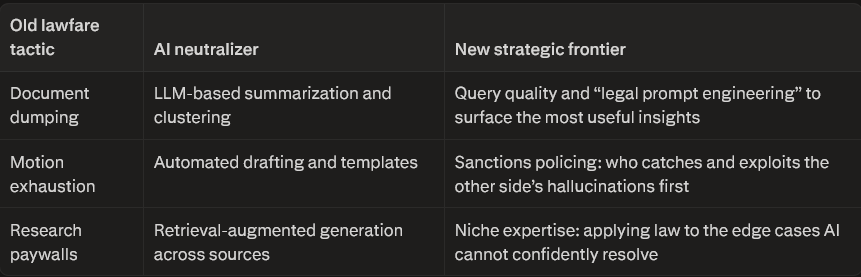
Large firms are already hiring or training people with specialized “legal prompt engineering” skills to design workflows, prompts, and retrieval strategies that get the most out of these tools. That creates yet another layer of asymmetry: knowing how to ask the right questions of the data becomes as important as having access to the data itself.
For large firms, AI changes the equation in both directions. A partner billing $4,000 per hour can argue that, with AI, many tasks are completed in a tenth of the time, potentially keeping total project costs competitive while maintaining high rates. At the same time, those firms must spend substantial human time verifying AI output to avoid sanctions and reputational harm. Pro se litigants and small shops face less reputational risk but may lack the closed‑loop systems that protect confidentiality or the expertise to spot AI’s subtle legal errors.
Generative AI is a double‑edged sword for access to justice. On the one hand, it democratizes capabilities that once required expensive tools and teams. A pro se litigant can now:
Use commercial AI to summarize voluminous discovery and highlight potential issues in hours rather than weeks.
Draft facially sophisticated motions, oppositions, and discovery requests that force a response.
Learn procedural rules and basic doctrine without paying for specialized treatises.
On the other hand, AI does not eliminate core financial barriers. It cannot:
Pay filing fees, expert witness costs, or deposition expenses.
Cover the opportunity cost of time spent litigating instead of working.
Absorb the downside risk of an adverse judgment or fee award.
There is also a “reverse cost” dynamic. A pro se litigant can, with minimal financial investment, generate lengthy AI‑assisted filings that opposing counsel must painstakingly review, deconstruct, and correct. A large firm must invest human hours to ensure that its own AI‑assisted filings are accurate and to expose defects in the other side’s AI‑generated work. Over time, courts may see increased volumes of AI‑assisted filings from self‑represented parties and will respond with stricter page limits, more robust pre‑motion conferences, and greater use of case‑management authority under Rule 16 to keep dockets under control.
AI meaningfully chips away at one form of asymmetry – the ability to generate and digest large volumes of legal text – but it leaves many others intact. It does not:
Finance expert witnesses, jury consultants, or multi‑day depositions.
Replace trial advocacy, cross‑examination, or strategic decisions about which claims and witnesses to emphasize.
Provide emotional intelligence or client counseling, such as preparing a witness for testimony or reading a room during a high‑stakes settlement negotiation.
In short, AI narrows the advantage that comes from having more hands to write and more eyes to read, but it does not eliminate the structural advantages of capital, experience, and human persuasion.
Looking ahead, asymmetric lawfare is evolving, not disappearing.
Courts will refine AI disclosure and certification rules, using Rule 11, Rule 16 case‑management powers, inherent authority, and local procedures to manage AI‑assisted filings while insisting on human responsibility.
E‑discovery will continue along the path from TAR to generative synthesis, building on Da Silva Moore, Rio Tinto, and similar cases, with disputes shifting from “can we use AI” to “did you configure and validate it properly.”
Appellate courts and bar regulators will increasingly weigh in through opinions and ethics guidance, as reflected in ABA Formal Opinion 512 and similar state‑level analyses, making AI competence part of basic professional competence.
The real competition will be in verification, prompt design, and strategic deployment: who can catch AI hallucinations fastest, who can use AI to surface the most persuasive factual patterns, and who can integrate AI without compromising privilege or ethics.
Litigation will still reward resources and expertise. AI will not replace lawyers, and it should not. A human must still protect privilege, navigate UPL and First Amendment boundaries, provide counsel, and make strategic choices. But AI is making one tactic, winning by sheer paper volume and procedural attrition, less reliable, and pushing the system, fitfully, toward outcomes that depend more on the merits than on who can afford to bury an adversary in paper.
This article is published by JJTP Law PLLC as a general-interest news and information service for clients and friends of the firm. Nothing in it is legal advice, and reading it does not create an attorney-client relationship. If you have a question about how this topic applies to your own situation, please reach out to the attorney you normally work with, or schedule a consultation. This is not a solicitation for legal work in any jurisdiction where JJTP Law is not authorized to practice. See our Attorney Advertising & Terms of Use.