27 August 2026
Insights

New York City has announced the policy The harder legal question is what appropriations, contracts,...

New York City’s municipal grocery initiative may properly face scrutiny over public money, public...
Regulatory change can make a product less commercially secure without making it unlawful to own or...
SaaS Style Gaming and the Legal Erosion of...
New York City has announced the policy The harder legal question is what appropriations, contracts,...
New York City’s municipal grocery initiative may properly face scrutiny over public money, public...
Regulatory change can make a product less commercially secure without making it unlawful to own or...
SaaS Style Gaming and the Legal Erosion of...
Originally published on LinkedIn on March 8, 2026
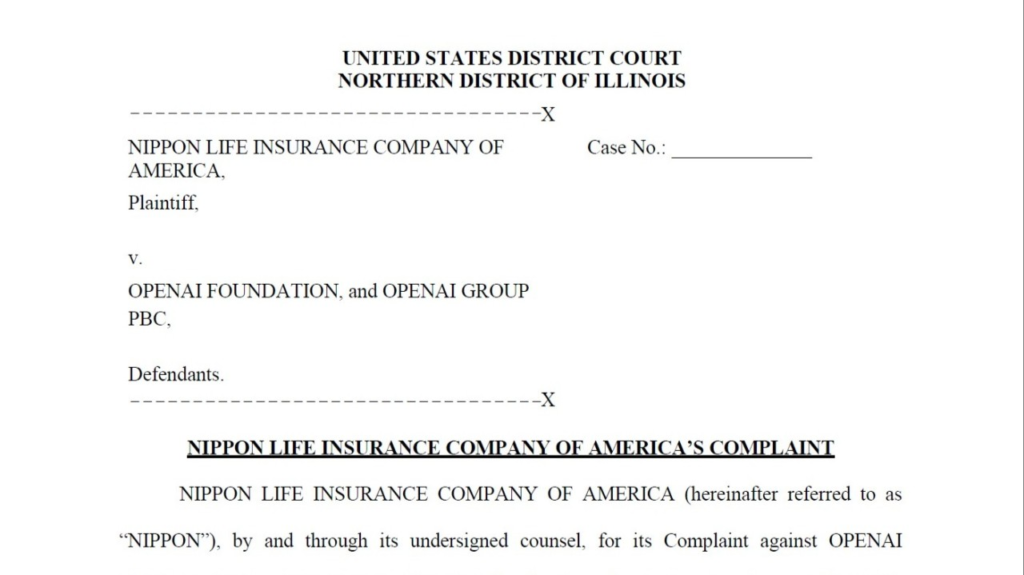
In Nippon Life Insurance Company of America v. OpenAI Foundation, pending in the United States District Court for the Northern District of Illinois, Nippon alleges that OpenAI’s ChatGPT crossed the line from research tool into unlicensed “legal assistant,” helping a pro se litigant breach a settlement and flood the court with filings. The suit is among the first to treat a mainstream generative model as a potential legal actor and raises hard questions at the intersection of unauthorized practice rules, First Amendment protections, Section 230 immunity, Rule 11 obligations and a widening access to justice gap.
A 2025 New York State Bar Association piece asked whether AI would render lawyers obsolete and described tools like ChatGPT as possible substitutes for junior associates in research and drafting. Nippon’s complaint turns that thought experiment into a concrete dispute by alleging that ChatGPT acted as a “legal assistant and advisor” to a real pro se litigant in active federal litigation.
What makes the story compelling is the human contrast. On one side is Dela Torre, a self described disabled pro se litigant who says she turned to ChatGPT because she could not afford continued counsel. On the other side is Nippon, represented by Sidley Austin LLP, asserting that the very tool she saw as her lifeline crossed the line into unlicensed practice and tortious interference.
According to the complaint, Dela Torre sued Nippon over the termination of her long term disability benefits and, after discovery, entered into a written settlement on January 2, 2024. In that agreement she broadly released all claims related to her LTD policy and promised to dismiss her federal case with prejudice. Her lawyers filed a joint stipulation of dismissal, and the court dismissed the case with prejudice on January 24, 2024, later confirming that the settlement was valid and enforceable.
Months later, Dela Torre grew dissatisfied. She emailed her lawyer alleging errors and omissions and expressing a desire to challenge the settlement. He responded that there were no such errors, reminded her of the mutual specific release and explained that a dismissal with prejudice could not simply be reopened. Nippon alleges that she copied that email into ChatGPT, asked whether she was being “gaslighted,” and received an answer characterizing the attorney’s email as invalidating and manipulative, a conclusion the complaint says helped fuel her belief that she had been wronged.
Nippon says Dela Torre then fired her attorneys, entered a pro se appearance and turned to ChatGPT as “a tool specifically designed to help individuals like [her]: pro se litigants trying to navigate the legal system without the benefit of counsel,” as she later wrote in another case. She allegedly told ChatGPT about her settlement, her release and the dismissal and asked how to undo them. The complaint asserts that ChatGPT responded with tailored legal arguments under Federal Rule of Civil Procedure 60(b), drafted an introduction, statement of facts, legal standard and prayer for relief, and produced a complete motion that she filed as a pro se Rule 60(b) motion to reopen.
After the court denied that motion, holding that “second thoughts” about a settlement are not a basis to reopen and reaffirming that the agreement was final and enforceable, Nippon alleges that Dela Torre filed a new lawsuit against other entities. She then supposedly used ChatGPT to amend that complaint to add Nippon and to reassert claims that the settlement had already resolved, breaching the release.
Over time, Dela Torre allegedly filed dozens of motions, notices and requests for judicial notice, many of which Nippon characterizes as legally baseless or harassing. The complaint notes that these filings do not just sound like AI text. They look like it. They allegedly mirror ChatGPT’s distinctive headings, phrasing, rhythmic sentence structure and even the placement of “thumbtack” and “scales of justice” icons, creating the impression that the filings were copied and pasted directly from the chat interface.
One example is the now infamous “Carr v. Gateway” citation. In a request for judicial notice, Dela Torre cites Carr v. Gateway, Inc., 944 F. Supp. 2d 602 (D.S.C. 2013) for a proposition about arbitration in ERISA cases. Nippon points out that no such case exists; the reporter and page number belong to unrelated decisions, and ChatGPT itself, when asked about “Carr v. Gateway,” allegedly provides the same fictitious citation and summary. For Nippon, this hallucination is emblematic of the danger of letting an unlicensed, probabilistic system act as a legal guide for a layperson.
All of these points remain allegations. The court will have to determine what ChatGPT actually produced, how closely Dela Torre followed its suggestions and whether any of that behavior is legally attributable to OpenAI.
Illinois law allows a claim when someone intentionally and unjustifiably interferes with a valid contract and causes a party to break it. Nippon’s tortious interference theory is built around the settlement.
To prevail, Nippon must prove:
OpenAI is likely to respond that a large language model does not have “intent” in the human sense, that it does not know it is interfering with any contract, and that Dela Torre alone decided to disregard her counsel’s advice, sign the pleadings and file them. Federal rules require pro se litigants to certify their filings under Rule 11, and OpenAI will argue that this certification and the litigant’s autonomy break the causal chain.
Abuse of process under Illinois law requires an ulterior motive and a misuse of legal process to accomplish a purpose for which it is not designed. Nippon does not mince words. It portrays Dela Torre as consumed by anger and resentment, using the court as a weapon to punish Nippon rather than as a neutral forum to resolve disputes.
The complaint points to repeated references in her filings to being “financially starved,” self descriptions as a “disabled pro se litigant,” and a pattern of filings that allegedly serve no legitimate procedural purpose but instead aim to embarrass Nippon and its counsel and to force them to expend resources. Courts have described abuse of process as an improper use of the court’s power itself, and Nippon argues that this is such a case.
It then extends that theory to OpenAI. Citing cases where non litigants were held liable for abuse of process because they advised, consented to or materially aided abusive litigation, Nippon contends that OpenAI “knowingly participated” in Dela Torre’s misuse by drafting her motions and requests and by providing the legal scaffolding for her campaign.
OpenAI will likely argue that this is a bridge too far. It will emphasize that it did not file anything, instruct anyone to harass Nippon or share in any supposed ulterior motive. It will portray ChatGPT’s outputs as generic, user driven text that Dela Torre chose to adopt and adapt, not as the kind of directed, intentional misuse of legal process that abuse of process doctrine traditionally targets.
The unauthorized practice claim is the most novel. Under 705 ILCS 205/1, no person may “practice as an attorney or counselor at law” without a license from the Illinois Supreme Court, and someone “practicing or holding himself or herself out to provide legal services” without a license is subject to contempt. The Illinois Supreme Court has defined practice of law broadly to include the preparation of pleadings and legal instruments, management of legal proceedings and “in general, all advice to clients, and all action taken for them in matters connected with the law.”
Nippon alleges that OpenAI, through ChatGPT:
The complaint also highlights an important timing detail. It alleges that OpenAI knew by 2023 and 2024 that ChatGPT was being used in real litigation and had generated hallucinated citations in cases like Mata v. Avianca and Park v. Kim, yet did not change its terms of use to prohibit “tailored legal advice” until October 29, 2025. Before that, the terms did not clearly bar users from relying on ChatGPT to draft filings or give legal analysis.
Nippon suggests that this October 29 policy pivot is telling: that OpenAI realized its model was straying into activities that look like practicing law, became concerned when its outputs surfaced in court orders and sanctions, and attempted to reposition ChatGPT as “just a tool” through updated terms. OpenAI is likely to respond that evolving policies are normal in emerging technologies, that a terms of use change is not an admission of past wrongdoing, and that disclaimers have consistently told users not to treat ChatGPT as a lawyer.
Whether the court treats ChatGPT’s behavior as “practice of law” under Illinois’ broad definition will have significant implications for every AI system that drafts contracts, pleadings or advice for individual users.
At its core, this case is about whether generative legal systems are primarily engaging in protected speech or in regulated professional conduct. States may regulate who may represent others, file papers and give individualized legal advice, even though those acts involve words. At the same time, the First Amendment protects the publication of legal information and commentary, including self help materials and advocacy group advice.
OpenAI will likely argue that ChatGPT is closer to a publisher or library than to a professional. It will point out that ChatGPT generates text in response to user prompts, does not appear in court, does not sign documents and is accompanied by warnings that it is not a substitute for professional legal advice. Regulating what it may say about law could be framed as a content based restriction that warrants strict scrutiny.
Nippon will counter that when ChatGPT takes in the facts of a specific case, analyzes a specific settlement and drafts a specific motion addressed to a specific court, it is doing what Illinois defines as practicing law, regardless of its nonhuman nature. Under that view, the state’s interest in protecting consumers from unqualified representation justifies treating AI legal assistants as subject to unauthorized practice rules, especially when they are used exactly where regulatory protection is most needed: by unrepresented litigants.
Rule 11 provides the immediate procedural context. Federal Rule of Civil Procedure 11 requires that any person who signs a pleading certify that, after a “reasonable inquiry,” the filing has evidentiary and legal support and is not being presented for an improper purpose. Courts in Mata and similar cases have stressed that lawyers cannot satisfy this obligation by blindly trusting AI.
Even though Dela Torre is pro se, Rule 11 applies to her too. Nippon’s complaint implicitly argues that an AI that confidently invents cases like “Carr v. Gateway” makes a reasonable inquiry almost impossible for a layperson, because the tool’s authoritative tone encourages reliance while its errors are difficult for nonlawyers to detect.
That tension between empowering pro se litigants and preserving the integrity of court filings is one of the hardest policy problems this lawsuit surfaces.
Although the complaint does not cite Section 230 of the Communications Decency Act, 47 U.S.C. § 230, any defense of OpenAI is likely to consider it. Section 230 generally protects providers of “interactive computer services” from liability for information created by “another information content provider.”
OpenAI might argue that ChatGPT is a service that processes and re expresses information based on user prompts and training data and that imposing tort liability for its outputs would undermine Section 230’s policy of encouraging online intermediaries. Nippon would respond that OpenAI is itself the information content provider for ChatGPT’s responses, because the model generates new text and legal reasoning rather than simply displaying what users submit, and that Section 230 does not protect actors who materially create or develop the offending content.
Courts are only beginning to wrestle with how Section 230 applies when AI systems synthesize training data into novel outputs. Some scholars suggest that as these cases evolve, courts may treat certain AI disputes more like product liability suits, focusing on design defects and failures to warn rather than speech based immunity. That would shift the debate from “is this speech?” to “is this product reasonably safe for its intended uses?”
Beyond doctrinal labels, any judge will ask a basic tort question: who caused the alleged harm? Nippon’s story is that ChatGPT’s outputs caused Dela Torre to breach her settlement and abuse the court process by inducing her to reopen a closed case and mount a campaign of vexatious filings.
OpenAI will likely emphasize a different chain: Dela Torre chose to ignore her lawyer’s advice, chose to seek input from a free online tool, chose which AI suggestions to adopt, edited the text and physically signed and filed each document. Under Rule 11 and basic procedural law, she, not the tool, bears the responsibility for her filings. On that view, any harm to Nippon was caused by a human litigant’s decisions, not by the maker of a general purpose text generator.
Nippon tries to tighten that chain by emphasizing that OpenAI operates ChatGPT as a mass market service, monitors its usage, knows it is being used in litigation and, in the complaint’s telling, continued to allow it to draft pleadings and legal arguments for pro se litigants even after widely publicized hallucination incidents. The October 29, 2025 policy change is presented as evidence that OpenAI recognized the risk but acted too late.
How the court resolves proximate cause will influence not only this case but future suits against AI providers in contexts ranging from financial advice to medical guidance.
The presence of Sidley Austin LLP on Nippon’s side underscores the economic asymmetry. This is not just a story about technology. It is a story about a self represented disability claimant using a free AI tool to stand against an international insurer represented by one of the world’s most elite firms.
At the top of the market, ABA Journal reporting shows at least one U.S. firm now billing around 4,000 dollars per hour for marquee litigators, with many elite partners charging over 1,500 dollars per hour. Reuters reports that at Susman Godfrey, partners Neal Manne and Bill Carmody have disclosed 4,000 dollar hourly rates for certain matters.
Even outside the Am Law 100, a 2024 survey places average small firm and solo hourly rates around 341 dollars nationally, with states like Illinois near the upper end. For someone on disability income or low wages, those numbers are simply unattainable. Against that backdrop, the idea of a free, always available AI “assistant” that can explain rules, review documents and draft motions is naturally attractive.
Lawyers’ pricing pressure is not imaginary. Using one reasonable set of national averages:
If we then assume, purely illustratively, that the lawyer begins practice around 95,000 dollars per year with 3 percent nominal growth, the GED worker continues with 2 percent growth, the lawyer faces a higher effective tax rate and devotes 10 percent of gross income to loans at 7 percent interest, a simple model suggests the lawyer might need on the order of 17 working years after law school to catch up in cumulative after tax cash flow.
Those numbers will differ by school, geography and practice area, but they help explain why hourly rates are high and why lawyers are understandably wary of tools that seem to offer similar outputs at a fraction of the cost. At the same time, those same forces help explain why litigants like Dela Torre will keep looking for alternatives.
Regulators are trying to widen the human side of the pipeline. Washington, for example, has approved alternative licensing paths that allow candidates to qualify for admission through structured experiential coursework and supervised practice portfolios rather than the traditional bar exam, building on its long standing law clerk program and expanding pathways designed to reflect real world skills.
Utah joined that trend in 2025 by allowing graduates of ABA accredited law schools to skip the conventional bar exam if they complete defined practice based requirements, part of a broader effort to address “legal deserts” and concerns about the fairness and utility of the current exam. Other states, including Oregon and New Hampshire, are exploring similar routes, and the American Bar Association has encouraged further experimentation.
Meanwhile, Washington and Arizona have launched paraprofessional and limited license technician programs that authorize trained nonlawyers to handle defined civil matters such as family law and housing, with regulatory oversight and ethics obligations tailored to their narrower role.
Florida has taken a different tack. Attorney General James Uthmeier petitioned the Florida Supreme Court to allow out of state government lawyers in his office to practice for up to three years without passing the Florida bar, citing staffing problems. The court declined, and commentary from The Florida Bar reflects unease about creating a privileged class of government lawyers not subject to the same licensure standards as private practitioners.
These developments show a profession testing new ways to expand access while guarding core professional boundaries. Nippon’s case asks whether AI should be recognized as a separate category of “legal helper,” kept outside the bar altogether, or treated as simply another tool that lawyers and litigants deploy at their own risk.
The fictitious “Carr v. Gateway” case that appears both in Dela Torre’s filings and in alleged ChatGPT outputs is a vivid reminder that AI can generate legal content that looks authoritative but is entirely made up. Courts have already responded to that problem in cases involving lawyers. In Mata v. Avianca, a Southern District of New York judge sanctioned counsel who filed a brief full of hallucinated cases sourced from ChatGPT, holding that they had violated Rule 11’s reasonable inquiry requirement by failing to verify the authorities. In Park v. Kim, the Second Circuit dealt with similar issues and again stressed that AI cannot replace human fact checking.
Those decisions treat AI as a tool within the control of licensed lawyers. Nippon’s complaint goes a step further and asks whether the tool provider itself can bear responsibility when an untrained layperson uses the tool to generate flawed filings that harm an adversary.
Privilege and confidentiality add another practical layer. Communications with a lawyer are generally protected by the attorney client privilege. By contrast, when a litigant uploads confidential settlement terms, medical information or mental impressions into a commercial AI chat, those communications are not privileged in the traditional sense and may be subject to the provider’s data practices. Enterprise products increasingly promise not to train on customer inputs, but consumer interfaces often reserve broader rights to log and review interactions. Nippon’s case shows how quickly text generated in what felt like a private consultation can be transformed into public filings and allegations.
For litigants and lawyers alike, the lesson is that AI should be used with the same caution as any unvetted source: useful for brainstorming and explanation, dangerous if relied upon blindly for authority, facts or confidential strategy.