27 August 2026
Insights


New York City has announced the policy The harder legal question is what appropriations, contracts,...
New York City’s municipal grocery initiative may properly face scrutiny over public money, public...
Regulatory change can make a product less commercially secure without making it unlawful to own or...
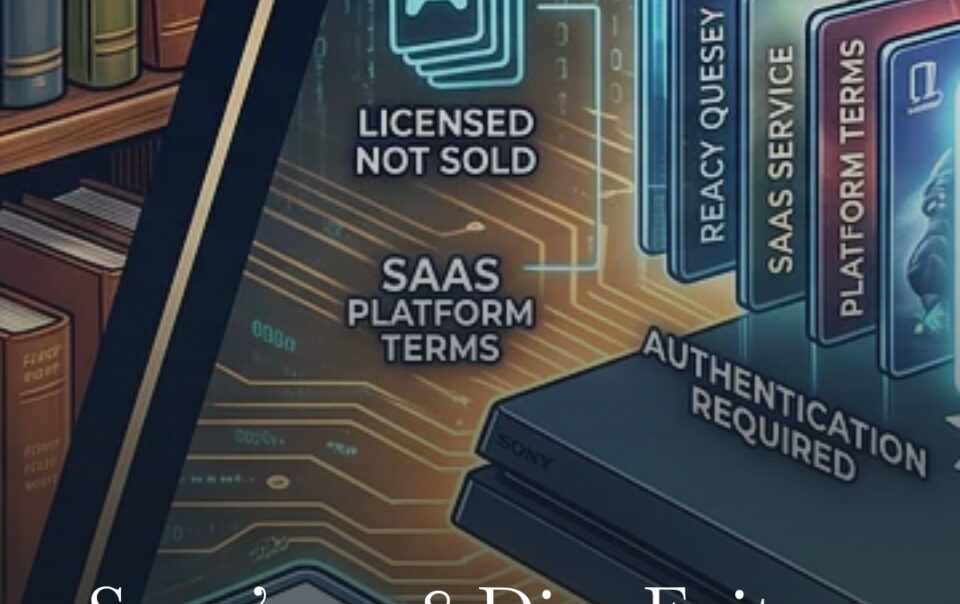
SaaS Style Gaming and the Legal Erosion of...
New York City has announced the policy The harder legal question is what appropriations, contracts,...
New York City’s municipal grocery initiative may properly face scrutiny over public money, public...
Regulatory change can make a product less commercially secure without making it unlawful to own or...
SaaS Style Gaming and the Legal Erosion of...
Originally Posted on February 6, 2026 on LinkedIn
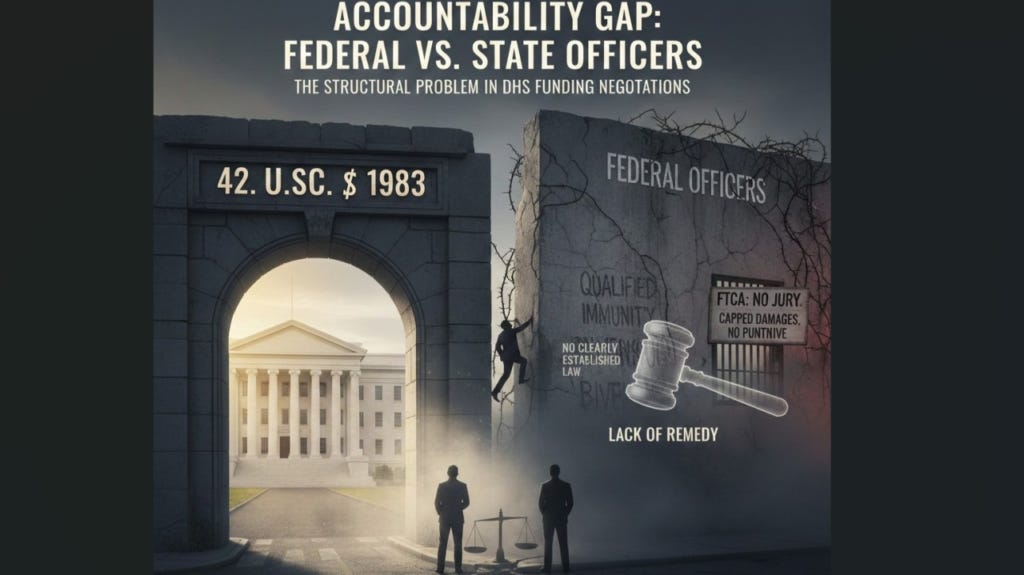
If Congress Is Serious About DHS Reform, It Has To Fix Federal Officer Accountability First.
Section 1983, originally part of the Ku Klux Klan Act of 1871, lets people sue state and local officials who violate federal rights. It does not apply to federal officers.
Qualified immunity is a judge created doctrine that shields government officials from personal liability unless they violate clearly established law, which in practice usually requires very similar prior precedent.
For federal officers, the main personal damages remedy is the judge created Bivens action, which the Supreme Court has now restricted to a few older contexts and made nearly impossible to extend.
The Federal Tort Claims Act (FTCA) lets people sue the United States for some torts, but it substitutes the government for the individual officer, requires a slow administrative process, bars juries, and excludes many important claims.
In federal employment and discrimination cases, damages are capped, and punitive damages against the federal government are generally unavailable, which often turns hard fought victories into limited and unsatisfying relief.
Every time Congress negotiates funding for ICE and the Department of Homeland Security, the public debate gravitates to optics and surface level conditions. Masks. Uniforms. Slogans about being tougher or more humane.
Those issues are not trivial, but they miss the structural problem. The legal system makes it much easier to hold a city police officer civilly accountable than a federal agent doing the same thing in the same city. That is true for use of force, unlawful searches, retaliatory arrests, and even violations of core First and Second Amendment rights.
If Congress is about to write another large check for federal enforcement power, the serious question is not what agents look like. It is whether the law gives ordinary people any realistic way to obtain a remedy when those agents violate the Constitution.
The modern framework starts with Reconstruction. After the Civil War, Congress and President Ulysses S. Grant confronted systematic violence and obstruction by state actors who refused to honor the new Amendments. In 1871, Congress passed what we now call the Ku Klux Klan Act. Section 1 of that Act is codified today as 42 U.S.C. section 1983.
Section 1983 allows suits against any person who, acting under color of state law, deprives someone of federal rights. It was designed for sheriffs, deputies, jailers, mayors, and other state and local officials who either committed or tolerated abuse. It gave victims a direct path into federal court.
Congress never created a parallel, general statute for federal officers. The assumption was that the federal government was the protector of rights against hostile states, not the main source of violations. That historical choice hardened into doctrine. Today, if a city police officer and a federal agent both violate the Fourth Amendment on the same street corner, only one of them is clearly covered by section 1983.
Even when a statute exists, qualified immunity sharply limits individual accountability. Courts ask two basic questions: whether the official violated a constitutional right, and whether that right was clearly established at the time. In practice, many courts look for prior cases with very similar facts before they will say the law was clearly established.
Because qualified immunity is treated as immunity from suit, not just a defense to liability, many cases are dismissed before plaintiffs can obtain discovery. The institutional incentive structure is predictable. Officers know that unless there is a close fact match in the case law, they are unlikely to face personal exposure. Where employers routinely indemnify officers, the financial burden often lands on taxpayers, not on the people who made the unlawful decisions.
The same basic dynamic applies to federal and state officers. The difference is that state and local officers at least sit under a clear statute, section 1983, that expressly permits damages suits. Federal officers do not.
Because section 1983 does not reach federal officials, the Supreme Court in 1971 created a direct constitutional damages remedy in Bivens v. Six Unknown Named Agents. Bivens involved federal narcotics agents who allegedly entered a home without a warrant, used excessive force, and conducted an unlawful search. The Court allowed a damages action directly under the Fourth Amendment against the individual agents.
Two later decisions modestly extended that idea. Davis v. Passman allowed a Fifth Amendment damages claim for sex discrimination by a Congressman against a staffer. Carlson v. Green allowed an Eighth Amendment damages claim against federal prison officials for deliberate indifference to serious medical needs. Together, those three cases formed the small core of what we now call Bivens actions.
Since then, the Court has moved in the opposite direction. In Ziglar v. Abbasi, it held that extending Bivens to new contexts is a disfavored activity, especially where national security, immigration, or high level policy decisions are involved. In Egbert v. Boule, it refused to allow a Bivens claim even for a Fourth Amendment excessive force allegation by a Border Patrol agent, and it rejected a First Amendment retaliation claim outright. Under Egbert, a single plausible reason to leave the issue to Congress is enough to bar a Bivens remedy.
The Court has never recognized a Bivens remedy for Second Amendment violations, and under the Egbert framework such claims are functionally foreclosed. The same is now true for most First Amendment claims. If ATF or DEA agents violate expressive, religious, or firearm rights, there is usually no workable personal damages remedy against the individual federal officers. That should concern civil libertarians on the right and left.
When Bivens is unavailable, many plaintiffs turn to the Federal Tort Claims Act. The FTCA waives sovereign immunity in limited ways and allows people to sue the United States for certain torts committed by federal employees. On the surface, this looks like accountability. In practice, it is often the opposite.
To use the FTCA, a claimant must first file an administrative claim with the agency, wait for a decision or six months of silence, and only then may file in court. Any eventual lawsuit is heard by a federal judge sitting without a jury. The statute imports state tort law, contains a broad discretionary function exception, and excludes many claims that matter deeply in real life, including most defamation claims.
Most importantly, the individual officer is not the defendant. The United States is. Any judgment is paid from the Treasury. The officer’s name may never appear on the caption. From the standpoint of personal deterrence and responsibility, this is a very weak tool. It is essentially a mechanism to spread the cost of government misconduct across taxpayers.
Even in areas where Congress has clearly provided a remedy, it frequently limits that remedy in ways that blunt accountability. In federal employment discrimination cases under Title VII, for example, compensatory damages are capped based on employer size, with a maximum of 300,000 dollars for the largest employers, including federal agencies. Punitive damages against the federal government are generally unavailable.
A federal employee who spends years litigating a meritorious discrimination or retaliation case can win and still emerge with a remedy that does not reflect the actual harm or the seriousness of the misconduct. Back pay and equitable relief help, but there is no ability to punish federal agencies with punitive awards, even for willful violations. The pattern is familiar. Rights exist on paper, but the tools for enforcing them against federal actors are sharply limited.
None of this is inevitable. It is the product of specific statutory choices by Congress and specific doctrinal choices by courts. As lawmakers debate how to fund ICE and DHS, there are several concrete reforms that belong on the table if accountability is genuinely the goal.
Congress could create a federal analogue to section 1983 that allows damages actions against federal officers who violate clearly defined constitutional rights, subject to appropriate safeguards. It could narrow qualified immunity so that it does not shield plainly wrongful conduct simply because no prior case involved the same level of detail. It could codify a limited set of Bivens like remedies, rather than leaving them entirely to judicial implication, and could make clear that immigration, border, and national security contexts do not create blanket immunity for ground level agents.
Congress could also reform the FTCA by preserving juries in certain serious cases, clarifying that key intentional torts by law enforcement remain actionable, and revisiting rigid damages caps and blanket bans on punitive damages in settings where deterrence is critical. None of these changes would prevent the government from carrying out legitimate enforcement. They would simply align federal accountability more closely with the standards already applied to state and local officials.
The current regime creates a structurally bifurcated liability system. State and local officers operate under section 1983, while federal officers often sit outside any comparable statutory framework.
Qualified immunity and the modern narrowing of Bivens have reduced personal damages remedies against federal officers to a level that makes practical enforcement nearly impossible in many contexts, especially immigration, border, and national security work.
The FTCA and capped federal remedies focus liability on the government as an entity, with limited damages and no punitive awards, which shifts costs to taxpayers and weakens individual deterrence.
This is not a partisan issue. The lack of remedies affects First Amendment, Second Amendment, Fourth Amendment, and due process rights in ways that cut across ideological lines.
If Congress wants DHS funding negotiations to be more than a fight over optics, it should prioritize structural reform of federal remedies and qualified immunity so that constitutional rights against federal officers come with meaningful, enforceable consequences.
Enjoyed this article? Subscribe to Jabari-Jason Tyson-Phipps — it’s free, and you’ll get future articles by email via Substack.
This article is published by JJTP Law PLLC as a general-interest news and information service for clients and friends of the firm. Nothing in it is legal advice, and reading it does not create an attorney-client relationship. If you have a question about how this topic applies to your own situation, please reach out to the attorney you normally work with, or schedule a consultation. This is not a solicitation for legal work in any jurisdiction where JJTP Law is not authorized to practice. See our Attorney Advertising & Terms of Use.
This article is published by JJTP Law PLLC as a general-interest news and information service for clients and friends of the firm. Nothing in it is legal advice, and reading it does not create an attorney-client relationship. If you have a question about how this topic applies to your own situation, please reach out to the attorney you normally work with, or schedule a consultation. This is not a solicitation for legal work in any jurisdiction where JJTP Law is not authorized to practice. See our Attorney Advertising & Terms of Use.