27 August 2026
Insights

New York City has announced the policy The harder legal question is what appropriations, contracts,...
New York City’s municipal grocery initiative may properly face scrutiny over public money, public...
Regulatory change can make a product less commercially secure without making it unlawful to own or...
SaaS Style Gaming and the Legal Erosion of...
New York City has announced the policy The harder legal question is what appropriations, contracts,...
New York City’s municipal grocery initiative may properly face scrutiny over public money, public...
Regulatory change can make a product less commercially secure without making it unlawful to own or...
SaaS Style Gaming and the Legal Erosion of...
Originally posted January 19, 2026 on LinkedIn
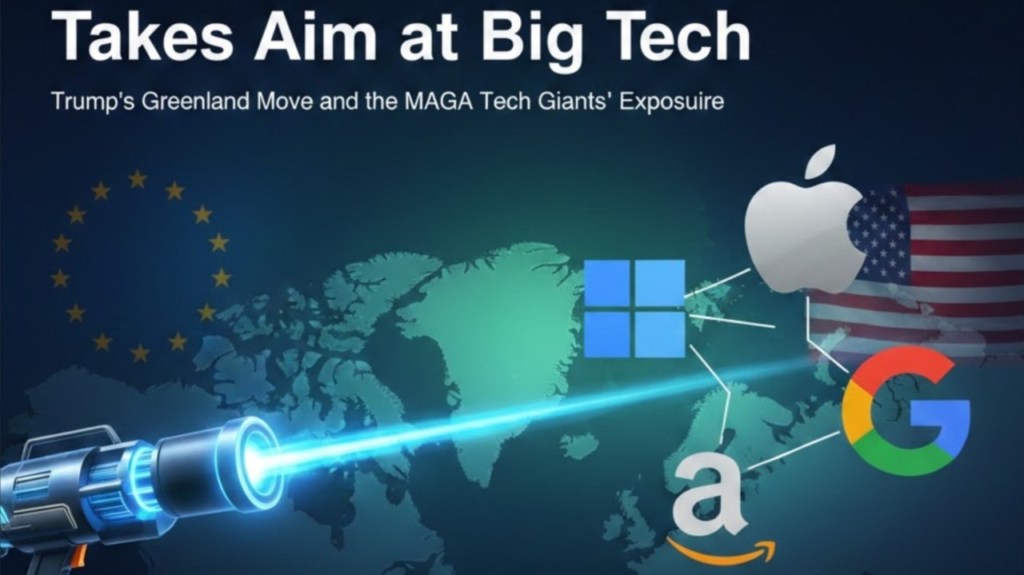
Consider the trade system the United States helped construct over decades. Reliable rules. Enforceable IP rights. Open doors for services across borders. That stability is now under real strain. The European Union’s Anti‑Coercion Instrument, the “EU bazooka,” was built for exactly this kind of moment. With President Trump pressing Denmark over Greenland and flirting with tariffs on allies, French President Emmanuel Macron is calling to take that tool off the shelf. Microsoft, Apple, Google, and Amazon, whose initials spell MAGA, sit squarely where law, politics, and economics collide. Not because they are slogans, but because they are deeply exposed to any serious breakdown in transatlantic norms.
TRIPS is the WTO agreement on Trade‑Related Aspects of Intellectual Property Rights. Since 1995 it has set minimum standards for patents, copyrights, trademarks, and enforcement. US tech, pharma, and content companies built global businesses on the assumption that TRIPS rules would be honored, especially in developed markets like the EU.
Article 73 of TRIPS is the security exception. It says nothing in TRIPS stops a member from taking actions it considers necessary for the protection of its essential security interests, including during war or other emergency in international relations. The key words are “it considers necessary.” WTO panels, including in the Russia – Traffic in Transit case, have made clear that this is largely self‑judging, but not limitless. Governments must invoke it in good faith, and the emergency has to be real, not invented.
The Anti‑Coercion Instrument is written with this escape hatch in mind. It explicitly allows the EU to suspend or adjust obligations relating to the protection or commercial exploitation of IP rights for nationals of a coercing country. In legal terms, that is the EU saying: if you use economic pressure against us, we are willing, in an emergency, to revisit how robustly we enforce your companies’ IP inside our market, using TRIPS Article 73 as cover.
Nobody invented the ACI in a vacuum. European policymakers watched three episodes in particular:
Taken together, those moments pushed the EU to build a faster, more unified response instrument. The Commission proposed the ACI in December 2021, relying on Article 207 of the Treaty on the Functioning of the European Union, which gives Brussels exclusive authority over common commercial policy.
The design is deliberate. The Commission investigates alleged coercion. The Council can confirm it by qualified majority, not unanimity. So one member state can no longer quietly block action. Diplomacy is still required as a first step. Only if sustained engagement fails do countermeasures come into play. But once the EU has this kind of tool in its legal arsenal, using it becomes a real option, not a theoretical one.
When coercion is found and diplomacy is exhausted, the Commission can propose concrete measures and then implement them across all 27 member states. The options include:
All of these measures are supposed to be proportionate and temporary. But in trade practice, “temporary” can mean several years. For companies whose business models rely on recurring contracts, subscriptions, or long‑term infrastructure commitments, that kind of “temporary” matters.
Calling Microsoft, Apple, Google, and Amazon the “MAGA companies” is intentional. Their initials line up, and so do their risk profiles. They share three traits that matter in this context:
Microsoft sells enterprise software, collaboration tools, and Azure cloud services across European public and private sectors. Apple relies on European consumers for high‑margin hardware, App Store revenue, and services like iCloud. Google dominates search and digital advertising in Europe and runs platforms like YouTube and Android that many European businesses depend on. Amazon combines a huge e‑commerce footprint with AWS cloud infrastructure, logistics, and streaming.
These are not automatically “targets” in a legal sense. The ACI does not name them. But if the EU wants to send a signal that Washington cannot ignore, it will look to sectors where US firms are dominant and heavily reliant on EU access. That is why MAGA companies are better thought of as prime exposure points, not slogans.
Public procurement is a powerful lever. EU governments spend around 2 trillion euros annually on infrastructure, health, defense, IT, and cloud contracts. The ACI allows the EU to close that pipeline to companies from a coercing country.
For example, if tensions escalate, Microsoft could find itself excluded from certain government cloud or software tenders. AWS could see restrictions on participating in new public sector data center projects. A large US cloud provider that has built EU data centers and won state contracts would suddenly need to model business continuity without that pipeline.
On the private side, measures short of outright bans still bite. New licensing hurdles, longer approval timelines, or sector‑specific conditions can all slow growth and increase costs for US tech firms operating in Europe.
US banks are deeply embedded in European financial markets. They make up a large share of derivatives activity and play a central role in dollar funding and clearing. European Banking Authority data show significant EU bank exposure to dollar funding, and US institutions like JPMorgan, Citigroup, and Goldman Sachs are key intermediaries.
The ACI explicitly covers banking and financial services. That does not mean Europe will suddenly cut off US banks. It does mean it can impose targeted restrictions: requirements for local clearing, limits on certain products, or conditions on accessing specific market segments. Each of these adds friction, cost, and uncertainty, and each can be dialed up or down in response to political developments.
Services are where the US has a clear edge. US exports of digitally deliverable services globally are in the hundreds of billions of dollars each year, with the EU a major destination. Cloud services, software subscriptions, online ads, streaming, and platform‑based ecosystems all fall into this category.
The ACI allows the EU to restrict “the provision of any service” by companies from a coercing country. In a serious crisis, that could mean:
It is unlikely that the EU would simply flip a switch and shut down major US platforms overnight. But even partial restrictions, introduced in a targeted and cumulative way, could significantly change revenue profiles and bargaining power.
The modern US economy leans heavily on IP and services. Studies of IP‑intensive industries indicate they account for a large share of US GDP and support tens of millions of jobs. Services make up roughly four fifths of US GDP. Manufacturing is important but no longer the main growth driver.
For years, US trade policy focused on winning strong IP rules globally. The TRIPS agreement was a major success from that perspective. It locked in protections that benefited exactly the kind of businesses that now dominate US exports.
The ACI does not mean the EU is about to invite counterfeiters and pirates to run wild. The EU has its own IP‑based champions to protect. But in a coercion scenario it does mean IP enforcement can be used as leverage. Article 10 of the ACI allows measures affecting “obligations concerning the protection of intellectual property rights or concerning their commercial exploitation” for nationals of a coercing third country, with TRIPS Article 73 as the legal backbone.
In practical terms, that could look like slower enforcement, more aggressive use of compulsory licensing in certain sectors, or procurement rules that favor solutions based on local or European IP. For US firms whose core assets are patents, code, algorithms, and brands, even marginal shifts in those areas matter.
Greenland is not just a curiosity in this story. It is a test case. It touches sovereignty, resources, and NATO strategy. When a US administration floats acquisition ideas or tariff threats aimed at Denmark to gain leverage over Greenland, European leaders see that as economic coercion directed at a member state. Macron’s public suggestion that this may warrant activation of the ACI is a sign that this behavior is now being assessed through a formal risk and response lens, not just managed quietly in diplomatic channels.
Even if the EU ultimately stops short of pulling the trigger in this particular case, the signal has been sent. The bazooka is not just for show.
This is not a call for panic. It is a call for serious, practical planning.
For companies with significant EU exposure, useful moves include:
Take a concrete example. A US software‑as‑a‑service provider with a major EU customer base could run a scenario where public sector customers in three large member states pause renewals under political pressure. That firm could then identify alternative markets, local partners, or joint ventures that might mitigate that risk ahead of time.
The Anti‑Coercion Instrument is not a curiosity. It is part of a broader pattern in which key partners are building tools to protect themselves from unilateral pressure, including from Washington. For seventy years, US businesses benefited from a relatively predictable international order that the US itself did a great deal to shape. That order is now being tested in ways that matter directly for revenue, IP, and strategic planning.
MAGA companies and major US financial institutions are not in immediate crisis. But they are more exposed than most to any sharp turn in the EU‑US relationship because their business models depend on services, data, and IP protection in Europe. Early movers will treat instruments like the ACI as real constraints and design around them. Others will assume that in the end, “it will work out” because it always has.
The reality is that the system is moving. The EU’s bazooka is one sign of that movement. Businesses that acknowledge that shift now and adjust will be in a much stronger position if and when the instrument is ever actually fired.
Enjoyed this article? Subscribe to Jabari-Jason Tyson-Phipps — it’s free, and you’ll get future articles by email via Substack.
This article is published by JJTP Law PLLC as a general-interest news and information service for clients and friends of the firm. Nothing in it is legal advice, and reading it does not create an attorney-client relationship. If you have a question about how this topic applies to your own situation, please reach out to the attorney you normally work with, or schedule a consultation. This is not a solicitation for legal work in any jurisdiction where JJTP Law is not authorized to practice. See our Attorney Advertising & Terms of Use