
27 August 2026
Insights

New York City has announced the policy The harder legal question is what appropriations, contracts,...

New York City’s municipal grocery initiative may properly face scrutiny over public money, public...
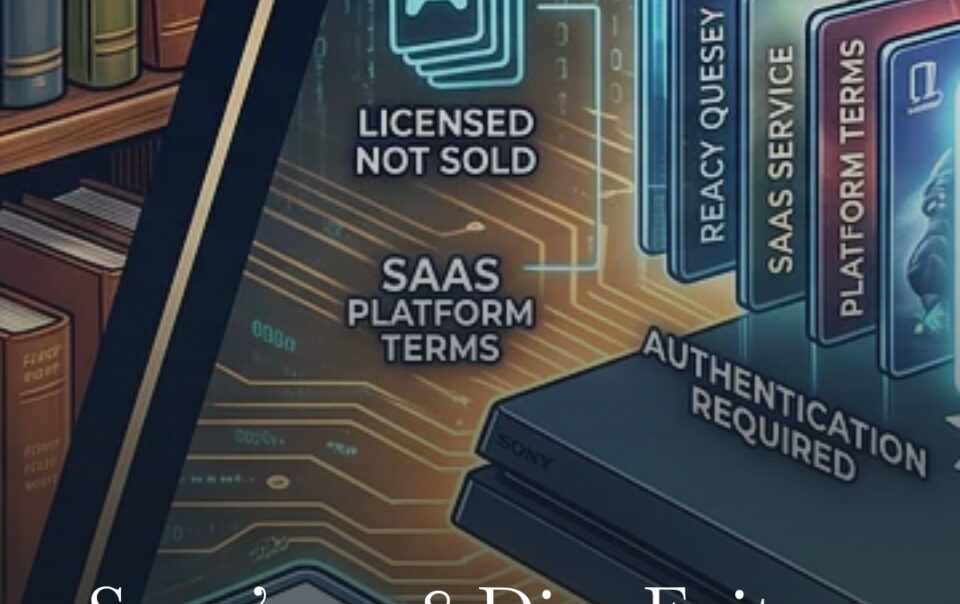
Regulatory change can make a product less commercially secure without making it unlawful to own or...
SaaS Style Gaming and the Legal Erosion of...
New York City has announced the policy The harder legal question is what appropriations, contracts,...
New York City’s municipal grocery initiative may properly face scrutiny over public money, public...
Regulatory change can make a product less commercially secure without making it unlawful to own or...
SaaS Style Gaming and the Legal Erosion of...
May 12, 2026
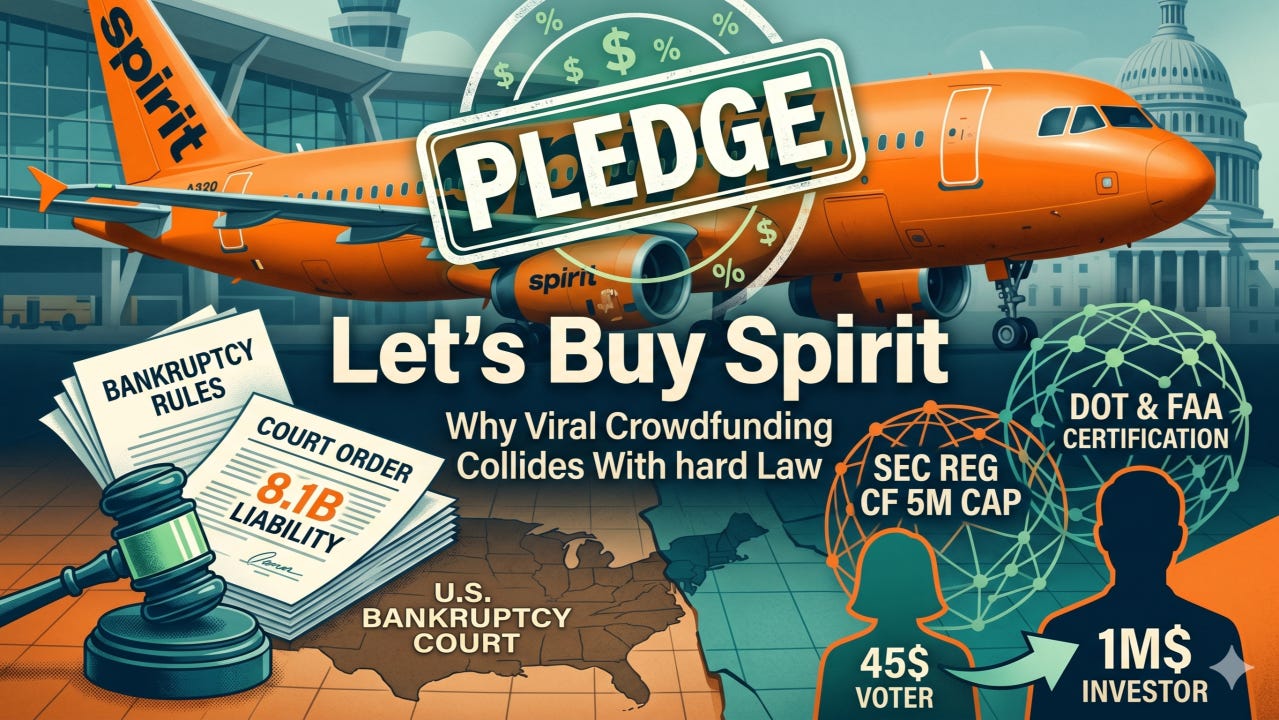
Spirit’s status. AP and NPR report that Spirit Airlines has secured court approval to dismantle the airline in Chapter 11, cease operations, and liquidate assets to pay roughly $8.1B in liabilities.
Grounded aircraft risk. Spirit’s all‑Airbus narrow‑body fleet has also been hit by Pratt & Whitney geared turbofan inspection and grounding issues, adding an operational headache on top of the balance‑sheet problem.
The Spirit 2.0 pledges. TikTok creator Hunter Peterson launched the “Let’s Buy Spirit” / “Spirit 2.0” campaign, which his site and press reports say has accumulated about $337M in nonbinding “intention pledges” from more than 370,000 people toward a $1.75B target, with no money collected yet.
Not 737s. Spirit operates an all‑Airbus fleet (A319, A320, A321), not Boeing 737s, and those aircraft sit inside a web of leases, engine agreements, slots, gates, and loyalty assets that the estate is trying to monetize for creditors.
Reg CF cap. SEC Regulation Crowdfunding permits an eligible issuer to raise a maximum aggregate amount of $5M in any 12‑month period through a registered intermediary, with investor caps and disclosure obligations, which is nowhere near a $1.75B equity target if you rely on that exemption alone.
Spirit’s capital stack. Under the absolute‑priority regime in Chapter 11, senior creditors are entitled to be satisfied before junior stakeholders or equity take value, absent a negotiated departure in a confirmed plan, so any community equity bid starts at the bottom of an $8B‑plus capital stack.
Airline fitness and cash. DOT and FAA “fitness” requirements for a certificated air carrier include competent, identifiable management, regulatory compliance, and substantial unencumbered cash to fund months of operations, plus strict U.S. citizenship and control thresholds; website pledges do not count as regulatory capital.
Governance tension. Giving every participant one vote while scaling profit participation by dollars invested bakes in a structural conflict between low‑fare passengers and large capital providers in a thin‑margin, capital‑intensive business.
Packers analogy. The Green Bay Packers are a nonprofit, grandfathered exception in the NFL whose shares are non‑dividend, non‑tradable, and tightly constrained, which makes them a poor legal template for buying a distressed airline in Chapter 11.
The organizer’s story. Peterson has said the idea began as a joke Instagram post, has described himself as autistic, and has emphasized that he is now consulting lawyers and aviation experts; autism is not a legal incapacity, and regulators will focus on structure and managerial competence, not diagnosis.
AP and NPR describe an airline that sought Chapter 11 protection in 2025, failed to execute a viable restructuring, and by early May 2026 had obtained court approval to shut down operations and begin selling off aircraft, engines, and other assets to pay creditors. Those are liquidation conditions, not a friendly going‑concern sale to a neighborhood shareholder club.
In that posture, the estate’s job is straightforward and unsentimental. The debtor and any trustee or committee owe fiduciary duties to maximize recoveries for the creditor body, not to preserve a brand or reward a viral movement, and under the absolute priority rule senior creditors sit in front of junior creditors and equity unless they voluntarily agree otherwise in a confirmed plan.
Practically, any Spirit 2.0 bid would be stacked against other proposals on three axes: total value, certainty of closing, and regulatory feasibility. If a strategic airline or private equity fund appears with committed financing, creditor support, and a proven management team, a court is not going to favor a structure anchored in millions of small, revocable pledges that have not yet been converted into cash or documented securities.
Social media talk about “buying Spirit” tends to focus on a row of yellow jets on a ramp. In reality, Spirit’s estate is a dense bundle of aircraft leases, engine arrangements, airport rights, labor contracts, loyalty economics, and financing facilities, and reporting indicates that Spirit’s Airbus fleet is largely leased and being repositioned or marketed as part of the wind‑down.
A buyer stepping into that world inherits, or bids into, at least five categories of complexity: aircraft lease and financing structures, including maintenance reserves, redelivery conditions, and the special protections aircraft lessors enjoy under Bankruptcy Code § 1110; gates and slots at constrained airports with independent market value and antitrust sensitivities; labor agreements that govern cost structure and flexibility; loyalty and co‑brand deals in which the frequent‑flyer program may be one of the most valuable assets; and cash‑collateral and debtor‑in‑possession financing arrangements that determine how the debtor can use cash and structure alternative transactions.
Airline restructurings often fail not because nobody wants the planes, but because lease obligations, labor costs, fuel volatility, Pratt & Whitney GTF downtime, and liquidity burn leave almost no room for operational mistakes. Any credible Spirit 2.0 offer has to show the court, lessors, lenders, and unions that it understands those realities and is capitalized to survive them.
At the moment, Spirit 2.0 sits on the safer side of an important legal line: the organizers are publicly collecting only nonbinding expressions of interest, not actual funds. From a legal standpoint, a database of “I would put in $45” is very different from a bank account holding wired investments.
Legally, the structure matters enormously. A pure donation model, where people give money without any promise of ownership, return, or governance, raises very different issues from an offering of securities that promises equity, revenue‑sharing, or voting rights. Hybrid “points,” “units,” or quasi‑ownership systems that emphasize financial upside or managerial efforts may still be analyzed as securities if participants reasonably expect value to flow from someone else’s work under the Supreme Court’s Howey investment‑contract test.
The character of Spirit 2.0 changes the moment money is accepted in exchange for something that looks like ownership, voting power, or a share of profits. Courts applying Howey look for an investment of money in a common enterprise, coupled with a reasonable expectation of profit derived from the efforts of others, and a crowd wiring funds into a vehicle that promises them a piece of a reorganized airline would likely fall inside that framework.
From there, the options look like a private‑markets menu. A pure donation campaign pushes securities concerns to the background but triggers consumer‑protection and possibly charitable‑solicitation rules; an equity or revenue‑sharing model needs either full SEC registration or a valid exemption, each with issuer‑eligibility limits, dollar caps, disclosure duties, and liability exposure. Calling claims “points” or “badges” on a platform does not shield them from being treated as securities if the economic reality matches the Howey test.
The key for would‑be contributors is that none of this nuance disappears because the idea started as a joke TikTok. The SEC and courts will apply the same statutory and case‑law frameworks whether a deal was born in a boardroom or on a For You page.
Regulation Crowdfunding is the federal exemption built for widely advertised, small‑ticket offerings to retail investors. The SEC’s own materials make clear that Reg CF allows an eligible company to raise up to $5M in a 12‑month period, requires use of an SEC‑registered broker‑dealer or funding portal, caps non‑accredited investors based on income and net worth, and mandates specified disclosures on Form C.
That $5M limit is a hard ceiling for that exemption, applied on a rolling 12‑month basis. Even if Spirit 2.0 were structured perfectly under Reg CF, a delta between a $5M cap and a $1.75B target remains, before you even address the roughly $8.1B in legacy debt that sits ahead of new equity.
This does not mean retail participation is impossible at every level. Larger offerings sometimes rely on Regulation A for “mini‑public” offerings, on Regulation D for private placements to accredited investors, or on cooperatives and membership structures that knit together state and federal exemptions, but any structure that tries to move hundreds of millions of dollars lawfully will look much more like a traditional securities deal with a community overlay than a pure “everyone chips in $45 and we own an airline together” story.
One of Spirit 2.0’s most attractive talking points is the notion that each participant would have one vote, regardless of whether they contributed $45 or $1M, while economic participation would scale with the amount invested. The aim is to detach voice from wealth and align the airline with its passengers.
That design collides with a familiar problem in corporate governance. In a highly leveraged, capital‑intensive sector, control usually follows risk for a reason: a small contributor who mainly wants $19 fares to Florida may rationally vote for choices that keep tickets cheap at the expense of margins, while a large investor who has put seven figures at risk will want pricing and capacity decisions that protect solvency and a realistic prospect of return.
If both have identical voting power over strategy, the first serious tradeoff between headline fares and balance‑sheet health becomes a built‑in fight. Practitioners spend significant time designing around exactly this misalignment between control and exposure because it tends to produce stalemate, opportunistic behavior, or “back‑door” structures that restore effective control to large capital providers.
In other words, the campaign’s most emotionally compelling feature is also its most fragile structural feature. Without a very careful governance design, equal votes layered on top of wildly unequal stakes in a distressed airline is not democratic innovation so much as a planned conflict.
Peterson has pointed to the Green Bay Packers as inspiration, highlighting millions of shares held by hundreds of thousands of fans and the idea of a community‑owned franchise. It is a compelling narrative, especially for people frustrated with institutional investors.
Legally, the Packers live in a different universe. They operate as a nonprofit corporation and are grandfathered under NFL rules that now generally forbid comparable public ownership structures; their “stock” pays no dividends, does not trade on public markets, can usually be transferred only back to the team, and is subject to individual ownership caps. Packers stock functions more like a civic donation certificate plus limited nonprofit governance rights than traditional equity in a leveraged operating company.
That model was not designed to fund the acquisition of a distressed airline, does not sit behind $8.1B of senior claims, and is not subject to DOT and FAA oversight or the capital demands of commercial aviation. Using the Packers as shorthand for “we can own Spirit together” may work rhetorically, but it is a poor roadmap for a bankrupt carrier whose certificate, safety programs, and liquidity profile are under federal scrutiny.
A football team is a civic treasure; an airline is a capital furnace. You can love the Packers without worrying about fuel hedges, maintenance reserves, or FAA audits; you cannot say the same for Spirit 2.0.
Even if Spirit 2.0 assembled real capital, won a court‑supervised auction for critical assets, and proposed a credible capital structure, it would still have to clear DOT and FAA fitness requirements. DOT materials make clear that any applicant for U.S. carrier authority must demonstrate managerial competence, financial fitness, and a willingness to comply with applicable regulations.
In practice, that means identifying experienced, acceptable management; demonstrating sufficient unencumbered cash to fund several months of operations without revenue; and showing that the ownership and control structure satisfies U.S. citizen control requirements for air carriers. A global online pledge campaign would need hard structural limits on foreign participation and real, committed capital, not just intention clicks.
On the FAA side, the focus is on safety and operations. The airline must designate qualified individuals in key roles such as Director of Operations, Director of Maintenance, and Chief Pilot and must present approved manuals, training programs, and oversight systems that meet regulatory standards. A diffuse crowd can hold shares; it cannot sign off on a maintenance program or crew training curriculum, so even the most democratic equity structure ends up resting on a conventional management chain once it confronts FAA and DOT.
There is also the reality that pledge and engagement data has value independent of whether a single flight ever operates. Reporting notes that hundreds of thousands of people have pledged hypothetical dollar amounts and engaged so heavily that the site has crashed, leaving a dataset of names, emails, and self‑reported investment appetites that would be meaningful to any marketer.
Platforms like Mutiny live in that space, awarding users “points” or synthetic units for engagement and referrals that feel like ownership but are often just contractual rights inside the platform, rather than equity that an SEC filing or bankruptcy judge would recognize. Organizers with existing influencer networks, including figures such as Mutiny’s Jay Davis, have strong incentives to maximize engagement and data even where formal equity is limited or absent.
That does not make the Spirit 2.0 effort inherently exploitative, but it does mean would‑be participants should consider not only whether they will ever own part of a reorganized airline but also what else they are handing over when they press “pledge.” “Ownership” points, badges, and dashboards may map poorly onto actual stock, leaving contributors with far less than the branding implies.
Pledges are not capital. The widely quoted $337M associated with Spirit 2.0 reflects nonbinding expressions of interest, not wired funds in a structured vehicle; once money moves, securities and bankruptcy rules stop being hypothetical and start being enforceable.
Reg CF has a hard ceiling. Regulation Crowdfunding’s $5M 12‑month cap, portal requirement, and investor limits make it impractical to finance a multibillion‑dollar airline acquisition through a simple “everyone chip in” retail exemption; any serious raise will resemble a conventional securities deal with a community veneer.
Bankruptcy does not care about vibes. Spirit’s multi‑billion‑dollar liabilities sit in front of any new equity, and the court’s mandate is to maximize creditor recoveries; a community proposal will be measured against competing bids on value, certainty, and regulatory feasibility, not on social media momentum.
Airlines are regulatory heavyweights. DOT and FAA fitness standards, including substantial unencumbered cash, qualified management, and U.S. ownership and control, pose real gating issues for a loose, global crowd model that cannot be solved through rhetoric or branding alone.
Equal votes plus unequal risk is unstable. A one‑person‑one‑vote governance structure layered on top of radically different financial stakes is likely to generate conflict between low‑fare‑focused small contributors and large investors who need returns, especially in a leveraged, thin‑margin business.
The Packers are an exception, not a template. Green Bay’s nonprofit, non‑dividend, non‑tradable stock model is a grandfathered anomaly in professional sports, not a precedent that bankruptcy courts, the SEC, or DOT can import into a distressed airline sale.
Data and “points” have their own economics. Even if no traditional securities are sold, pledge data and gamified “ownership” points can become valuable assets for platforms and organizers, while contributing little in the way of legally recognized equity to supporters.
Do not substitute a TikTok for a term sheet. If this campaign ever moves from pledges to actual fundraising, it should be approached like any other high‑risk private investment: understand the structure, read the risk factors, identify the legal basis for the raise, and, if the numbers get meaningful, have someone steeped in securities, bankruptcy, and aviation regulation look at the documents before you hit send.
The instinct behind Spirit 2.0 is understandable. People are tired of feeling that essential services are financed and governed only for institutions, not for the people who rely on them, and a crowd‑owned airline is a powerful way to express that frustration.
But compelling is not the same as compliant. When the target is a bankrupt carrier, the referee is a Chapter 11 judge, the securities regulator is watching, and the operating certificate lives at DOT and FAA, “we will figure out the legal part later” is not a plan. If all you ever do is click “I would pledge $45,” your cost is mostly time and data.
The moment you are asked to move real money, the calculus changes. At that point, the safest posture is to assume you could lose everything you invest, to assume the legal terrain is far more complicated than the marketing, and to bring in someone whose instincts are shaped by statutes, capital structures, and operating certificates rather than by the For You page before you authorize a wire.
This article is published by JJTP Law PLLC as a general-interest news and information service for clients and friends of the firm. Nothing in it is legal advice, and reading it does not create an attorney-client relationship. If you have a question about how this topic applies to your own situation, please reach out to the attorney you normally work with, or schedule a consultation. This is not a solicitation for legal work in any jurisdiction where JJTP Law is not authorized to practice. See our Attorney Advertising & Terms of Use.