
27 August 2026
Insights
New York City has announced the policy The harder legal question is what appropriations, contracts,...
New York City’s municipal grocery initiative may properly face scrutiny over public money, public...
Regulatory change can make a product less commercially secure without making it unlawful to own or...
SaaS Style Gaming and the Legal Erosion of...
New York City has announced the policy The harder legal question is what appropriations, contracts,...
New York City’s municipal grocery initiative may properly face scrutiny over public money, public...
Regulatory change can make a product less commercially secure without making it unlawful to own or...
SaaS Style Gaming and the Legal Erosion of...
June 6, 2026
A jury consultant spent $30,000 worth of time creating research to help January 6 defendants get their cases moved out of Washington, D.C. The lawyers who paid her filed her report on the public docket. Then other lawyers downloaded it for free and used it for their own clients. Now those lawyers are being sued for copyright infringement by the very person they helped create their defense strategy. This case reveals a harsh truth about the legal profession: not all clients are good clients, and sometimes taking a case can cost a lawyer far more than they will ever make from it. The irony is thick. These lawyers defended people Trump called to fight to overturn the election results for him. Now they face a lawsuit from a person whose work they appropriated, while Trump himself may end up paying for their defense through his administration’s copyright infringement liability.
The Plaintiff: Lindsay Olson, a Texas-based jury consultant who created a 26-page “community attitude” survey about D.C. jurors’ feelings toward Capitol rioters
The Fee: Olson charged $30,000 for her report, which concluded D.C. residents felt about as much sympathy for insurrectionists as they do for telemarketers
The Defendants: Attorneys Stanley Woodward, Paul Garrity, and Kira Anne West, along with their law firms, who represented January 6 defendants
The Use: Defense attorneys attached Olson’s publicly filed report to their own motions to transfer venue, arguing D.C. jurors were biased against people attempting to overthrow the government
The Result: All venue transfer motions failed, and judges universally denied requests from Capitol riot defendants to move their cases
The Ruling: On May 26, 2026, U.S. District Judge Beryl Howell denied the defendants’ motions to dismiss, allowing Olson’s copyright infringement claims to proceed
The Government Suit: Olson also sued the Trump administration, alleging federal public defenders used her report at least 11 times without paying
The Pardons: Over 1,500 January 6 defendants, including those represented by these lawyers, were pardoned by President Trump on Inauguration Day 2025
Copyright infringement exists in two forms: civil and criminal. Understanding the difference matters because Olson chose the civil path, and the consequences differ dramatically.
Civil copyright infringement occurs when someone violates one of the exclusive rights granted to a copyright holder under 17 U.S.C. § 106. To prove civil infringement, a plaintiff must establish two elements:
Ownership of a Valid Copyright: The plaintiff must show they created an original work of authorship fixed in a tangible medium. Olson’s 26-page survey report qualifies as this.
Copying of Constituent Elements: The plaintiff must prove the defendant copied original elements of the work. This requires showing the defendant had access to the work and that the works are substantially similar.
Civil remedies include actual damages plus the infringer’s profits, statutory damages ranging from $750 to $30,000 per work (or up to $150,000 for willful infringement), and potentially attorney’s fees.
Criminal copyright infringement under 17 U.S.C. § 506 and 18 U.S.C. § 2319 requires proof beyond a reasonable doubt of:
Willful Infringement: The defendant knowingly violated copyright law
For Commercial Advantage or Private Financial Gain: The infringement served a financial purpose
The Work Was Copyrighted: Valid copyright existed
Criminal penalties include fines and imprisonment up to 5 years for first-time offenses, and up to 10 years for repeat offenses.
Civil and criminal copyright infringement can overlap but serve different purposes. Civil cases protect private rights and compensate victims. Criminal cases protect public interests and punish wrongdoing. The government must bring criminal charges, while private parties bring civil suits. Olson’s civil case does not prevent criminal charges, but she has not pursued them.
In Olson’s case, Judge Howell found she sufficiently alleged:
Her report qualified as an original work of authorship protected by copyright
Defendants used the copyrighted work without permission for the same purpose it was created
The report has a fair market value of $30,000 per case
Each lawyer exploited the entire written report for venue transfer motions
The court rejected defendants’ arguments regarding fair use and collateral estoppel, stating the issues were distinct from previous litigation.
Lindsey Olson runs a jury consulting firm in Texas. She was paid $30,000 by a law firm representing a January 6 defendant in the Oath Keepers case to conduct a “community attitude” survey about D.C. jurors’ feelings toward Capitol rioters. Her conclusion was blunt: D.C. residents felt about as much sympathy for insurrectionists as they do for telemarketers who tried to hang the Vice President on livestream.
The survey found respondents in Washington, D.C. were more likely to characterize January 6 as an “insurrection,” “racially motivated,” or “planned in advance” than prospective jurors in other regions. The survey also argued the D.C. jury pool was more likely to feel “personally” affected or less safe because of the Capitol siege.
The defendants include:
Stanley Woodward and his law firm
Paul Garrity and his law firm
Kira Anne West, a D.C.-based defense attorney whose firm attached Olson’s report to three separate criminal cases
West defended Alex Harkrider, who was accused of carrying a tomahawk axe amid the mob. Harkrider was found guilty in 2024 of felony charges including civil disorder, obstruction of an official proceeding, and entering a restricted building with a deadly weapon. He was later pardoned by Trump.
Olson’s lawsuits allege the defense attorneys infringed on the copyright of her research studies when they made filings seeking a change of venue for Capitol riot defendants. Her complaint states:
“After Plaintiff delivered a copy of the Report to the Requesting Attorneys, they and [sic] uploaded a copy of the Report to the Court’s public docket… causing a public display of the Report in support of a motion to transfer venue, as authorized by Plaintiff in exchange for the required $30,000 payment”
But then other lawyers did what lawyers do: they pulled the public filing, attached it to their own motions, and argued the same point about D.C. juror bias.
Olson’s attorney James Bartolomei stated:
“Each lawyer exploited the entire written report for the very same purpose that she created it, which was for use in support of a motion to transfer venue out of DC. The report has a fair market value of $30,000 per case”
Olson also filed a separate lawsuit against the Trump administration, alleging federal public defenders published her report in its entirety at least 11 separate times. She claims she was unaware of the government’s unauthorized use until she found her report with file stamps from multiple case numbers.
On May 26, 2026, U.S. District Judge Beryl A. Howell denied the defendants’ motions to dismiss Olson’s copyright infringement lawsuits. Judge Howell determined that Olson’s 2025 lawsuits presented “novel” issues since “the copyrighted work in question was used in an attempt to safeguard essential individual rights”.
Judge Howell emphasized:
“Defendants’ motions to dismiss are denied”
The ruling clarified several important points:
Copyright Protection Applies: Copyright protection applies to original works of authorship and Olson’s report qualified as such
Statute of Limitations: The statute of limitations for copyright claims could be influenced by the discovery rule, which allows claims to be filed within three years of when the plaintiff discovers the infringement
Fair Use Rejected: The court rejected defendants’ arguments regarding fair use, stating the issues were distinct from previous litigation
Factual Issue Remains: The court found Olson had not conclusively failed to meet the statute of limitations, as the timeline of her discovery was a factual issue not suitable for dismissal
The case began when Olson delivered her report to the requesting attorneys in exchange for the $30,000 fee. Those attorneys uploaded the report to the court’s public docket in the Oath Keepers case. From there, lawyers for other defendants pulled the public filing and attached it to their own motions.
Dozens of January 6 defendants sought a change of venue using Olson’s research study, but none succeeded. Judges universally denied requests to transfer cases to other federal districts despite repeated claims that jurors would be biased in D.C. due to media coverage.
Some judges derided the change-of-venue requests. In April 2024, a federal judge remarked that “while there has certainly been significant media coverage of Jan. 6, much of it has consisted only of straightforward, unemotional factual accounts of events”. In July 2023, federal judge Rudolph Contreras ruled that “a fair trial is possible even where that impact is the result of particularly heinous crimes”.
If Olson prevails, the defense attorneys could face:
Actual Damages: Compensation for Olson’s lost licensing fees at $30,000 per case
Statutory Damages: Up to $30,000 per work, or $150,000 if willful infringement is proven
Attorney’s Fees: Potential liability for Olson’s legal costs
Reputational Damage: Public finding of copyright infringement could harm their practice
The attorneys could appeal Judge Howell’s decision, especially if they believe there are grounds to challenge the ruling on copyright or procedural issues.
This ruling has significant implications for the legal community regarding copyright claims and the use of public documents in court. It reinforces the idea that attorneys must seek permission before using copyrighted materials, even if those materials are publicly available.
Above the Law noted the unusual nature of this case:
“If authors could claim intellectual property rights over their explicitly intended for litigation work product after it enters the docket, it defeats the whole purpose of a common law legal system”
The article continued:
“Access to justice is baked into any case that involves experts, but the idea that a relatively deep-pocketed litigant can commission a report and poorer litigants have to pay an additional toll to access it creates a dystopian justice model”
This case could impact how courts handle copyright claims involving publicly filed legal documents. The court noted this presents “novel” issues because the copyrighted work was used to safeguard individual rights.
If Olson’s position prevails, it could create a system where legal arguments can be hoarded to the exclusive benefit of one party once they are filed, potentially undermining consistent outcomes for similarly situated defendants.
The irony in this case is thick enough to cut with a knife. These lawyers defended people who were called by President Trump to fight to overturn the election results for him. Those same people stormed the Capitol on January 6, 2021. Trump later pardoned over 1,500 January 6 defendants on Inauguration Day 2025.
Now those lawyers face a copyright infringement lawsuit from Lindsay Olson, whose work they appropriated without paying. And here is the kicker: Olson also sued the Trump administration itself, alleging federal public defenders used her report at least 11 times without paying. The Trump administration may end up paying for these lawyers’ misconduct through copyright infringement liability.
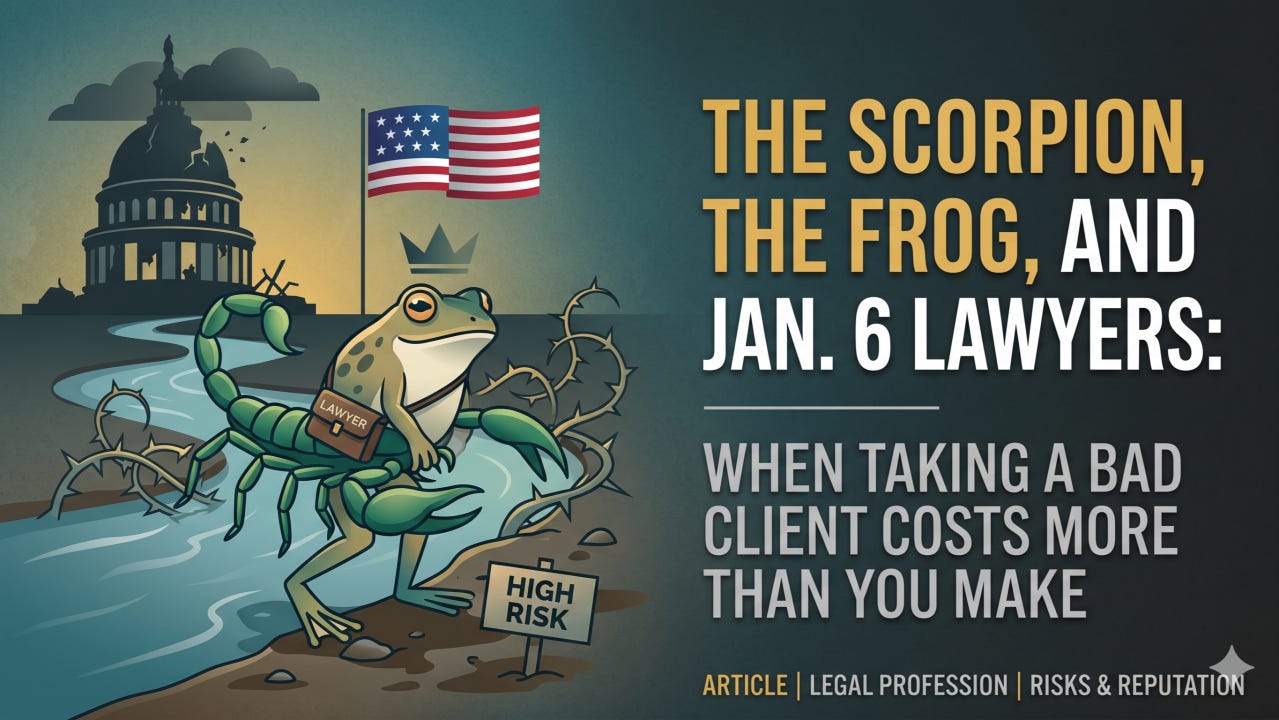
This situation perfectly illustrates the African parable of the scorpion and the frog. The parable goes like this: A scorpion wants to cross a river and asks a frog to carry him on his back. The frog hesitates, saying the scorpion will sting him. The scorpion argues that if he stings the frog, they will both drown. The frog is convinced and helps the scorpion cross. But when they reach the middle of the river, the scorpion stings the frog anyway. As they sink, the frog asks why. The scorpion replies: “It’s my nature”.
In this case, the Jan. 6 defendants were the scorpions. The lawyers who defended them were the frogs. The lawyers helped the scorpions cross the river of justice, expecting payment and professional satisfaction. But the scorpions’ nature meant they would sting anyway. The lawyers used Olson’s work without paying her, betraying the very person who helped build their defense strategy.
As Olson’s attorney stated:
“If everyone stole authors’ work all the time, there would eventually be none made at all. Everyone understands that would be wrong”
Not All Clients Are Good Clients: Taking on certain clients can cost lawyers more in reputation and legal exposure than they will make in fees. The January 6 defense attorneys are now facing copyright infringement lawsuits that could cost them far more than their original fees
Copyright Protection Extends to Public Filings: Just because a document is filed on the public docket does not mean it enters the public domain free for all to use. Copyright protection can still apply
Civil and Criminal Copyright Differ: Civil cases compensate victims while criminal cases punish wrongdoing. Olson chose civil court, which requires proving ownership and copying by a preponderance of evidence
Fair Use Is Not Automatic: Using copyrighted material for litigation does not automatically qualify as fair use. The court rejected the defendants’ fair use arguments
The Discovery Rule Matters: Copyright claims can be filed within three years of when the plaintiff discovers the infringement, not necessarily when it occurred
Public Access vs. Copyright Protection: This case creates tension between public access to court documents and copyright protection for works created specifically for litigation
Irony Abounds: The lawyers who defended Trump’s supporters now face a lawsuit that may be paid by Trump’s own administration, illustrating how the legal profession’s ethical complexities can circle back unexpectedly
The scorpion stings because it is its nature. Sometimes lawyers take clients because it is their job. But when the client’s nature is to sting, even the lawyers get burned. This case reminds us that in law as in life, not every transaction ends in profit, and sometimes helping someone cross the river means getting stung on the way to the other side.
This article is published by JJTP Law PLLC as a general-interest news and information service for clients and friends of the firm. Nothing in it is legal advice, and reading it does not create an attorney-client relationship. If you have a question about how this topic applies to your own situation, please reach out to the attorney you normally work with, or schedule a consultation. This is not a solicitation for legal work in any jurisdiction where JJTP Law is not authorized to practice. See our Attorney Advertising & Terms of Use.