27 August 2026
Insights

New York City has announced the policy The harder legal question is what appropriations, contracts,...

New York City’s municipal grocery initiative may properly face scrutiny over public money, public...
Regulatory change can make a product less commercially secure without making it unlawful to own or...

SaaS Style Gaming and the Legal Erosion of...
New York City has announced the policy The harder legal question is what appropriations, contracts,...
New York City’s municipal grocery initiative may properly face scrutiny over public money, public...
Regulatory change can make a product less commercially secure without making it unlawful to own or...
SaaS Style Gaming and the Legal Erosion of...
Originally posted January 17, 2026 on LinkedIn
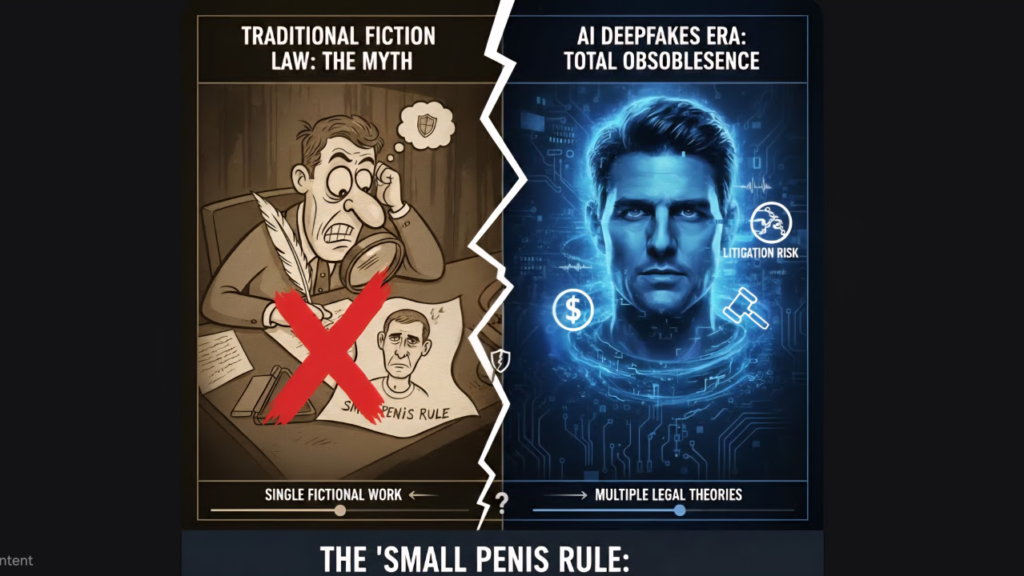
Why authors’ attempts to evade defamation liability through crude characterization often amplify legal exposure, and how AI-generated synthetic media changes the calculus entirely
In the entertainment and publishing industries, there exists an informal and largely ineffective legal strategy known as the “small penis rule.” Libel lawyers have long whispered about this tactic as a supposed shield against defamation lawsuits, particularly in fiction writing. Yet like many myths born in legal practice, this doctrine represents a fundamental misunderstanding of defamation law that often works against the very authors who employ it. And in the emerging era of artificial intelligence and deepfakes, the rule’s irrelevance has become even more pronounced.
The small penis rule, first documented in a 1998 New York Times article by journalist Dinitia Smith, operates on a deceptively simple premise: when an author creates a fictional character closely modeled on a real person, adding an unflattering and embarrassing detail specifically, the character’s diminutive male anatomy will allegedly deter the real person from suing. The logic is almost absurdist: no self-respecting male would want to file a lawsuit, the theory goes, because doing so would effectively require him to admit he is the fictional character and therefore possesses the unflattering physical attribute.
This doctrine gained cultural currency through high-profile examples, most notably Michael Crichton’s controversial 1998 novel “Next,” in which a character named “Mick Crowley” a privileged Yale alumnus and political journalist based in Washington was depicted with a small penis. The resemblance to real journalist Michael Crowley was unmistakable. Crowley didn’t sue, but instead published a scathing article accusing Crichton of “literary hit-and-run,” arguing that the author deployed the small penis rule as a shield to avoid accountability for his literary assault.
The small penis rule fails for several compelling reasons that any competent defamation attorney should recognize immediately:
The critical flaw in the small penis doctrine is that the accusation itself becomes actionable defamatory material. Unlike the theory suggests, a plaintiff need not admit they are the fictional character to pursue a defamation claim. Instead, they can simply characterize the small penis reference as an additional defamatory statement separate from the identification question itself. The statement is false (or at least, the plaintiff would argue it is false), published to third parties, and harmful to reputation. Rather than creating a disincentive to sue, the tactic merely expands the defendant’s exposure by creating additional damages claims.
Courts view the deployment of the small penis rule with profound skepticism. Its very use signals to a jury that the defendant was aware of potential defamation liability and deliberately chose to compound the problem rather than mitigate it through standard protective measures such as changing character names, altering identifying details, or simplifying occupation descriptions. This conscious strategy demonstrates bad faith and can be weaponized against the defendant at trial as evidence of actual malice (a critical element for public figure defamation cases under the New York Times v. Sullivan standard).
Using the small penis rule is essentially an admission that the author knew the character closely identified with a real person and deliberately included negative, false information about them. Defense attorneys understand this, which is why most reputable publishers and experienced authors reject the tactic outright. If the tactic is being deployed for the stated purpose, to reduce defamation liability, then its very existence becomes evidence that the defendant consciously engaged in defamation in the first place.
The one limited benefit of the small penis rule is not legal but psychological. If someone believes (incorrectly) that the rule provides legal protection, they may decide not to pursue litigation in the first place. In this narrow sense, the doctrine could be viewed as operating through myth and deterrence rather than legal principle. However, this benefit relies entirely on the plaintiff’s legal ignorance and misunderstanding of defamation doctrine, hardly a foundation on which a responsible author should build their litigation defense strategy.
To fully contextualize the small penis rule’s failures, it’s essential to distinguish it from a related but distinct area of entertainment law: right of publicity claims.
While defamation protects individuals’ reputations against false statements disseminated to third parties, the right of publicity protects against the unauthorized commercial use of a person’s name, likeness, image, and persona. These are separate legal doctrines with different elements, burdens of proof, and remedies.
Defamation Elements:
Right of Publicity Elements:
A plaintiff might pursue either claim, or both, depending on how their identity and likeness were misappropriated.
The practical stakes in entertainment law become clear when examining cases where celebrities have successfully prosecuted publicity rights violations:
This landmark case remains one of the most significant right of publicity victories for entertainment personalities. In 1989, the advertising agency Tracy-Locke created a radio commercial for SalsaRio Doritos inspired by Tom Waits’ song “Step Right Up.” The agency specifically hired vocalist Steve Carter, who had perfected an imitation of Waits’ distinctive raspy voice, to perform the jingle. Tracy-Locke supervisors were concerned enough about the legal implications that they consulted a lawyer during production, but proceeded anyway.
Tom Waits, famous for his refusal to endorse commercial products having declined offers from Honda, Kraft, and Burger King heard the commercial broadcast on over 250 radio stations nationwide and was devastated. When he learned the true facts, Waits filed suit against both Frito-Lay and Tracy-Locke under California’s voice misappropriation doctrine and the federal Lanham Act for false endorsement.
In April 1990, after a four-week trial before Judge James M. Ideman in the United States District Court for the Central District of California, a jury returned a verdict awarding Waits $2,475,000 in damages comprised of $375,000 in compensatory damages ($100,000 for fair market value of his services under the Lanham Act, $200,000 for injury to his peace, happiness, and feelings, and $75,000 for injury to goodwill and future publicity value) and $2,100,000 in punitive damages ($500,000 against Frito-Lay and $1,000,000 against Tracy-Locke).
The case was groundbreaking because it was the first time punitive damages had been awarded to a popular singer for having his voice misappropriated in advertising. The appellate court affirmed the judgment in part, vacating only the duplicative damages on the Lanham Act claim but upholding all compensatory and punitive damages on the voice misappropriation claim.
The rapper sued after the financial services company used his image, likeness, and altered lyrics in advertisements without authorization. Ice Cube asserted claims under the Lanham Act for false designation of origin and trademark infringement, arguing that the use falsely implied his endorsement. The case underscores that celebrities can protect their commercial identity through federal trademark law as well as state publicity rights statutes.
Fox created a three-minute promotional video for Super Bowl LI that featured Muhammad Ali’s name, image, and likeness as the centerpiece of the promotion. The video was broadcast immediately before the start of the game to an estimated national audience of over 111 million viewers. Muhammad Ali Enterprises LLC which owns all trademark rights, copyrights, right of publicity, and intellectual property rights to Ali’s identity sued Fox, alleging that the network failed to request or receive permission to use Ali’s identity and that the use falsely implied Ali’s or MAE’s endorsement of Fox’s services.
MAE initially sought over $30 million in damages, arguing that Fox could have sold the three minutes of airtime to other advertisers for that amount. Fox initially characterized the video as “editorial” content protected by the First Amendment, rather than commercial speech (which receives less First Amendment protection). However, in July 2018, Fox settled the lawsuit with Muhammad Ali Enterprises without disclosing the settlement terms.
This seminal California Supreme Court case established the framework courts use to balance right of publicity claims against First Amendment protections. Gary Saderup, a visual artist, created charcoal drawings of the faces of The Three Stooges (Larry, Moe, and Curly) and sold lithographs and T-shirts bearing these images without obtaining any permission from Comedy III Productions, which held the publicity rights to the deceased comedians’ identities.
Saderup earned $75,000 in profits from selling these items. Comedy III sued for violation of California’s publicity rights statute. The trial court found in favor of Comedy III, awarding $75,000 in damages and $150,000 in attorney’s fees, and issued a permanent injunction against Saderup from producing further materials bearing the Stooges’ likenesses.
The California Supreme Court affirmed the judgment, holding that Saderup’s works, being literal reproductions without significant creative transformation, primarily derived their economic value from the fame of The Three Stooges and directly trespassed on their right of publicity. The court found these works were not entitled to First Amendment protection because they contained no significant transformative elements. Saderup’s literal reproductions were distinguished from genuine artistic expression that would transform or recontextualize the celebrities’ identities into new creative works.
One reason the small penis rule persists in publishing circles is that the First Amendment provides robust protections for fictional narrative. However, these protections are not absolute, and courts apply a “transformativeness” test to balance free expression against publicity rights.
Under this framework, courts ask: Has the artist genuinely transformed the celebrity’s identity into something creatively new, or is the celebrity merely the “raw material” being exploited? If a fictional character is so closely modeled on a real person that readers would recognize them without question, and if the depiction serves no transformative purpose beyond commercial or reputational injury, the First Amendment defense weakens considerably.
The Comedy III court articulated the test this way: “when an artist’s skill and talent is manifestly subordinated to the overall goal of creating a conventional portrait of a celebrity…then the artist’s right of free expression is outweighed by the right of publicity.” Applying this standard, Saderup’s charcoal drawings literal facial reproductions failed to demonstrate sufficient transformative content.
The emergence of deepfake technology and generative AI creates a novel and urgent context for entertainment law considerations. The small penis rule already legally flawed in traditional fiction becomes almost quaintly irrelevant when creators can now generate synthetic video, audio, and images of real people with photorealistic accuracy.
In 2021, visual effects artist Chris Umé created a viral series of TikTok deepfakes depicting actor Tom Cruise performing silly tasks: playing coin tricks, shopping at luxury menswear stores, and playfully falling while telling anecdotes about former Soviet leader Mikhail Gorbachev. The videos accumulated over 11 million views and sparked intense debate about whether viewers were watching the real Tom Cruise or AI-generated content.
Umé’s process was technically sophisticated: he trained an AI model using hundreds of hours of Cruise’s public interviews and footage to understand his facial geometry and movements from multiple angles. He then worked with actor Miles Fisher, a professional Cruise impersonator, who performed the scenes while wearing the same clothing and maintaining Cruise’s mannerisms. Finally, Umé used AI face-swapping technology to replace Fisher’s face with Cruise’s likeness, creating the final output.
Umé’s team reached out to Cruise’s management offering to remove the videos and transfer ownership of the TikTok account if Cruise disapproved. Cruise’s management never responded. Importantly, Cruise never sued not because the small penis rule applied (it didn’t), but because the videos were clearly marked as parody/deepfakes on the creator’s profile, involved no defamatory statements, contained no false endorsements of products, and many viewers understood them as AI-generated rather than authentic Cruise footage.
However, this benign outcome masks a more troubling legal landscape. If Umé had instead created deepfakes depicting Cruise in compromising, false, or defamatory scenarios, or if Umé had used the deepfakes in commercial advertising (implying endorsement), or if a bad-faith creator distributed the videos with misleading claims that they were authentic, multiple legal theories would have applied.
Courts have begun to recognize that deepfake technology creates new forms of identity misappropriation that existing publicity rights doctrine can address. In Lehrman v. Lovo, Inc. (2024) a federal case in the Southern District of New York professional voice actors Paul Lehrman and Linnea Sage discovered that an AI voiceover startup called Lovo had misused their voices to create commercial voice-cloning products.
The actors had been recruited through Fiverr by someone claiming to want their voices for “academic research purposes.” Lehrman provided 104 voice recordings for $1,200, explicitly believing (based on representations by the Lovo representative) that his voice would not be used publicly or commercially. However, Lovo subsequently cloned both actors’ voices using AI and:
Both actors filed suit under federal copyright and trademark law, and under state right of publicity and contract law. While Judge P. Kevin Castel dismissed some of the trademark and copyright claims, he denied the motion to dismiss the state right of publicity claims, finding that “construing the Civil Rights Law to exclude digital clones would frustrate the statutory purpose, and, for all practical purposes, enable commercial entities to appropriate individuals’ identities without restraint.”
This represents a critical development: courts are extending right of publicity protections to cover AI-generated digital replicas, not just original photographs or footage of real people.
Recognizing that traditional intellectual property law was inadequate to address deepfake misappropriation, Tennessee enacted the Ensuring Likeness, Voice, and Image Security (ELVIS) Act, which took effect July 1, 2024.
The ELVIS Act specifically expands Tennessee’s Personal Rights Protection Act of 1984 to include protection for an individual’s “voice” defined to encompass both actual voice recordings and AI-generated simulations of that voice. The law prohibits any person from knowingly publishing, performing, distributing, transmitting, or otherwise making available to the public an individual’s voice or likeness without authorization, with knowledge that the use was unauthorized.
The Act was prompted partly by the “Fake Drake” incident: in 2023, an anonymous artist released an AI-generated song that convincingly imitated both Drake and The Weeknd’s voices, performed together. The song initially fooled many listeners into believing it was an authentic collaboration. The Drake deepfake generated significant commercial attention and highlighted how voice cloning could be weaponized to dilute an artist’s brand, misdirect commercial value, and create false associations without consent.
Beyond Tennessee, additional states have moved aggressively:
At the federal level, Congress has proposed multiple bills:
In the traditional fiction context, the small penis rule at least theoretically confronted a plaintiff with an embarrassing dilemma: admit you’re the character, or stay silent. With deepfakes, this calculus has collapsed entirely:
Given the legal complexity of modern content creation from traditional fiction to AI-generated synthetic media the guidance for entertainment lawyers and their clients is clear and unambiguous:
1. Substantially Alter Identifying Details
Change the character’s name, profession, geographic location, educational background, and physical appearance. Composite characters drawn from multiple real-world sources are significantly less vulnerable to identification claims. The more distance between the fictional character and the real person in terms of occupation, age, geography, and defining characteristics the weaker the plaintiff’s identification argument.
2. Add Transformative Elements
Ensure the fictional character serves a purpose in the narrative beyond merely attacking the real person. The First Amendment protects expressive works that contribute to public discourse, even when based on real figures. If the character functions as a vehicle for genuine storytelling, social commentary, or artistic expression rather than as a thinly veiled personal attack courts are more likely to grant First Amendment protection.
3. Seek Permissions and Licenses
When possible, secure consent from the person being depicted. This eliminates both defamation and publicity rights claims entirely. A signed license agreement is the gold standard defense against all publicity rights litigation.
4. Include Proper Disclaimers
Include clear statements that characters are fictional and not based on specific real individuals. While not foolproof, such disclaimers demonstrate good faith and can mitigate damages if a dispute arises.
5. Consult Entertainment Counsel Early
Have attorneys review manuscripts before publication. Catching identification vulnerabilities before publication is vastly preferable to defending lawsuits after the fact. An entertainment attorney can identify high-risk language, suggest modifications to character details, and assess overall defamation and publicity rights exposure.
1. Never Create Deepfakes Without Explicit Written Consent
Secure detailed, unambiguous written permission from the person whose likeness will be used. This license should specifically address:
Cruise’s management’s silence should not be construed as consent. Explicit written permission is essential.
2. Understand Your Jurisdictional Exposure
If your deepfake might be viewed or accessed by residents of Tennessee, New York, Minnesota, or soon (likely) additional states with deepfake statutes, you are subject to those laws. Courts have begun to assert jurisdiction over deepfake cases based on where the content is hosted or viewed, not just where it was created.
3. Disclose Synthetic Media Clearly
If deepfakes are used for educational, satirical, or demonstrative purposes (not commercial), courts are more likely to grant First Amendment protection if the synthetic nature is clearly disclosed. Explicit labeling (e.g., “This is a deepfake created for educational purposes”) may protect against defamation claims and help establish transformative use.
4. Avoid Intimate or Damaging Depictions
Non-consensual intimate deepfakes, and deepfakes depicting people in false or damaging scenarios, face the highest legal risk. Even with clear labeling, creating a deepfake that shows someone engaged in behavior they would never consent to is likely actionable.
5. Consult AI-Specialized Entertainment Counsel
Entertainment law has not yet settled into a stable equilibrium regarding AI and deepfakes. Legislation is evolving rapidly, judicial standards are still forming, and state-by-state variation is significant. Counsel specializing in AI liability is essential.
6. Document Creative Intent and Transformative Elements
If your deepfake serves satirical, parodical, or educational purposes, maintain thorough documentation showing transformative intent. This becomes critical evidence if you face legal challenges.
When originally discussing this topic, I referenced the following claim without adequate source verification:
Status: CORRECTED. The Tom Waits v. Frito-Lay case does involve voice imitation in a commercial with damages in the millions, but the specific breakdown cited was incomplete. The actual award was $375,000 in compensatory damages and $2,100,000 in punitive damages (totaling $2,475,000, not exactly $2M in punitive damages alone). The source has been corrected above with proper verification from multiple authoritative sources.
The small penis rule endures as legal folklore, repeated in publishing circles as though it were settled law. Yet a rigorous examination of defamation doctrine reveals it to be both legally unsound and strategically counterproductive. Rather than discouraging litigation, it amplifies legal exposure by creating additional defamatory statements, signaling consciousness of guilt, and strengthening the plaintiff’s ability to prove identification.
For entertainment lawyers and creators, the lesson is clear: robust free expression is protected by the First Amendment, but that protection must be earned through genuine artistic transformation, not through crude attempts at legal trickery. The small penis rule remains a cautionary tale about the dangers of relying on myth rather than law, and a reminder that entertaining defenses are rarely good defenses.
The cases discussed, from Tom Waits to Muhammad Ali to Comedy III, demonstrate that courts will enforce publicity rights and defamation protections even in contexts where First Amendment protections might ordinarily apply. The only reliable defense is to create work that genuinely transforms its source material into something new, or to obtain the necessary permissions. Everything else is just betting on litigation lottery odds a wager that rarely pays off.
In the era of artificial intelligence and deepfakes, this counsel becomes even more urgent. As technology democratizes the creation of synthetic media, the legal frameworks are becoming more protective of identity rights, not less. The small penis rule was always a flawed strategy but in the age of deepfakes, it’s not just ineffective. It’s obsolete.
Nebraska Law Review, “The Big Problem with the Small Penis Rule: Why It Does Not Limit Defamation Liability,” Professor Michael Conklin (2021)
Wikipedia, “Small penis rule”; New York Times, Dinitia Smith article (1998)
New York Times, “Columnist Accuses Crichton of ‘Literary Hit-and-Run'” (December 14, 2006); New Republic, “Cock and Bull” (discussing Crichton’s use of the small penis rule)
National Law Review, “Advertising Injuries: Defamation and Right of Publicity” (2022); First Amendment Encyclopedia, “Right of Publicity”
UMKC School of Law, Tom Waits v. Frito-Lay, Inc., 978 F.2d 1093 (9th Cir. 1992); Los Angeles Times, “Tom Waits Wins $2 1/2 Million in Voice-Theft Suit” (May 9, 1990); New York Times, “A Singer Wins Frito-Lay Suit” (May 10, 1990)
Tom Waits Library, “Copyright: Waits V. Frito-Lay” (comprehensive damages breakdown)
Ference & Associates, “Celebrity Image Trademark Infringement” (Ice Cube case analysis)
Muhammad Ali Enterprises v. Fox Broadcasting Company, Complaint filed October 10, 2017, U.S. District Court for the Northern District of Illinois, Eastern Division, Case No. 1:17-cv-7273
Courthouse News, “Fox Settles $30 Million Muhammad Ali Lawsuit” (July 16, 2018); Variety, “Muhammad Ali Enterprises Socks Fox With $30 Million Lawsuit Over Super Bowl Promo” (October 10, 2017)
Comedy III Productions, Inc. v. Gary Saderup, Inc., 25 Cal. 4th 387 (2001); Justia Law, case brief and full opinion; Studicata, Case Brief Summary
California Supreme Court Opinion, Comedy III Productions, Inc. v. Gary Saderup, Inc., Stanford Supreme Court Opinion Database
CNN, “How a deepfake Tom Cruise on TikTok turned into a very real AI company” (August 6, 2021)
NBC News, “Creator of viral Tom Cruise deepfakes speaks out” (March 4, 2021); ABC News, “The Tom Cruise deepfake that set off ‘terror’ in the heart of Washington” (June 22, 2021)
MoFo, “Digital Avatars Deep Dive Series: Navigating the Legal and Regulatory Landscape,” Lehrman v. Lovo Inc. analysis (September 21, 2025); Fashion Law, “From ChatGPT to Deepfake Creating Apps: A Running List of AI Lawsuits” (January 5, 2026)
Lehrman v. Lovo, Inc., Southern District of New York, Case No. 1:24-cv-04086; Opinion by Judge P. Kevin Castel (2024)
Skadden Arps, “Tennessee Law Addresses Proliferation of Deepfakes” (February 3, 2024); Ensuring Likeness, Voice and Image Security (ELVIS) Act, Tenn. Code Ann. § 47-25-1105 (effective July 1, 2024)
Alston & Bird, “Tennessee Law Designed to Combat Deepfakes Set to Take Effect in July” (June 9, 2024); SAUL, “The ELVIS Act: Tennessee Law Addresses AI’s Impact on the Music Industry” (April 15, 2024)
Agility PR, “AI deepfakes in 2025: Global legal actions taken this year” (September 15, 2025); SAUL, “The ELVIS Act analysis of Fake Drake incident” (2024)
Wiley LLP, “Deepfakes, Deep Claims: Using Intellectual Property to Combat AI’s Digital Deception” (November 23, 2025); Agility PR, “AI deepfakes in 2025: Global legal actions taken this year” (September 15, 2025)
Skadden, “‘Take It Down Act’ Requires Online Platforms To Remove Unauthorized Intimate Images or Deepfakes” (October 5, 2025)
Enjoyed this article? Subscribe to Jabari-Jason Tyson-Phipps — it’s free, and you’ll get future articles by email via Substack.
This article is published by JJTP Law PLLC as a general-interest news and information service for clients and friends of the firm. Nothing in it is legal advice, and reading it does not create an attorney-client relationship. If you have a question about how this topic applies to your own situation, please reach out to the attorney you normally work with, or schedule a consultation. This is not a solicitation for legal work in any jurisdiction where JJTP Law is not authorized to practice. See our Attorney Advertising & Terms of Use
