27 August 2026
Insights

New York City has announced the policy The harder legal question is what appropriations, contracts,...

New York City’s municipal grocery initiative may properly face scrutiny over public money, public...
Regulatory change can make a product less commercially secure without making it unlawful to own or...
SaaS Style Gaming and the Legal Erosion of...
New York City has announced the policy The harder legal question is what appropriations, contracts,...
New York City’s municipal grocery initiative may properly face scrutiny over public money, public...
Regulatory change can make a product less commercially secure without making it unlawful to own or...
SaaS Style Gaming and the Legal Erosion of...
March 25, 2026
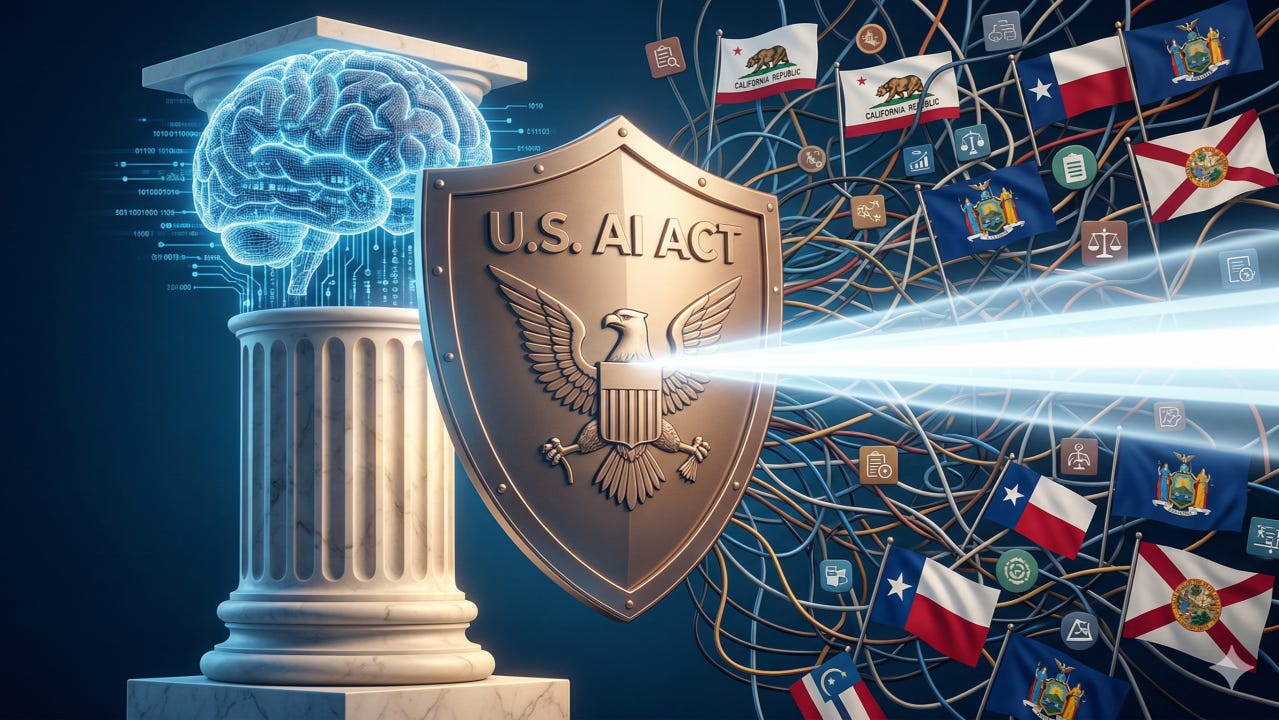
This is the closest the United States has come to an EU style comprehensive AI law, but built around liability, enforcement, and risk allocation rather than a Brussels style licensing bureaucracy. A discussion draft attributed to Senator Marsha Blackburn and aligned with policy proposals described by the Trump Administration as a “National Policy Framework for Artificial Intelligence” would shift the center of gravity for AI from speech based immunity toward a hybrid negligence and statutory liability framework, with strict child protections and aggressive IP and provenance rules. As of publication, this “TRUMP AMERICA AI Act” remains a discussion draft only; it has not been formally introduced, assigned a bill number, or advanced through committee.
The draft moves toward treating many AI systems as a high risk product category inside a broader negligence and statutory liability regime. That choice will influence how models are designed, documented, insured, and contracted for years, even if the final statute looks different.
The discussion draft is framed as a legislative vehicle aligned with the Trump Administration’s National AI policy materials and the White House’s March 2026 National AI Legislative Framework, both of which emphasize federal preemption of conflicting AI specific state rules, national security, child safety, and limiting “unnecessary” burdens on U.S. innovation.
The act spans 17 titles: AI chatbot duties of care, AI job impact reporting, a two year “Sunset Section 230 Act,” Kids Online Safety and GUARD Act, a compute triggered advanced AI risk regime, explicit developer and deployer liability, foreign AI registration, bias audits, NIST standards and NAIRR, NO FAKES rights, TRAIN Act discovery powers, content provenance mandates, AI copyright and training rules, federal procurement rules for “unbiased” AI, and preemption plus severability.
The White House’s National AI Framework explicitly calls for a national policy that preempts conflicting AI specific state laws (especially in content labeling and child safety) while preserving generally applicable state consumer protection and tort regimes, and Senator Blackburn’s discussion draft is the leading Senate aligned implementation of that approach.
States such as California, Colorado, Illinois, New York, and Texas have already moved into AI relevant domains with laws on automated decision tools, biometric privacy, deepfakes, and algorithmic discrimination, creating a growing patchwork across employment, housing, credit, and online content. For AI providers, that means building and maintaining state specific compliance overlays on top of sectoral federal rules and general consumer protection law.
Outside the U.S., the EU Artificial Intelligence Act tiers obligations by use case risk, imposing ex ante conformity requirements and documentation for “high risk” systems, while China’s generative AI rules rely on licensing, security review, and content controls. Unlike the EU’s risk tiering, the Blackburn draft uses downstream liability, duties of care, and compute thresholds as its primary tools. For global players, that means navigating a licensing regime in the EU, a liability heavy regime in the U.S., and content/security regimes in China.
The Supremacy Clause and Commerce Clause give Congress the authority to displace conflicting state AI laws when AI services and cloud infrastructure are inherently interstate. Courts recognize express and implied preemption in decisions like Gibbons v. Ogden and English v. General Electric Co., but they are cautious about reading preemption broadly in areas tied to traditional state police powers such as health, safety, and consumer protection.
The Trump AI executive order framework, as described in public analyses, directs DOJ to stand up an AI Litigation Task Force to challenge state AI laws that obstruct interstate AI activity, and it tells Commerce and NIST to lead on national standards. The White House’s National AI Legislative Framework recommends express preemption of AI specific content and child safety rules that conflict with federal standards, with carveouts for generally applicable state law.
Title XVII of the Blackburn draft follows that script. Section 1701 says the act does not preempt generally applicable state laws or sectoral regimes that may incidentally apply to AI, but the structure of Titles I, III, VI, VII, XIV, and XV signals clear intent to occupy AI specific ground. Courts will have to decide how far that occupation goes. States will argue their AI laws are ordinary consumer protection; DOJ and industry will argue they are conflicting technology regulations. That federal–state tug of war is a feature of this framework, not a bug.
Title I creates “Minimum Safeguards Regarding Duty of Care for Artificial Intelligence Chatbot Developers.”
Scope: AI chatbots are defined as interactive services or software that produce new expressive content, accept open ended natural language or multimodal inputs, and respond adaptively across topics, excluding narrow, context limited tools.
Duty of care: Developers must “exercise reasonable care in the design, development, and operation” of chatbots to prevent and mitigate harms where harms were reasonably foreseeable and the chatbot’s design, development, or operation contributed to those harms.
The FTC must issue rules specifying “minimum reasonable safeguards” and may treat violations as unfair or deceptive acts or practices under Section 5 of the FTC Act, with its usual injunctive and remedial powers. State attorneys general can bring actions in state or federal court as parens patriae, with notice and intervention rights for the FTC.
This effectively nationalizes a negligence style duty of care for conversational AI and gives two sets of enforcers real tools. The institutional question is whether the FTC can realistically supervise and enforce chatbot safeguards across a fast moving ecosystem. That capacity gap is likely to be a recurring theme in Administrative Procedure Act challenges alleging arbitrary or capricious rulemaking or enforcement.
Title II imposes quarterly AI job effects reporting duties on large employers and agencies.
Who reports: Publicly traded companies, federal agencies, and non public companies designated by regulation based on workforce size, enterprise value, or employment impact.
What is reported: AI related layoffs and contract non renewals, AI driven hires, positions left unfilled due to AI, retraining efforts, and other AI related job effects, with NAICS classification.
The Department of Labor can integrate this into existing surveys, must publish quarterly summary reports and periodic net impact analyses, and must share the data and analysis with Congress and the President. Noncompliance carries civil penalties up to 1 million dollars per violation and allows civil actions seeking penalties and injunctive relief, with fee shifting for prevailing plaintiffs.
The enforcement teeth matter. This is not just a survey; it is a statutory reporting obligation that will feed into labor policy debates and also be a target for discovery in employment and discrimination cases tied to AI decisions.
Title III repeals Section 230 (47 U.S.C. § 230) two years after enactment and updates cross references in other laws.
Today, Section 230(c)(1) prevents providers and users of an “interactive computer service” from being treated as the publisher or speaker of content provided by another, and Section 230(c)(2) protects good faith moderation. Courts have used these provisions to dismiss a wide range of claims against platforms and some AI related services where user inputs and outputs are intertwined.
The draft removes Section 230 entirely after a two year “glide path” and does not replace it with a general immunity. Platforms and AI providers would instead rely on underlying tort and statutory doctrines, First Amendment protections, and any specific safe harbors, while operating under new duties of care and AI specific liability provisions. Historically, broad repeal efforts have failed because of fears of over-deterrence and its impact on smaller services.
Even without Section 230, courts can and likely will adjust doctrines to avoid strict liability for intermediaries; for example by narrowing what counts as “publication,” tightening proximate cause in algorithmic amplification cases, or limiting duties owed under negligence. But that adaptation will be case by case and messy, not the bright-line immunity we have now.
Title IV incorporates an enhanced Kids Online Safety Act (KOSA), and Title V adds the GUARD Act focusing on AI companions.
Kids Online Safety
“Covered platforms” (platforms, games, messaging apps, and streaming services likely to be used by minors) must:
Exercise reasonable care in design features to prevent and mitigate reasonably foreseeable harms to minors, including self harm, disordered eating, compulsive usage, severe harassment, sexual exploitation, and exposure to illegal drugs and gambling.
Provide minors and parents with tools and default settings to limit contacts, restrict personal data visibility, control or disable engagement optimizing features such as infinite scroll and autoplay, and opt out of personalized recommendation systems in favor of chronological feeds.
Offer accessible reporting mechanisms for harms with defined response timelines and undergo independent audits and transparency reporting, especially for larger platforms.
Market research on children and minors is restricted without verifiable parental consent, and the FTC and state AGs can enforce violations.
GUARD Act
Title V targets AI companions and prohibits certain uses with minors, including sexualized content and grooming, and creates offenses related to using AI companions to facilitate sex trafficking or child sexual abuse material. Covered entities must implement age gating, content controls, and reporting protocols, with federal and state enforcement.
For practitioners, these titles set up parallel liability tracks: statutory duties of care layered on top of common law negligence, with causation disputes about what design choices and algorithms actually caused a given minor’s harm. Proximate cause in multi actor chains (developer, deployer, user, and perhaps third party add-ons) will be one of the hardest issues in these cases.
Title VI defines a regime for “advanced artificial intelligence systems,” and Title VII sets liability rules for those systems.
Advanced AI thresholds
“Advanced AI” is initially defined via a compute threshold of 10^26 operations, with authority for the Secretary to propose a new definition that must be approved by joint resolution of Congress.
“Adverse AI incidents” include loss of control, weaponization by foreign adversaries or terrorist organizations, severe threats to critical infrastructure, major civil liberties or competition harms, and “scheming behavior.”
Developers of advanced AI must participate in an “Advanced Artificial Intelligence Evaluation Program” involving testing, red teaming, and incident reporting, with penalties for noncompliance. That threshold captures current frontier scale models, but rapid advances in efficiency and smaller models could make raw compute an increasingly blunt proxy. It may also leave certain powerful “small” models outside the stricter regime.
Hybrid product liability
Title VII:
Imposes liability on advanced AI developers when products are defective or unreasonably dangerous and cause harm, borrowing from products liability but with statutory contours.
Extends liability to deployers who fine tune, integrate, or configure these systems in harmful ways, with a “special rule for deployers” clarifying their exposure.
Restricts unenforceable “unconscionable” liability waivers in contracts where there is a significant power imbalance, keeping some risk from being pushed entirely onto end users.
Creates a federal cause of action and statute of limitations, while preempting conflicting AI specific liability regimes but not general state tort law.
This is not pure strict product liability; it is a hybrid of negligence concepts and statutory liability. There will be parallel tracks: plaintiffs can sue in federal court under the new cause of action and in some instances may also proceed under state tort law where not preempted. Courts will have to sort out how the federal cause of action interacts with state negligence, failure to warn, and design defect claims.
Subtitle D’s foreign developer registration requirement forces foreign advanced AI developers serving the U.S. to register as foreign agents, with a public registry and penalties. Expect challenges under due process (minimum contacts), Foreign Commerce Clause limits, and extraterritoriality principles, especially for developers with limited U.S. presence or conflicting obligations under foreign law.
Title VIII mandates bias audits and ethics training, and Title XVI sets “unbiased AI” principles for federal procurement.
Title VIII requires covered entities to conduct periodic audits for bias and provide ethics training, aiming to mitigate discrimination on protected characteristics and political affiliation.
Title XVI defines “unbiased artificial intelligence principles” that include truthfulness, scientific objectivity, acknowledgment of uncertainty, and ideological neutrality on contested policy issues, with skepticism toward certain DEI frameworks, and limits agency procurement to LLMs that conform to those principles.
OMB must issue guidance within 120 days on how vendors can demonstrate compliance through documentation of prompts, safety specifications, testing, and alignment techniques. These are so called “ideological neutrality” provisions, often described politically as “no woke AI,” and they will be flashpoints in both First Amendment and administrative law litigation.
The key legal questions will be whether such standards amount to viewpoint discrimination when imposed on private vendors seeking government contracts, and whether agencies have sufficient clear statutory authority to define and enforce “neutrality” in contentious areas under the major questions doctrine articulated in West Virginia v. EPA. At the same time, companies with robust global DEI commitments will face a compliance collision between these federal procurement rules and EU or state level social governance expectations.
Titles IX–XI are the “carrot” side of the regime.
Title IX instructs NIST to create a Center for AI Standards and Innovation, coordinate AI testbeds with DOE and other agencies, develop metrics, and lead international standardization efforts.
Title X codifies the National AI Research Resource (NAIRR), giving researchers, smaller firms, and educational institutions access to shared compute and datasets under a governed regime with privacy and security protections.
Title XI focuses on “Ratepayer Protection,” urging that AI data center buildouts not lead to unjust rate increases for ordinary utility customers.
These provisions reduce technical barriers for smaller players but also centralize evaluative and standards power at NIST and NAIRR. They will generate their own Administrative Procedure Act litigation around NIST’s and NAIRR’s rulemakings and prioritization decisions, including arbitrary and capricious challenges from parties who feel disadvantaged by how standards and access are allocated.
NO FAKES (Title XII)
Title XII federalizes voice and likeness rights, granting individuals a property right in their voice and visual likeness to combat unauthorized digital replicas, including AI generated deepfakes. It provides exceptions for news, commentary, parody, and certain expressive uses and offers civil remedies.
TRAIN Act (Title XIII)
The TRAIN Act authorizes subpoenas for records relating to AI models, such as training data logs, documentation, and other technical materials in AI related litigation. That will be a discovery goldmine for plaintiffs and a trade secret and privacy challenge for developers. Courts will need to develop technical case management tools and protective orders to prevent TRAIN Act discovery from overwhelming them and to manage access to model internals.
Content provenance (Title XIV)
Title XIV directs NIST to support standards for content provenance and synthetic content detection and requires certain providers to attach or preserve provenance metadata, implement detection mechanisms, and avoid tampering with provenance data.
These requirements underpin AI labeling and authenticity efforts but currently outpace what is robust against adversaries. Watermarking and provenance signals are easy to strip or spoof in many pipelines. There will also be compelled speech questions if courts view provenance metadata as expressive and subject to scrutiny under Miami Herald v. Tornillo and platform speech theories in the NetChoice line of cases. Arbitrary or inconsistent NIST or FTC rules in this area will be prime targets for APA challenges.
Fair use and training (Title XV)
Title XV takes a strong stance on copyright and AI.
Section 1501 purports to exclude AI training on copyrighted works from fair use under 17 U.S.C. § 107, redefining the statutory scope of fair use in the AI training context.
Section 1502 establishes liability for AI generated outputs that constitute unauthorized derivative works substantially incorporating protected expression.
Congress can redefine the statutory contours of fair use, but courts may still police constitutional limits and retroactivity, particularly where due process or speech concerns are raised. This redefinition will collide with fair use case law such as Campbell v. Acuff-Rose Music, Inc., and with ongoing class actions around training data.
The retroactivity issue is critical. If a model was trained in 2023–2024 on unlicensed copyrighted data under an arguable fair use theory, it is unclear whether the statute will be read to penalize that past training, only future training, or primarily outputs going forward. That question will drive early litigation strategy.
Title XVI governs federal agency adoption of AI and LLMs under the “unbiased AI” principles, while Title XVII addresses preemption, severability, and effective dates.
Section 1703 sets a general effective date 180 days after enactment, with specific longer timelines, including the two year delay for Section 230 repeal. Realistically, legislation this complex would move over multiple sessions, and agencies would then need additional time for rulemaking. That gives companies a window to prepare architectures, documentation, and contracts before enforcement ramps up.
Several provisions are almost guaranteed to see early challenge:
Section 230 sunset: Challenges will test how far Congress can change the liability baseline without violating the First Amendment, with arguments framed around Miami Herald and NetChoice rulings on platform editorial discretion and state interference.
Fair use redefinition and retroactivity: AI developers and rightsholders will clash over whether Congress’s redefinition of fair use can be applied to past training and how it interacts with 17 U.S.C. § 107 and judicial fair use precedent.
Unbiased AI procurement: Vendors and advocacy groups will press First Amendment, major questions, and APA challenges to OMB and agency guidance implementing “ideological neutrality,” arguing that vague neutrality standards invite arbitrary enforcement.
Foreign AI registration: Foreign developers will challenge registration duties on due process, Foreign Commerce Clause, and extraterritoriality grounds, particularly where they have limited U.S. contacts.
Kids’ duties and chatbot care: First wave cases will test what “reasonable care” looks like in practice and how courts handle proximate cause where harms are mediated through multi actor AI systems whose behavior is emergent rather than scripted.
APA challenges will also be prominent whenever FTC, NIST, or other agencies issue broad rules or guidance under these titles, especially where the rules are seen as going beyond clear statutory text or failing to account for technical realities.
The move from broad immunity toward liability and reporting will rewire insurance and contracting.
Insurance carriers: Likely early winners. They will price new AI specific liability coverage, adjust cyber and E&O products, and insist on documented model governance, incident tracking, and training data controls as underwriting conditions.
Contracting: Enterprise SaaS and cloud contracts will see more detailed AI representations, warranties, and indemnities, with customers pushing risk upstream to developers and platform providers and developers invoking Title VII’s unconscionability limits to resist unlimited exposure.
Developer vs deployer: The split liability structure in Title VII will push parties to clarify roles in integration agreements, allocate who is responsible for safety tuning, and embed flow down obligations for downstream customers.
Open source models face asymmetric exposure: they may be used and redistributed widely without the resources to absorb or insure against new statutory risks, especially where attribution of responsibility between upstream model authors and downstream deployers is muddled.
Even as a discussion draft, this framework is a clear signal of regulatory direction. If you prioritize nothing else, focus on training data provenance and AI incident tracking—those are the two areas most likely to generate early liability and discovery pressure.
Audit training data provenance: Catalog what your models were trained on, where you have licenses, where you rely on arguable fair use or public domain, and where sensitive or personal data appears. This drives both copyright and NO FAKES exposure.
Rework terms and contracts: Assume unconscionability limits and increased scrutiny of blanket waivers. Update TOS, enterprise agreements, and DPAs to realistically allocate AI risks in light of Title I and VII, and build in cooperation and documentation obligations.
Implement AI incident tracking: Create processes and tooling to log and triage harmful outputs and adverse AI incidents, including user reports and internal red team results, so you can meet future reporting expectations and argue you exercised reasonable care.
Stress test child safety exposure: Map where minors are using your products, assess engagement features, and prototype KOSA compliant controls and reporting, even in advance of any federal mandate.
Prepare for TRAIN Act style discovery: Begin organizing model documentation, training data categorizations, and evaluation protocols so that, when subpoenas come, you can respond without exposing core trade secrets or violating privacy obligations.
Large platforms and model developers will face higher liability and compliance costs, but also benefit from barriers to entry and influence over NIST and NAIRR standard setting. Insurance carriers and risk consultants will see increased demand. Open source projects and smaller AI startups face the hardest balance: they gain potential access to NAIRR and federal standards but risk being squeezed by legal exposure and discovery burdens that they are least able to manage. Creators and rightsholders gain leverage across NO FAKES, provenance, and redefined fair use rules.
If even half of this discussion draft becomes law, AI in the U.S. will move from a speech oriented, immunity heavy environment to one where AI is treated as a regulated, high consequence product category that must be designed, documented, insured, and litigated accordingly. The question for your board is not just whether you are ready for the act—it is whether your insurance program, contracts, and training data logs are ready for the first subpoena.
This article is published by JJTP Law PLLC as a general-interest news and information service for clients and friends of the firm. Nothing in it is legal advice, and reading it does not create an attorney-client relationship. If you have a question about how this topic applies to your own situation, please reach out to the attorney you normally work with, or schedule a consultation. This is not a solicitation for legal work in any jurisdiction where JJTP Law is not authorized to practice. See our Attorney Advertising & Terms of Use.