27 August 2026
Insights
New York City has announced the policy The harder legal question is what appropriations, contracts,...

New York City’s municipal grocery initiative may properly face scrutiny over public money, public...
Regulatory change can make a product less commercially secure without making it unlawful to own or...

SaaS Style Gaming and the Legal Erosion of...
New York City has announced the policy The harder legal question is what appropriations, contracts,...
New York City’s municipal grocery initiative may properly face scrutiny over public money, public...
Regulatory change can make a product less commercially secure without making it unlawful to own or...
SaaS Style Gaming and the Legal Erosion of...
June 7, 2026
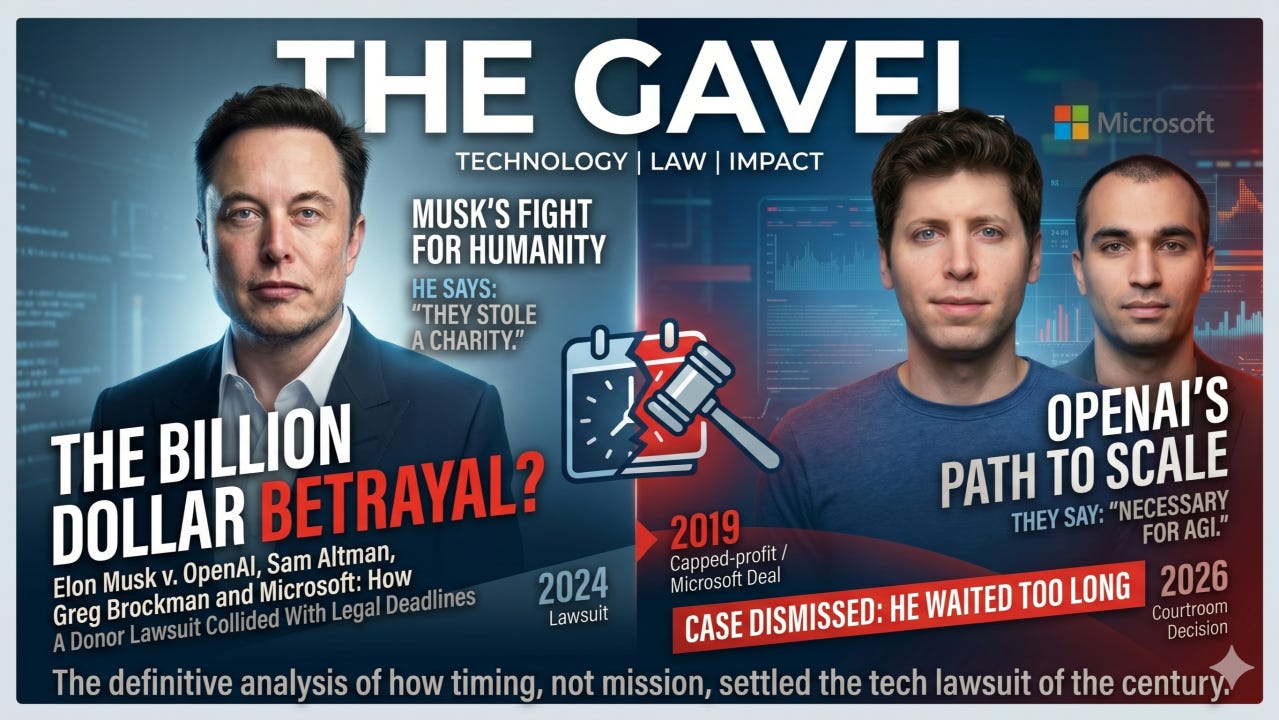
The courtroom fight between Elon Musk and OpenAI ended not with a sweeping ruling on the future of artificial intelligence, but with a blunt message about timing. On May 18, 2026, in federal court in Oakland, an advisory jury found that Musk had simply waited too long to challenge what he now describes as a betrayal of OpenAI’s original mission, and Judge Yvonne Gonzalez Rogers agreed. The decision leaves OpenAI and its partners free to press ahead with widely discussed ambitions to tap public markets and forces a harder look at how much legal bite “for humanity” promises really have once an AI lab grows into a global business.
In 2024, Musk sued OpenAI, CEO Sam Altman, President Greg Brockman and Microsoft in the Northern District of California, claiming they had diverted what he characterized as a nonprofit AI project for humanity into a commercial vehicle, effectively “stealing a charity” he helped create.
He alleged an original understanding that OpenAI would remain a nonprofit focused on safe, broadly shared AI and argued that the 2019 capped‑profit structure and deep Microsoft partnership violated that understanding.
Musk sought roughly 134 to 150 billion dollars in relief and aggressive structural remedies and said any monetary recovery would be routed back to OpenAI’s nonprofit parent.
After an 11‑day trial spread over about three weeks, an advisory jury empaneled to resolve key factual questions unanimously found that Musk’s claims were barred by California’s limitations periods because he knew or should have known about OpenAI’s restructuring and the Microsoft deal years before he sued in 2024.
Judge Gonzalez Rogers accepted the advisory verdict on the timeline, held that the claims were out of time, and dismissed the case against all defendants without moving to any phase that would consider remedies.
Musk has publicly condemned the outcome as a “technicality,” insisted that no court has yet ruled on whether OpenAI abandoned its founding ideals, and vowed to appeal to the Ninth Circuit.
By the time of trial, Musk was not just a former donor and founder; he was also running xAI, a direct competitor to OpenAI, a fact the defense used to cast the lawsuit as entangled with commercial rivalry.
OpenAI launched in 2015 as a nonprofit research lab, with Musk as a prominent co‑founder and early funder and Altman and Brockman in key leadership roles. Public materials described a mission to develop artificial general intelligence in a way that benefits humanity as a whole, with an emphasis on safety and openness, and those themes shaped Musk’s later account of what he believed he was supporting.
As model training costs soared, OpenAI’s leadership concluded that philanthropy alone could not fund frontier‑scale systems. In 2019 the organization created a capped‑profit subsidiary and struck a multibillion‑dollar strategic partnership with Microsoft, which supplied cloud infrastructure and integrated OpenAI models into products ranging from Azure to Office. At the same time OpenAI became more guarded about its most advanced models, moving from open code releases toward commercial APIs and enterprise licensing built around systems like GPT‑4 and ChatGPT.
Musk publicly objected to this evolution, portraying it as a betrayal of the original nonprofit, open‑research vision and later characterizing the shift as taking a charity built on his money and reputation and converting it to private gain. OpenAI and Microsoft, for their part, framed the same moves as necessary to raise capital and compute at scale, while maintaining that the nonprofit parent retained ultimate control and that the partnership terms did not hand Microsoft outright ownership of OpenAI’s mission.
By the time he filed suit, Musk had launched xAI, which is developing its own large‑scale models and competing directly with OpenAI in both technology and talent. That context mattered in the courtroom because it allowed the defense to argue that the case was not only about charitable ideals, but also about business leverage in a crowded AI market.
Musk’s complaint drew on several overlapping theories. He alleged an enforceable founding agreement that OpenAI would remain a nonprofit organization focused on public benefit rather than shareholder profit and argued that the creation of a capped‑profit entity and the Microsoft tie‑up breached that agreement. He pointed to early communications and charter language as evidence of this understanding, while OpenAI maintained that those materials were mission statements and governance documents, not detailed contracts prohibiting later structural changes.
He also advanced a charitable‑trust theory. In broad terms, he claimed that his contributions and OpenAI’s initial structure created a trust to pursue safe, widely shared AI and that transferring value and control into a commercial arm serving specific commercial partners violated that trust. That argument ran into a familiar problem: in most jurisdictions, including California, charitable enforcement is primarily the job of the state attorney general or similar regulators, and courts are wary of giving individual donors or founders standing to supervise charitable missions indefinitely because that can fragment governance and expose nonprofits to constant litigation risk.
Alongside those theories, Musk alleged unjust enrichment and what he described as knowing participation by Microsoft in breaches of OpenAI’s charitable and fiduciary obligations. In his telling, OpenAI, its leaders and Microsoft had all benefited from a structure built on his early money, data and brand, yet they steered that structure away from the public‑benefit commitments that induced his support. OpenAI and Microsoft countered that his contributions were treated and understood as donations, not investments, and that they had not promised him ongoing control or a veto over later governance decisions.
The remedies Musk asked for underscored how ambitious the case was. Reporting from the trial put the damages range between roughly 134 and 150 billion dollars and described requests for governance changes that could have removed Altman and altered the relationship with Microsoft. In practice, courts are extremely reluctant to unwind mature corporate structures that involve third‑party investors, major contracts and market reliance, which meant Musk was asking the court to go very far if he could get past the procedural hurdles.
OpenAI and Microsoft did not concede that any charity had been taken. They argued that OpenAI’s evolution was driven by the economics of modern AI, not by a bait‑and‑switch on donors, and that key elements of the restructuring and partnership had been announced publicly as they occurred. They pointed to press releases and blog posts from 2019 onward that described the capped‑profit model and the Microsoft investment, and they highlighted Musk’s own public criticism of those moves as evidence that he was fully aware of what was happening at the time.
A major line of defense involved motive and history. OpenAI has long maintained that in 2018 Musk floated proposals to consolidate control of OpenAI under himself or to fold it more closely into Tesla, pushing for a more commercially aggressive direction before leaving when the board resisted. That history, coupled with his launch of xAI, allowed the defense to portray Musk not only as a disappointed philanthropist but also as a spurned insider and current competitor who later criticized moves similar to the ones he had once backed.
On the legal side, the defense emphasized the distinction between aspirational mission language and enforceable contractual commitments. In their view, statements about benefiting humanity and maintaining openness helped define OpenAI’s philosophy but did not bar its board from adopting a hybrid structure or entering deep commercial partnerships if that was the judgment of its fiduciaries. They also argued that whatever charitable obligations existed under California law were overseen by the attorney general, not by private suits seeking to re‑engineer a complex AI company years after the fact.
The most consequential step in the case was the decision to focus on timing. Under California law, many contract‑based and unjust‑enrichment claims are subject to limitations periods in the three‑year range, sometimes four, depending on exactly when a claim accrues. OpenAI and Microsoft argued that any injury Musk suffered was apparent by 2019, when the capped‑profit structure was announced and the Microsoft deal was made public, and they pointed to his own statements from that period as evidence that he understood the new direction.
Because Musk’s core theories sought equitable relief, including charitable‑trust‑type remedies and structural changes, Judge Gonzalez Rogers empaneled an advisory jury to address specific factual questions, including when he knew or reasonably should have known enough to bring his claims. Musk’s lawyers argued that he did not grasp the full scope of what he calls a bait‑and‑switch until 2022, when internal and media reporting shed more light on the scale of Microsoft’s commercial stake and the long‑term control dynamics.
After hearing evidence over 11 trial days, the advisory jury unanimously concluded that Musk was outside the relevant limitations periods by the time he filed in 2024. Judge Gonzalez Rogers reviewed that finding, stated that there was ample support in the record, and dismissed the claims against all defendants on that basis, which also meant Microsoft could not be liable for participating in breaches the court would not reach on the merits. Whether OpenAI legally broke any founding commitments therefore remains an open question; what the court decided is that Musk waited too long to ask.
Musk has reacted by calling the outcome a “calendar” decision and promising to appeal to the U.S. Court of Appeals for the Ninth Circuit. An appeal in this posture will almost certainly concentrate on limitations issues: whether the wrong limitations periods were applied to particular claims, whether the clock should have started later in light of what Musk says he learned in 2022, and whether doctrines such as delayed discovery or concealment should have tolled the deadlines.
Those are legally recognized arguments, but they face a familiar headwind. Appellate courts give substantial deference to factual determinations, even from advisory juries that the trial judge has chosen to adopt, particularly on questions like what a plaintiff knew and when. Without a clear legal error in how the jury was instructed or how the court classified the claims for limitations purposes, persuading the Ninth Circuit to reopen the case will be difficult.
For now, the judgment leaves OpenAI’s hybrid structure and its Microsoft partnership intact and removes a large potential obstacle as the company explores future capital‑market options that many observers expect will include some form of public offering. For AI governance, the pressing issue is whether law can credibly lock powerful systems into “for humanity” commitments once those systems require immense capital, infrastructure and commercial partnerships to exist at all.
Whether OpenAI abandoned its founding ideals remains unresolved. The court concluded only that Musk waited too long to litigate the question.
Musk framed the case as a betrayal of OpenAI’s original nonprofit mission and described the restructuring as “stealing a charity,” but the court never ruled on that claim; it dismissed his lawsuit on statute‑of‑limitations grounds.
His theories relied on an alleged founding agreement, charitable‑trust concepts and unjust enrichment, yet they collided with standing rules that reserve most charitable enforcement authority to regulators like the California attorney general, not to individual donors or founders.
OpenAI and Microsoft made effective use of the public record from 2019 onward to show that the restructuring and partnership were openly announced and that Musk criticized them at the time, undermining his claim that he discovered the alleged breach only years later.
The advisory jury’s unanimous finding that Musk sued too late, combined with Judge Gonzalez Rogers’s adoption of that finding, will be difficult to overturn on appeal because appellate courts rarely disturb a trial court’s supported conclusions about what a plaintiff knew and when.
For founders, donors and AI labs, the case underscores that if they want “for humanity” language to have real legal force against later commercialization, those commitments must be written into binding governance and funding terms, and any challenge to a perceived change in course must be brought before legal deadlines silently close off the option of litigating it.
This article is published by JJTP Law PLLC as a general-interest news and information service for clients and friends of the firm. Nothing in it is legal advice, and reading it does not create an attorney-client relationship. If you have a question about how this topic applies to your own situation, please reach out to the attorney you normally work with, or schedule a consultation. This is not a solicitation for legal work in any jurisdiction where JJTP Law is not authorized to practice. See our Attorney Advertising & Terms of Use.