
27 August 2026
Insights

New York City has announced the policy The harder legal question is what appropriations, contracts,...

New York City’s municipal grocery initiative may properly face scrutiny over public money, public...

Regulatory change can make a product less commercially secure without making it unlawful to own or...

SaaS Style Gaming and the Legal Erosion of...
New York City has announced the policy The harder legal question is what appropriations, contracts,...
New York City’s municipal grocery initiative may properly face scrutiny over public money, public...
Regulatory change can make a product less commercially secure without making it unlawful to own or...
SaaS Style Gaming and the Legal Erosion of...
March 20, 2026
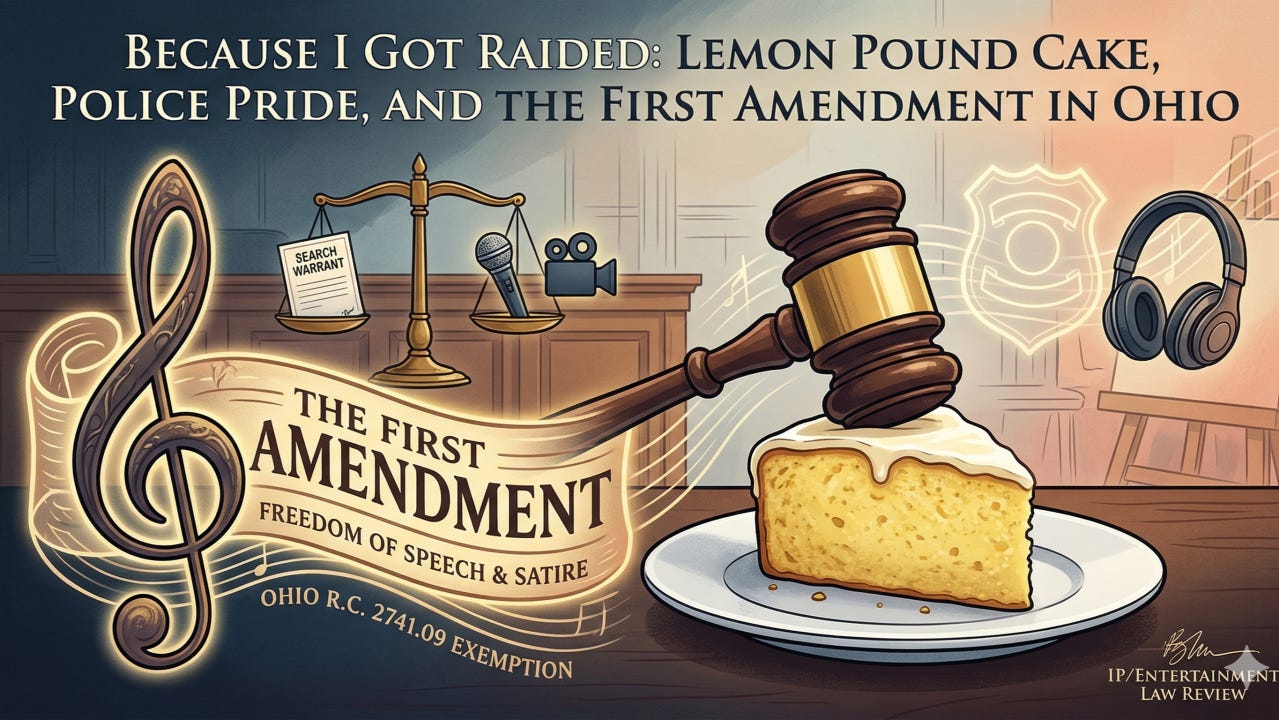
The Afroman “Lemon Pound Cake” case shows that in Ohio, using real police raid footage from your own home in a satirical, monetized music video is protected speech, while on duty officers face serious First Amendment hurdles when they try to reframe that criticism as right of publicity or defamation.
In 2022, Adams County deputies raided Joseph Foreman p/k/a “Afroman”’s home in Ohio for suspected drugs and kidnapping; no drugs or kidnapping victims were found.
Foreman used his home security footage in songs and videos, including “Lemon Pound Cake,” adding lyrics and edits that mocked the raid and the officers, and posted them on YouTube, Instagram and music platforms.
Seven deputies sued in Ohio state court for misappropriation of likeness and right of publicity under R.C. 2741, defamation, false light, invasion of privacy and emotional distress, seeking about $3.9 million and takedown orders.
Public reporting indicates that the court dismissed the right of publicity claims as protected expressive use, and that a jury later returned a defense verdict for Foreman on the remaining defamation and privacy claims.
In 2025, Ohio enacted the Uniform Public Expression Protection Act, an anti SLAPP statute codified at R.C. 2307.661 et seq., adding early dismissal and fee shifting protections for speech on public issues.
The Adams County Sheriff’s Office came through Joseph Foreman p/k/a “Afroman”’s gate with long guns, a battering ram and a warrant. They left with no drugs, no kidnapping victim and a future in which the most replayed image of their work was an officer pausing in front of a lemon pound cake on his kitchen counter.
Foreman did not respond with a press conference. He responded with songs. He took his own surveillance footage, set it to music, layered in sarcastic captions and invited the internet to laugh at what happened inside his house. The deputies then tried to recast that criticism as theft of their personas and lies about their integrity. A judge and a jury treated it as what it looked like: expressive, opinionated commentary about a real police raid on a public figure’s home.
Ohio’s right of publicity statute in Chapter 2741 gives individuals a property right in their “persona.”
“Persona” includes a person’s name, voice, signature, photograph, image or likeness.
R.C. 2741.02 bars using someone’s persona for a “commercial purpose” without written consent, including in advertising, on products or to promote goods or services.
R.C. 2741.06 and 2741.07 allow recovery of actual damages and attributable profits or statutory damages between $2,500 and $10,000 per violation, plus possible punitive damages and attorney’s fees.
The deputies argued that featuring their faces in monetized videos and on merch turned them into unwilling brand assets.
“Commercial purpose” in this statute is narrower than “anything that makes money.” Courts look at whether the use is primarily expressive or primarily an endorsement or sales pitch, and they apply a First Amendment lens to that distinction.
R.C. 2741.09 contains the key safety valves. It exempts uses of a persona in connection with news, public affairs, sports broadcasts and expressive works, and permits truthful identification of performers.
That is why a news station can show you in a crowd shot, why a documentary can include real officials and why a musician can incorporate footage of officers executing a real warrant into a song that criticizes how they did it.
Across jurisdictions, courts often talk about “transformative use” in these cases. The question is whether the work adds new expression, meaning or message, or whether it simply exploits someone’s identity.
Foreman’s videos did more than re upload raw clips. He added original music, lyrics and editing that turned a security feed into a critique of policing, race and the experience of a failed raid. Public reporting suggests the court saw that as expressive, transformative use tied to a matter of public concern, not as a product endorsement built on deputy headshots.
The deputies also pointed to merchandise that used raid imagery. Reporting indicates the merch was treated as incidental to the core expressive work rather than as a separate, standalone commercial exploitation of their likenesses, which kept it inside the protected zone created by R.C. 2741.09.
Ohio is one stop on a larger right of publicity map.
California protects name and likeness by statute and common law, but its courts have built a robust “transformative use” doctrine that shelters expressive works, including art and parody, when they add significant new expression.
New York historically focused on name and photo and has recently expanded to address digital replicas and deepfakes while retaining carve outs for news and expressive content.
Indiana has one of the broadest statutes, with long post mortem rights, but still runs into First Amendment limits when the use is artistic or news related.
Ohio’s combination of a clear commercial purpose requirement and explicit exemptions for news, public affairs and expressive works gives creators significant space to talk about public officials without tripping a publicity claim, especially when they are documenting an event like a police raid.
The deputies’ lawsuit was a shotgun approach. They tried to reframe the same set of videos as IP theft, factual falsehood and privacy invasion all at once.
They described the videos and posts as unauthorized commercial use of their likeness under R.C. 2741. They cast lyrics and captions about missing money and “crooked cops” as factual accusations of theft and misconduct. They labeled the edits and jokes as highly offensive, misleading portrayals that exposed them to harassment and emotional harm.
They did not just want money. They wanted the court to force Foreman to erase or alter his work. That request for a takedown order is functionally a prior restraint on speech about a public raid, which sits in one of the most suspect corners of First Amendment doctrine.
Defamation in Ohio requires a false statement of fact, publication, a defamatory meaning, fault and damages, unless the statement is defamatory per se.
Because these plaintiffs were on duty deputies executing a warrant, they are public officials. Under New York Times v. Sullivan and its progeny, including cases like Hustler Magazine v. Falwell, they had to prove actual malice: that Foreman knew his statements were false or acted with reckless disregard for the truth.
Three lines define this case.
Fact versus opinion. A flat statement that “Deputy X stole $400 from me” reads very differently than a verse about “crooked cops” over music. The first looks like a factual charge. The second often looks like opinion, insult or hyperbole.
Untrue versus unflattering. A fabricated allegation of theft can be actionable. Being portrayed in an unflattering, mocking way because of how you actually behaved on camera is generally not, especially when you are executing public duties.
Substantial truth. Even if minor details are off, there is no liability if the gist is true. Here, the gist that a heavily armed raid hit Foreman’s home, found none of the suspected crimes and looked bad on video is not disputed.
The record suggests the jury, after watching the videos and hearing testimony on the money dispute, concluded that Foreman’s content sat on the opinion, satire and substantial truth side of that line, not the fabricated fact side.
False light asks whether a person was presented to the public in a misleading way that would be highly offensive to a reasonable person.
One of the most charged moments in the trial reportedly involved a deputy who testified about a particular parody video that targeted her personally and described the impact on her. That is the sort of evidence plaintiffs hope will push a jury toward finding “highly offensive” portrayal.
The jury still declined to impose liability. That result mirrors the standard in Hustler Magazine v. Falwell, where the Supreme Court held that even deeply offensive parody of a public figure is protected absent false statements of fact made with actual malice. Public officials cannot convert hurt feelings about crude or vulgar caricature of their official conduct into a false light payday when the work is clearly parody and grounded in real events.
This was a defense friendly fact pattern. It is useful to mark where the law would cut the other way.
Fabricated footage or deepfakes would move this case. If Foreman had altered video or created synthetic clips that showed deputies doing things they never did, the “truthful recording of a real raid” foundation would vanish and both defamation and false light exposure would spike.
Concrete, knowingly false accusations would also change the analysis. A pattern of making specific, factual claims like “Deputy Smith stole exactly $400 from my safe” in the face of clear evidence that there was no shortage would look very different under the actual malice standard.
A pure merch campaign built around a deputy’s face with no broader commentary would move things closer to classic commercial use under R.C. 2741.02 and away from the expressive work carve out in 2741.09. An artist who only sells shirts with a cop’s face and no message is not in the same position as an artist who sells a song that happens to have shirts attached.
The lesson is that artists usually win when they build new expression on top of real events and signal when they are offering opinion, not when they fabricate facts or detach the persona from any expressive context.
The First Amendment constrains government action, not private moderation. It does not require platforms to host content, but it does sharply limit how government actors can use law to punish speech they do not like.
Here, the government’s agents came into court as civil plaintiffs asking for money and takedown orders over speech about their official conduct. Foreman used the First Amendment as a shield, arguing that defamation, false light and publicity law could not be applied in a way that penalizes truthful or opinion based commentary on a public issue.
The jury’s refusal to punish even the most personal parody fits comfortably within the line of cases protecting satire of public figures. Hustler v. Falwell made clear that offensive caricature based on real personalities is not enough, standing alone, to justify tort liability. This verdict applies that same instinct to local law enforcement caught on a home security camera.
Ohio’s adoption of the Uniform Public Expression Protection Act in 2025, codified at R.C. 2307.661 et seq., means defendants in speech cases now have a statutory mechanism to seek early dismissal of claims targeting speech on public issues and to recover fees if those claims fall short.
Because this case started before UPEPA, Foreman had to litigate through substantive motions and trial. If the same complaint were filed today, he could move at the outset for relief under R.C. 2307.662 and force a much earlier merits screening, with fee shifting on the table.
On the reputational side, the Streisand effect is hard to miss. The attempt to bury “Lemon Pound Cake” and similar videos produced national coverage, viral clips of trial testimony, and new commentary about the raid itself. The deputies’ own words on the stand became part of the story that people saw and shared.
For lawyers advising public officials, the hard question is not just “can we sue” but “what happens if we do.” Counsel has to weigh the legal merits under R.C. 2741 and defamation law, the procedural risks created by UPEPA’s early dismissal and fee shifting, and the near certainty that litigation will amplify the very speech the client finds intolerable.
For creators and brands, the case is a reminder that documenting government action on your own property and building expressive work on top of that documentation is one of the strongest shields you can have against misappropriation and defamation claims. When the government comes into your home with a warrant and your cameras are already rolling, Ohio law gives you significant room to turn that experience into art and criticism, even if the people in uniform do not like the cut.
This article is published by JJTP Law PLLC as a general-interest news and information service for clients and friends of the firm. Nothing in it is legal advice, and reading it does not create an attorney-client relationship. If you have a question about how this topic applies to your own situation, please reach out to the attorney you normally work with, or schedule a consultation. This is not a solicitation for legal work in any jurisdiction where JJTP Law is not authorized to practice. See our Attorney Advertising & Terms of Use.