27 August 2026
Insights


New York City has announced the policy The harder legal question is what appropriations, contracts,...
New York City’s municipal grocery initiative may properly face scrutiny over public money, public...

Regulatory change can make a product less commercially secure without making it unlawful to own or...

SaaS Style Gaming and the Legal Erosion of...
New York City has announced the policy The harder legal question is what appropriations, contracts,...
New York City’s municipal grocery initiative may properly face scrutiny over public money, public...
Regulatory change can make a product less commercially secure without making it unlawful to own or...
SaaS Style Gaming and the Legal Erosion of...
March 27, 2026
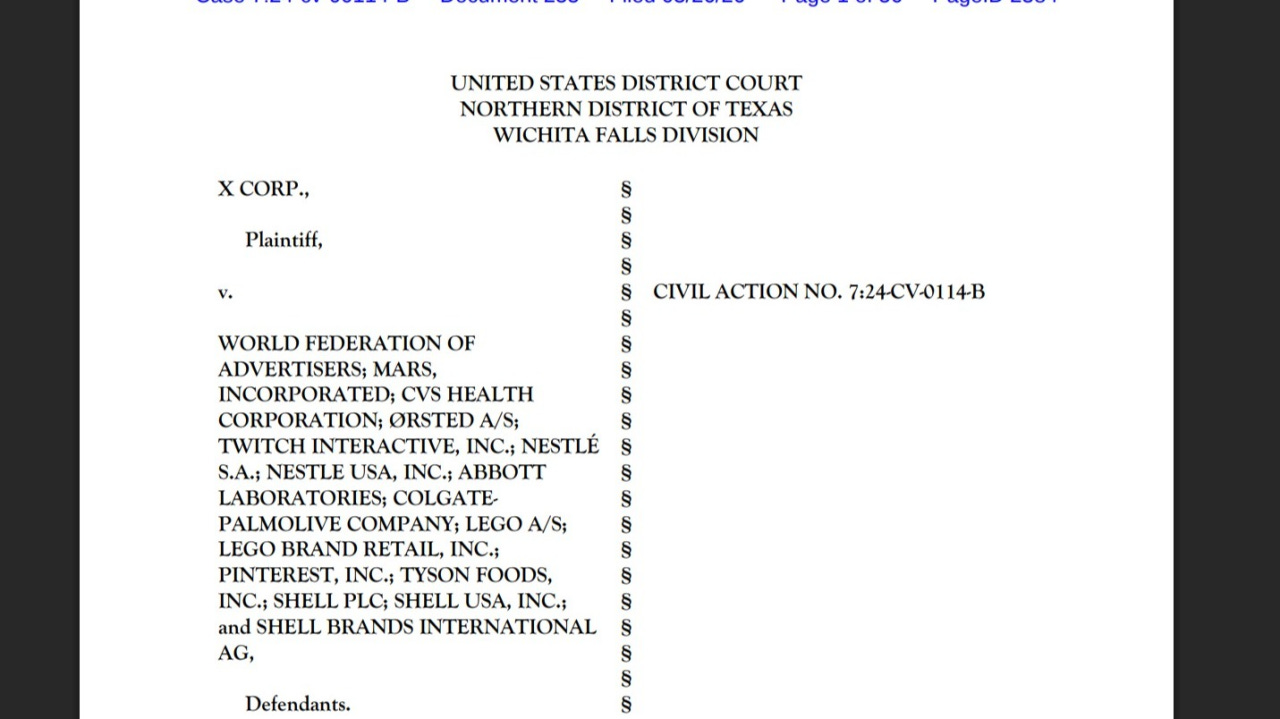
You cannot sue someone into liking you, and you cannot turn reputational harm into an antitrust injury. That is the blunt lesson from Judge Jane Boyle of the Northern District of Texas in X Corp v. World Federation of Advertisers, a case that tried to recast advertisers’ exit from X as an illegal boycott and instead produced a with‑prejudice dismissal that fits squarely within mainstream antitrust doctrine. For platforms, brands, and executives, the opinion is a reminder that antitrust law polices market structure, not reputational harm, and that free speech principles do not give any company a right to other people’s ad budgets.
X sued the World Federation of Advertisers and a group of blue‑chip brands, including Mars and CVS, alleging that they used the Global Alliance for Responsible Media to coordinate an advertiser boycott of X that supposedly cost the platform billions of dollars in ad revenue.
The lawsuit asserted two Sherman Act Section 1 group boycott claims, arguing that horizontal competitors in the advertising market entered a conspiracy, with X as the vertical counterparty being collectively refused.
Judge Boyle, in the Northern District of Texas, held that X failed to plead antitrust injury or a plausible restraint in any defined market and dismissed the case with prejudice, treating the defects as legal rather than factual.
The court emphasized that GARM’s brand‑safety standards were voluntary, that GARM did not buy or sell advertising inventory, and that advertisers remained free to make independent decisions, which undercut any theory of coercive trade association conduct.
The complaint also failed to plausibly allege that defendants possessed market power in any defined market, a key ingredient for transforming coordinated refusals to deal into antitrust violations rather than ordinary parallel conduct.
The opinion noted that X itself has said that nearly all of its top advertisers have since returned, a fact in the record that further undermines the notion of an ongoing boycott harming competition rather than a temporary reallocation of spend.
The dismissal with prejudice makes any appeal to the Fifth Circuit an uphill battle, because X would have to persuade a court that has not generally expanded antitrust liability absent clear market harm that its alleged facts amount to an antitrust problem rather than ordinary market dynamics.
The forum choice is part of the story. X filed in the Northern District of Texas, a jurisdiction often perceived as relatively friendly to business‑oriented or conservative plaintiffs, which makes the total dismissal especially telling about the strength of the claims. The factual backdrop will be familiar. After Elon Musk acquired Twitter, rebranded it as X, and changed content moderation and enforcement priorities, many major advertisers pulled or reduced campaigns, citing brand‑safety and toxicity concerns.
In 2024, X moved from public pressure to litigation. It sued the World Federation of Advertisers and various member brands, alleging that they used GARM to orchestrate a collective refusal to deal with X, despite X’s claim that its inventory and reach remained attractive on the merits. In X’s narrative, this was not independent business judgment. It was a coordinated strike to discipline a platform that departed from prevailing brand‑safety norms and political sensibilities.
Defendants responded with a Rule 12(b)(6) motion to dismiss. They argued that GARM was a voluntary standard‑setting initiative, that advertisers retained full discretion over placement and spend, and that the complaint failed on the core elements any serious antitrust case needs: agreement, market definition, antitrust injury, market power, and a cognizable restraint. Judge Boyle agreed and dismissed with prejudice.
On the federal side, X’s case rested on two Section 1 Sherman Act claims framed as group boycotts. The theory was that horizontal advertisers, acting through GARM as a hub, agreed to reduce or eliminate spending on X, leaving X as the vertical counterparty being collectively refused.
Specifically, X alleged:
A horizontal conspiracy among large competing advertisers, coordinated via GARM standards and communications, to reduce or stop buying ads on X.
A group boycott that allegedly cut X off from essential advertising revenue and undermined its ability to compete effectively for user attention and ad dollars.
Conduct that X tried to characterize as inconsistent with independent self‑interest, suggesting advertisers sacrificed profitable reach solely to punish X for its platform and speech choices.
X tied these allegations to its own internal metrics, claiming that the supposed boycott led to lost revenue, forced price reductions, and reduced capacity to invest in features and safety, which it argued would ultimately harm consumers and the competitive process in digital advertising. Publicly, X amplified this with rhetoric about “going to war” with advertisers and cast the exodus as an effort to coerce or censor its version of “free speech.”
The complaint thus attempted to translate what looked like reputational and commercial backlash into a coordinated antitrust conspiracy.
Judge Boyle evaluated the complaint through the lens of Bell Atlantic Corp. v. Twombly, which requires that antitrust plaintiffs plead facts that push claims from conceivable to plausible. In this context, courts look for “plus factors” that tend to exclude independent action, such as:
Coercion or threats among firms to enforce a boycott.
Binding commitments or sanctions within a group like GARM for those who deviate.
Actions that are difficult to explain as unilateral self‑interest.
The opinion concludes that X did not allege these plus factors in a plausible way. Parallel advertiser decisions in response to shared brand‑safety concerns, without more, are exactly the kind of conduct Twombly says cannot, by itself, support an inference of agreement.
On group boycotts, the court’s reasoning aligns with the shift from earlier per se treatment to rule‑of‑reason analysis reflected in cases like Northwest Wholesale Stationers v. Pacific Stationery. Today, alleged boycotts are typically examined under the rule of reason unless there is clear market power or coercive exclusion. Judge Boyle underscored that GARM did not control inventory, set prices, or enforce a binding refusal to deal, and that the complaint did not plausibly allege that defendants had market power in any defined market. That combination placed X’s claims firmly in rule‑of‑reason territory, where they came up short.
Market definition is where many antitrust cases quietly die, and this one was no exception. X referred broadly to digital advertising and competition for user engagement, but it never offered a coherent product and geographic market in which the alleged restraint operated. Courts sometimes assume a market arguendo at the pleading stage, but without a plausible market definition, most antitrust claims fail before discovery.
The problem is magnified by the nature of X as a two‑sided platform. Users sit on one side; advertisers on the other; and participation, pricing, and quality on each side affect the other. The opinion implicitly recognizes that in a world where advertisers can readily shift spend to rival platforms and users can move across platforms, coordinated advertiser exits from one service rarely translate into a genuine reduction of competition across the relevant market.
Equally important, the complaint did not plausibly allege core antitrust outcomes such as reduced output, higher prices, or degraded quality in any defined advertising market. X focused on its own revenue, pricing pressure, and investment decisions. Judge Boyle treated that as what it is: a story about firm‑specific harm, not about market‑wide effects. The ease with which advertisers reallocated budgets to other platforms, and later returned, undercuts any claim of foreclosure or durable distortion of competition.
Even stepping back, the remedy theory was thin. The complaint never clearly explained how a court order would improve competition rather than effectively forcing advertisers to buy from a platform they had chosen to leave or chilling legitimate brand‑safety coordination in a competitive market.
X’s theory turned GARM into the hub of the supposed conspiracy. Trade association law, however, distinguishes between standard‑setting and cartel behavior. Associations become antitrust problems when they facilitate binding commitments, coercive enforcement, or information exchange that is paired with sanctions in a way that constrains independent decision‑making.
Judge Boyle highlighted several points:
GARM did not itself buy or sell advertising or allocate ad spend.
Its standards were voluntary, and members remained free to deviate.
The complaint did not allege the kind of detailed, competitively sensitive information exchange coupled with enforcement that can transform coordination into conspiracy.
Some trade association matters implicate Noerr‑Pennington immunity when collective efforts are aimed at petitioning the government, but that was not the driving issue here. GARM functioned more as a private standard‑setting and information‑sharing forum. Within that framework, rule‑of‑reason analysis focuses on whether the standards and any related practices actually restrict competition. On the facts alleged, Judge Boyle concluded they did not.
For other trade groups, the message is not that there is no risk, but that the line is crossed when standards stop being aspirational and start being enforced with real teeth in markets where the association has significant power.
Judge Boyle described X’s complaint as sprawling but legally insufficient and dismissed it with prejudice, denying leave to amend. That signals a judgment that the flaws were structural, not curable with more detail. In the court’s view, even taken at face value, the alleged conduct did not fit the Sherman Act.
A dismissal with prejudice does not extinguish X’s right to appeal, and the next stop, if X chooses, is the Fifth Circuit. But it does frame the appeal as a challenge to the legal characterization of the allegations, not to the court’s treatment of facts. And the Fifth Circuit has not generally expanded antitrust liability absent clear market‑level harm, which means X will be asking an appellate court to broaden doctrine in a direction recent cases do not support.
This was not a close case under the prevailing standards. In a forum X selected, in a circuit often seen as plaintiff‑friendly for certain kinds of claims, the court still concluded that the complaint was beyond saving.
X framed the dispute as retaliation for its “free speech” stance, suggesting that advertisers were punishing it for refusing to police content to their liking. The law does not support that inference.
In Citizens United v. FEC, the Supreme Court confirmed that corporations have First Amendment rights to engage in political speech, including by spending money. That logic implies that spending can be expressive conduct. The corollary is that refusing to spend can also be expressive. When advertisers pull their budgets from a platform, they are expressing their own values, risk assessments, and views of what they want their brand associated with.
The First Amendment’s state action requirement does the rest. It restrains government actors, not private companies. There is no constitutional right to be funded by other private entities, and no First Amendment claim when advertisers independently decide that a particular platform no longer aligns with their interests. Government could not constitutionally force advertisers to return to X or penalize them for leaving. Within that constitutional space, what remains are private choices that may be harsh but are lawful.
This is not state censorship. It is the interplay of multiple private actors, each exercising their own speech and association rights in a competitive environment.
There is also a freedom‑of‑association angle. The Supreme Court has long recognized that forcing people or entities into expressive relationships they do not want can raise serious constitutional concerns when the state is involved. Here, the relationships at issue are advertising partnerships, and the decisions to leave were made by private firms without state compulsion.
From a business standpoint, this looks like a familiar pattern. Leadership decisions, platform policies, and public statements change the risk and brand calculus for counterparties. Those counterparties respond by staying, renegotiating, or walking. That feedback loop may be uncomfortable, but it is not a legal defect. It is a feature of a system that allows each player to choose its own associations.
You cannot tell your largest advertisers to “go f**k themselves” in a high‑profile interview and then ask a court to force them, directly or indirectly, to keep buying from you. That is not what the Sherman Act is for, and Judge Boyle’s opinion makes that clear.
Seen in this light, the lawsuit looks like strategic overreach, an effort to use antitrust labels to reframe reputational and commercial backlash as a legal wrong. The complaint “solved for optics” more than for competition, attempting to recast a loss of favor in the market as a coordinated antitrust injury.
The best counterargument for X is that in an era of coordinated ESG and brand‑safety initiatives, collective standards can function as soft power to discipline disfavored speakers or platforms, raising legitimate questions about when private coordination shades into private regulation of speech. Judge Boyle’s opinion shows why that argument did not succeed here: no plausible allegation of coercion by GARM, no market power, no meaningful foreclosure, and ready substitution to other platforms.
Meanwhile, X and related entities face separate regulatory and legal scrutiny in other areas, including reported concerns about AI tools like Grok and their handling of sensitive content, which present far more conventional regulatory risk than this antitrust suit ever did. Against that backdrop, the advertiser case looks less like a core defense of competition and more like an expensive sideshow.
Once stripped of rhetoric, the decision fits squarely within mainstream antitrust doctrine, but its implications extend beyond a single platform.
For brands and advertisers, the opinion reinforces that participating in trade groups and developing shared brand‑safety standards is not inherently unlawful when adoption is voluntary, enforcement is absent, and no one is wielding market power to close rivals out. The risk increases when standards become de facto mandates backed by sanctions or when the group collectively controls a critical share of a market.
For platforms, the case is a blunt reminder that antitrust law is not a backstop for reputational harm. Losing advertisers, even in large numbers, is not inherently an antitrust problem in a competitive market where those dollars can and do move to other channels and where users have alternatives.
For executives and counsel working on ESG, content policy, and brand safety, the opinion illustrates how courts are likely to treat future “boycott” claims. Allegations of conspiracy will be tested against concrete questions: Is there a defined market? Are there plus factors that exclude independent action? Is there market power? Is there actual injury to competition? And what, exactly, would a pro‑competitive remedy look like?
Antitrust injury requires harm to competition, not just harm to one firm. X alleged lost revenue, pricing pressure, and reduced investment, but did not plausibly allege reduced output, higher prices, degraded quality, or foreclosure in any defined advertising market.
In a two‑sided platform environment, advertisers reallocating spend to rivals, and later returning, looks like competition working, not being suppressed. The ease of substitution here undercut any theory of durable harm to the market as a whole.
Trade associations like GARM become antitrust risks when they facilitate binding commitments, coercive enforcement, or substantive information exchange tied to sanctions. Judge Boyle found none of that here, and also found no plausible allegation of market power.
Dismissal with prejudice on legal grounds does not bar X from appealing to the Fifth Circuit, but it signals that any appeal will have to change how courts think about these facts under the Sherman Act, in a circuit that has not generally expanded liability absent clear market harm.
The First Amendment and freedom of association protect advertisers’ right not to fund or associate with a platform whose conduct they find objectionable. There is no constitutional right to other people’s endorsement or money, even for large platforms owned by prominent figures.
This article is published by JJTP Law PLLC as a general-interest news and information service for clients and friends of the firm. Nothing in it is legal advice, and reading it does not create an attorney-client relationship. If you have a question about how this topic applies to your own situation, please reach out to the attorney you normally work with, or schedule a consultation. This is not a solicitation for legal work in any jurisdiction where JJTP Law is not authorized to practice. See our Attorney Advertising & Terms of Use.