27 August 2026
Insights

New York City has announced the policy The harder legal question is what appropriations, contracts,...
New York City’s municipal grocery initiative may properly face scrutiny over public money, public...

Regulatory change can make a product less commercially secure without making it unlawful to own or...

SaaS Style Gaming and the Legal Erosion of...
New York City has announced the policy The harder legal question is what appropriations, contracts,...
New York City’s municipal grocery initiative may properly face scrutiny over public money, public...
Regulatory change can make a product less commercially secure without making it unlawful to own or...
SaaS Style Gaming and the Legal Erosion of...
April 1, 2026
In the South Bay right now a croissant is not just a pastry. It is a piece of intellectual property being fought over in federal court, in a case that feels lighter than my usual topics only because the battlefield smells like butter instead of gunpowder. The fight between a neighborhood boulangerie and a social‑media‑driven startup looks like a bakery war online, but underneath the memes are real questions about weak marks, social‑media “vibes,” and how much it costs to protect a brand.
The case is Little French Bakery LLC v. The Little Cake LLC, et al., No. 2:26‑cv‑00839 (C.D. Cal. filed Jan. 27, 2026), assigned to Judge R. Gary Klausner. It is still at an early stage, and the facts described here come from the complaint and exhibits, not from any judicial findings.
On Instagram and TikTok, commentators have treated it as a silly fight over who “owns” croissant photos. In reality, it is a sophisticated Lanham Act and California trademark case that tests how far a business can stretch rights in a relatively descriptive name by pointing to the totality of its branding, menu, and social‑media presentation. It also showcases the business risk of suing a smaller, viral “cottage food” operator who can frame the lawsuit as David versus Goliath and fund a defense with GoFundMe.
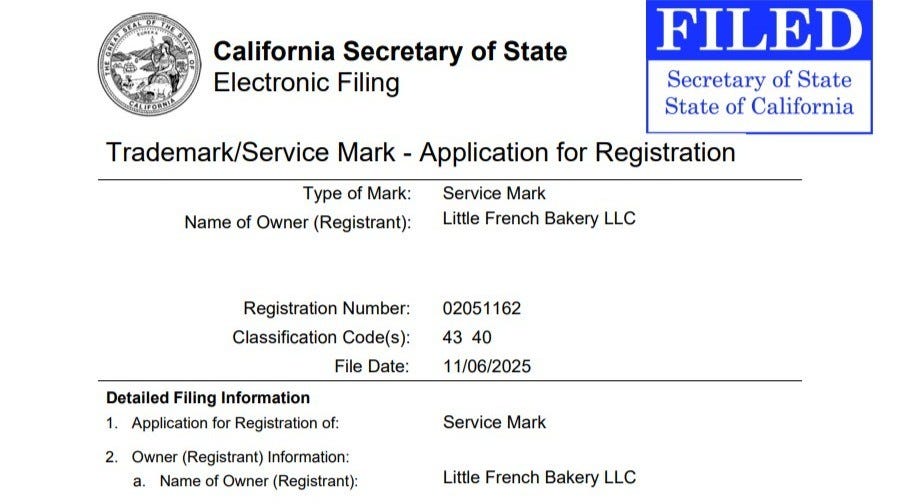
Plaintiff Little French Bakery operates a French bakery in Redondo Beach’s Riviera Village and owns California Service Mark Reg. No. 02051162 for the standard‑character mark “Little French Bakery” covering bakery, café, and catering services.
The registration disclaims exclusive rights in “French” and “Bakery,” which underscores that the protectable portion of the mark is the phrase “Little French Bakery” as a whole rather than its descriptive components.
Defendants The Little Cake and owner Monica L. Goncalves operate a bakery in Commerce, California, a separate city roughly 20 miles from Redondo Beach but squarely within the same Los Angeles‑area market. Goncalves reportedly started as a home‑based “cottage food” baker before moving into a brick‑and‑mortar operation powered by TikTok and Instagram.
The complaint alleges that after Little French Bakery gained a strong local reputation and online following, The Little Cake adopted branding, product offerings, and social‑media styling that closely tracked plaintiff’s look and messaging, especially around croissants, laminated pastries, and “authentic” French techniques.
Plaintiff points to specific incidents of alleged actual consumer confusion, including visitors asking whether plaintiff opened another “Little” bakery in Commerce, a caller asking if plaintiff was associated with the Commerce shop, and a distributor remarking that the Commerce layout looked very similar. A Yelp review compares defendants’ bakery to a Redondo Beach bakery the reviewer had tried before, which plaintiff believes is its location.
On Nov. 24, 2025, plaintiff sent a social‑media message warning that defendants’ use of “The Little Cake” for bakery services was causing confusion; on Dec. 8, 2025, counsel followed with a cease‑and‑desist letter. The complaint alleges that defendants declined to rebrand and continued using the challenged branding.
On Dec. 12, 2025, days after the cease‑and‑desist letter, defendants filed a federal service‑mark application for “THE LITTLE CAKE BAKERY CAFÉ” for bakery‑café services, which plaintiff characterizes as a bad‑faith attempt to secure rights in a confusingly similar mark.
The nationwide federal registration for the standard‑character mark “LITTLE FRENCH BAKERY” is owned by a Wisconsin bakery and was renewed in 2024, so the California plaintiff relies on its state registration and common‑law rights while someone else holds the federal registration for the same literal mark.
Procedurally, Judge Klausner struck an initial motion to dismiss on Mar. 10, 2026, for failure to comply with C.D. Cal. Local Rule 7‑3’s meet‑and‑confer requirement; defendants then filed a renewed motion to dismiss set for hearing on Apr. 20, 2026. (Those motions address legal sufficiency; the court has not yet weighed evidence.)
The complaint uses a layered, “belt‑and‑suspenders” approach: a federal unfair‑competition claim paired with three state‑law theories, all converging on likelihood of confusion. Ultimately, the case will turn on the familiar Ninth Circuit likelihood‑of‑confusion framework, often associated with the Sleekcraft factors, which considers issues like similarity of marks, proximity of goods, marketing channels, and evidence of actual confusion.
Section 43(a) of the Lanham Act lets a business sue in federal court for false designation of origin and unfair competition based on use in commerce, even if it does not own a federal registration. 15 U.S.C. § 1125(a). Here the plaintiff alleges that it has protectable rights in “Little French Bakery” through use and its California registration, and that defendants’ use of “The Little Cake,” along with overlapping products and marketing, is likely to cause confusion about whether the Commerce bakery is affiliated with or sponsored by the Redondo Beach bakery.
Because another bakery owns the federal “LITTLE FRENCH BAKERY” registration, defense counsel can argue that plaintiff’s claim to exclusive rights in that phrase is limited given its descriptive components and the existing nationwide registrant. That does not eliminate plaintiff’s local rights, but it may influence how broadly the court is willing to construe the scope of protection. In cases like this, the weaker the mark, the more the plaintiff must lean on evidence of actual confusion and overall presentation rather than the name alone.
California’s trademark statute gives owners of state registrations a cause of action against later users of confusingly similar marks on related goods or services within the state. Cal. Bus. & Prof. Code § 14245. Plaintiff’s California Service Mark Reg. No. 02051162 covers bakery and café services under the “Little French Bakery” name, supported by specimens such as menus, signs, and business cards. The complaint alleges that defendants’ use of “The Little Cake” for a bakery in Commerce, within the same regional market, creates a likelihood of confusion and infringes the state‑registered mark.
Under California common law, trademark rights arise from use, not registration. A business that uses a mark first in a given area can assert priority and sue later users whose conduct creates a likelihood of confusion. The complaint alleges that Little French Bakery has used its mark in the South Bay market since 2020 and that The Little Cake’s later entry with similar branding and presentation infringes those common‑law rights.
Common‑law claims rely heavily on marketplace reality. That is why the complaint highlights alleged misdirected calls, in‑store inquiries, and online reviews that mix up the parties. If those facts are proven and the mark is found descriptive but has acquired distinctiveness in that area, they will be central to any relief.
California’s Unfair Competition Law prohibits any “unlawful, unfair or fraudulent” business practice. Cal. Bus. & Prof. Code § 17200. Trademark infringement can be both “unlawful” (because it violates other statutes) and “unfair” if it misleads consumers or free‑rides on goodwill.
Here plaintiff uses § 17200 as a broad safety net, asserting that defendants’ alleged copying of name elements, social‑media styling, and menu concepts, combined with their decision to double down after receiving a cease‑and‑desist letter, amounts to unfair competition warranting injunctions and corrective actions.
If successful on these theories, plaintiff can seek injunctive relief prohibiting further use of the challenged branding, corrective steps on social media and menus, monetary remedies such as damages or disgorgement of profits, and potentially attorneys’ fees in an “exceptional” case under 15 U.S.C. § 1117(a).
At its core, this case asks how far a business can extend protection for a relatively descriptive name by pointing to the totality of its branding, menu, and social‑media execution.
The complaint’s exhibits place the parties’ posts side by side. On one side are Little French Bakery’s Instagram posts showing a chocolate marshmallow croissant, a croissant “Christmas tree,” and behind‑the‑scenes videos of the chef working in the kitchen with captions about “craftsmanship,” “authenticity,” “real butter,” “premium fillings,” and “no shortcuts.” On the other side are The Little Cake’s posts, sometimes shortly after, showcasing similar croissant‑style pastries, trays of laminated dough, and narratives about imported French butter and artisanal technique, tagged with overlapping hashtags like #frenchbakery, #viennoiserie, and #croissant.
The First Amended Complaint reportedly adds TikTok screenshots to emphasize not only similarity but sequence: plaintiff rolls out a particular pastry or style of promotional “drop,” and defendants follow with a similarly styled promotion. That alleged sequential mimicry is meant to strengthen a trade‑dress‑style theory that what is being copied is not just a name but a recognizable campaign structure.
Menu comparisons play a supporting role. Plaintiff’s menu has long featured a savory “potato, bacon and mushroom puff pastry,” while defendants promoted a “Mushroom Bacon” laminated pastry with creamy mushroom and bacon filling topped with parmesan, presented in a similar rectangular form. The complaint does not claim ownership over mushroom pastries as such; it argues that the combination of product mix, naming, and social‑media rollout contributes to an overall presentation that makes confusion more likely.
It is easy to assume you need to own a federal registration to be in federal court. This case shows why that assumption is wrong. Section 43(a) of the Lanham Act creates a federal cause of action for unfair competition and false designation of origin that does not depend on registration. 15 U.S.C. § 1125(a).
Little French Bakery uses § 1125(a) as the jurisdictional anchor and layers its California statutory and common‑law claims underneath to ensure overlapping remedies. The existence of a federal “LITTLE FRENCH BAKERY” registration held by the Wisconsin bakery does not bar plaintiff from asserting local rights in Southern California, but it gives defendants ammunition to argue that plaintiff’s exclusivity claims should be construed narrowly. Federal registration also normally provides procedural advantages such as automatic access to federal court for infringement of the registration and stronger presumptions of validity and ownership—advantages the California plaintiff does not currently enjoy.
The inclusion of an individual defendant, owner Monica Goncalves, is notable. Naming an individual suggests alleged personal involvement in the challenged conduct and preserves the option of individual liability, which can matter if the LLC is thinly capitalized or if an injunction needs to bind a person rather than just an entity.
This dispute is a live illustration of the tradeoffs between federal and state trademark strategies.
A federal registration on the Principal Register offers nationwide presumptions of ownership and validity, constructive notice to others, broader remedies including certain damages and attorneys’ fees in exceptional cases, and smoother use of online enforcement tools and customs recordation. 15 U.S.C. §§ 1057(b), 1072, 1114, 1116, 1117. The Wisconsin bakery that owns the “LITTLE FRENCH BAKERY” registration enjoys those benefits and has renewed its registration through at least 2033.
By contrast, a California registration like Little French Bakery’s protects only within the state, although it still offers meaningful evidentiary and enforcement advantages. State registration can be less expensive and faster, and it may be the only realistic option when a similar mark already occupies the federal space, as appears to be the case here.
The structure of plaintiff’s mark raises a classic issue of strength. It combines “Little,” “French,” and “Bakery,” with disclaimers for “French” and “Bakery,” both descriptive of the goods and services. Even if plaintiff proves confusion, the descriptive nature of the components may narrow the scope of protection the court is willing to recognize and affect how far any injunction can reach. That is the core tension: a relatively weak mark being used to support a broader confusion narrative based on branding and presentation.
Trademark history is full of examples where branding had to bend around prior rights. Burger King operates under that name across the United States but historically could not use it near a prior “Burger King” in Illinois; in Australia, the same chain is known as Hungry Jack’s because of earlier local rights. Similar dynamics explain the dual identities of Rally’s and Checkers, and of Carl’s Jr. and Hardee’s. These splits show how early trademark choices and existing registrations can constrain later national branding—precisely the kind of constraint that the Wisconsin registration introduces into Little French Bakery’s potential expansion story.
Can you own a “vibe”? That is one of the most modern questions in this case.
Trade dress protects the total image and overall appearance of a product or service, so long as the claimed features are nonfunctional, distinctive, and associated in consumers’ minds with a single source. See, e.g., Two Pesos, Inc. v. Taco Cabana, Inc., 505 U.S. 763 (1992). Here the plaintiff argues that the combination of its name, menu (including items like the potato‑bacon‑mushroom puff), and TikTok/Instagram aesthetic has created a recognizable, source‑identifying presentation.
The sequential side‑by‑side screenshots are designed to show more than generic croissant content. They are meant to show a pattern: a particular style of promotional drop with specific products and story beats followed by defendants echoing that same structure. If Judge Klausner allows those allegations to move forward at the pleading stage, it will not mean that “Instagrammability” is automatically protectable, but it will signal that courts are at least willing to engage seriously with digital trade‑dress theories. That would matter for any creator whose primary storefront is a social‑media feed rather than a street address.
This is where the case stops being about croissants and starts being about doctrine and dollars.
Trademark enforcement is expensive. IP litigators in major markets often bill several hundred dollars per hour, and a fully contested federal case through trial can cost six figures per side. Those numbers help explain why The Little Cake reportedly launched a GoFundMe to fund its defense and quickly raised a significant amount from supporters, reinforcing a “David versus Goliath” narrative.
For Little French Bakery and its owners, that public narrative creates a PR tightrope. They have spent decades building a reputation for “Old World” authenticity and understandably want to stop customers from assuming that any “Little” French‑style bakery they see on TikTok is theirs. But every enforcement decision now plays out instantly in the court of public opinion. A lawsuit that may be legally necessary to avoid weakening the mark can still make the plaintiff look like the villain of the local baking scene if the internet decides that croissant aesthetics should belong to everyone.
From a remedies standpoint, the complaint asks for injunctive relief barring use of “The Little Cake” and similar designations, corrective steps for online and offline branding, abandonment of defendants’ pending USPTO application, restitution or disgorgement where available, costs, and attorneys’ fees in an appropriate case. Those are serious stakes for a small bakery, which is precisely why pre‑launch trademark strategy matters.
This case is a reminder that a modest legal spend up front can save a lot of pain later. A solid clearance search before committing to “Little French Bakery” or “The Little Cake” would have revealed:
The existing federal “LITTLE FRENCH BAKERY” registration owned by the Wisconsin bakery.
The California service‑mark application and registration for “Little French Bakery” in the Los Angeles area.
A crowded landscape of “Little” and “French” bakery names that makes distinctiveness an uphill climb.
With that information, and advice from a licensed trademark attorney, a new bakery could choose a more distinctive name, adjust its branding strategy, or negotiate coexistence instead of betting its future on an arguably descriptive mark and a social‑media aesthetic that might or might not be protectable. The cost of that early work is almost always lower than the cost of litigating in federal court or rebranding under pressure once customers, menus, and signage are already in place.
This is a § 1125(a) unfair‑competition case built on state and common‑law rights. Plaintiff uses federal false‑designation law as the hook for jurisdiction and layers California statutory and common‑law claims to secure overlapping remedies.
The mark is relatively weak, so presentation and confusion evidence do most of the work. Because “Little,” “French,” and “Bakery” are largely descriptive and partially disclaimed, the strength of plaintiff’s case rests on how convincingly it can show actual confusion and copying of overall branding rather than ownership of a fanciful word.
The Wisconsin registration is a built‑in defense tool. An unrelated bakery’s federal “LITTLE FRENCH BAKERY” registration gives defendants a ready argument that plaintiff’s exclusivity and distinctiveness claims should be narrowly construed and complicates any national branding aspirations for the California business.
Trade‑dress theories are moving onto TikTok and Instagram. Plaintiff’s reliance on sequenced screenshots and “vibe” allegations pushes courts to consider whether a curated online aesthetic can be protectable trade dress, not just logos and brick‑and‑mortar décor.
Enforcement is both legal strategy and public‑relations warfare. The GoFundMe, the cottage‑food backstory, and the social‑media backlash show how protecting goodwill in court can simultaneously damage goodwill in the community if enforcement is perceived as overreach.
For new businesses, clearance and early advice are cheaper than a bakery war. Running searches, understanding the federal‑versus‑state tradeoffs, and choosing a distinctive mark with guidance from a qualified attorney can keep you focused on making good pastry instead of defending it in federal court.
This article is published by JJTP Law PLLC as a general-interest news and information service for clients and friends of the firm. Nothing in it is legal advice, and reading it does not create an attorney-client relationship. If you have a question about how this topic applies to your own situation, please reach out to the attorney you normally work with, or schedule a consultation. This is not a solicitation for legal work in any jurisdiction where JJTP Law is not authorized to practice. See our Attorney Advertising & Terms of Use.