
27 August 2026
Insights


New York City has announced the policy The harder legal question is what appropriations, contracts,...

New York City’s municipal grocery initiative may properly face scrutiny over public money, public...
Regulatory change can make a product less commercially secure without making it unlawful to own or...

SaaS Style Gaming and the Legal Erosion of...
New York City has announced the policy The harder legal question is what appropriations, contracts,...
New York City’s municipal grocery initiative may properly face scrutiny over public money, public...
Regulatory change can make a product less commercially secure without making it unlawful to own or...
SaaS Style Gaming and the Legal Erosion of...
May 4, 2026
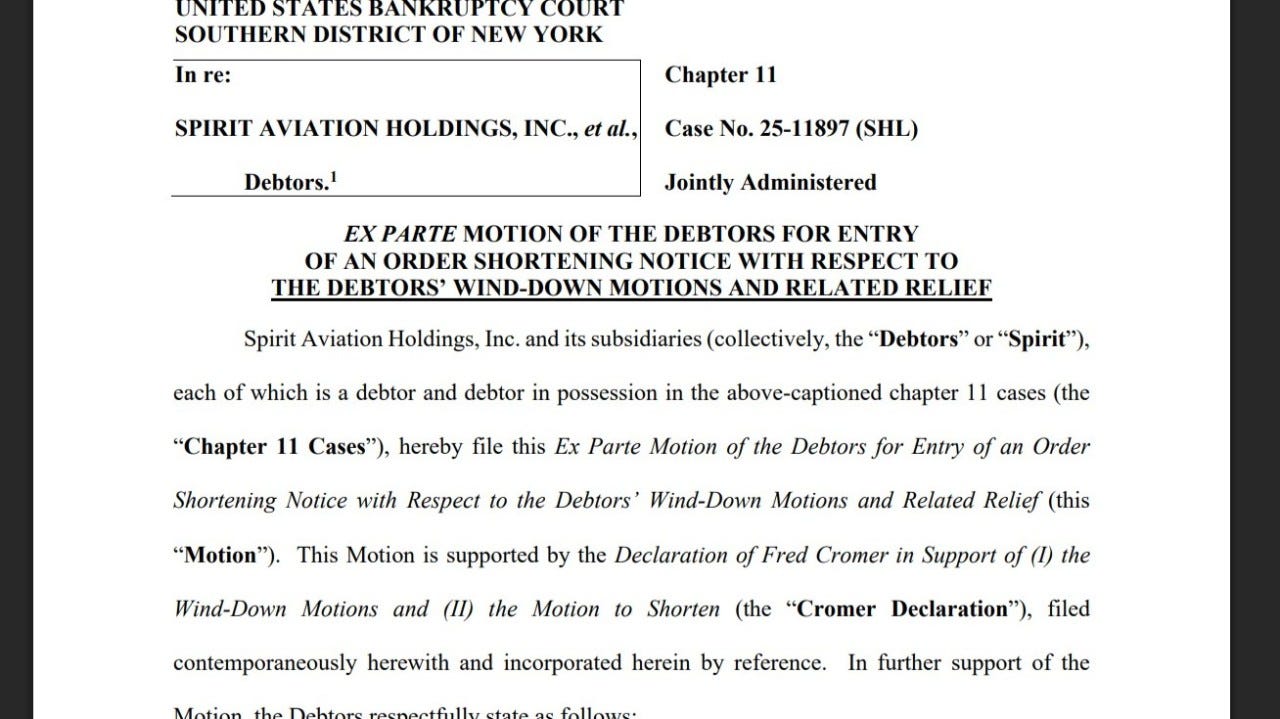
Airlines rarely fail because of a single shock. They fail when a thin margin model runs out of room to absorb risk. Spirit Airlines’ wind‑down in 2026 is ultimately a simple story: a financially stressed ultra low cost carrier lost its ability to absorb a sudden fuel and routing shock tied to a regional conflict involving Iran, and that same shock exposed how fragile the broader travel system really is.
Spirit was already in Chapter 11 and facing continued restructuring pressure, with a highly leveraged balance sheet and a business model built on ultra low fares and thin margins.
Company projections and analyst work indicated fuel assumptions around $2.24 per gallon for 2026 and roughly $2.14 for 2027, while post‑escalation jet fuel prices moved into the mid‑$4 range, nearly doubling a core input cost.
The regional conflict involving Iran constrained or risk‑priced traffic through and near the Strait of Hormuz, pushed up global oil and jet fuel prices, and forced airlines to reroute around sensitive airspace, lengthening flights and increasing fuel burn.
Fuel typically represents roughly one quarter to one third of airline operating costs, so a rapid spike is not just a budgeting nuisance for ultra low cost carriers without hedging or premium revenue. It is an existential event.
Gulf hubs like Dubai International Airport, Hamad International Airport in Doha, and Abu Dhabi International Airport are not mere luxury stopovers. They are strategic bridges linking Europe, Asia, Africa, and Oceania.
Cruise lines and European airlines have warned of higher fuel bills, shifting routes, and tighter capacity, showing that this is a system‑wide cost and risk shock, not a Spirit‑only problem.
Every year I take a birthday trip to a new country. I have been to 97 countries so far, which means I see these disruptions not just in filings and charts, but in the way a “simple” itinerary suddenly turns into a strategic exercise. This year, my own travel plan became a case study in how quickly a regional conflict can rearrange the map for an individual traveler.
Spirit did not go from “healthy” to “grounded” overnight. It arrived at its wind‑down point after years of mounting financial stress.
Even before the recent escalation involving Iran, Spirit had been losing money and carrying significant debt, with aircraft financed through leases and a cost structure that left very little room for error. A failed merger attempt with JetBlue consumed time and strategic focus, while larger legacy carriers continued pushing into the low fare space, squeezing Spirit’s pricing power.
The ultra low cost model works when three conditions hold: fuel is relatively cheap, demand is stable, and capital markets are willing to back a carrier that needs time to scale. Spirit no longer enjoyed any of those advantages. By early 2026 it was already in Chapter 11, trying to execute a tight turnaround in an environment of higher interest rates, rising labor costs, and increasingly demanding investors.
The arithmetic of its restructuring plan only worked if fuel stayed within a narrow band. According to company filings and analyst estimates, Spirit’s projections assumed jet fuel prices around $2.24 per gallon in 2026 and roughly $2.14 in 2027. As the regional conflict involving Iran intensified and markets reassessed the risk to flows through and near the Strait of Hormuz, global jet fuel prices climbed into the mid‑$4 range. That move effectively doubled one of the airline’s largest operating expenses.
Analysts noted that if fuel remained near those levels, Spirit’s projected margin for 2026 could swing from a modest positive to deeply negative, with the added fuel bill alone exceeding its year‑end cash balance by hundreds of millions of dollars. At that point, this was no longer a matter of tightening belts. It was a matter of the plan not penciling out.
A larger legacy carrier might have had some protection in the form of fuel hedging, diversified global networks, cargo revenue, and premium cabins whose customers can absorb fare increases. Spirit lacked those buffers. Its exposure to spot fuel prices and its reliance on highly price‑sensitive customers meant that it felt the full impact of the spike almost immediately.
Rescue financing discussions intensified, including efforts to secure federal support, but creditors and policymakers ultimately did not coalesce around a bailout. Spirit began an orderly wind‑down process, including widespread flight cancellations and preparations to cease operations as a going concern. While exact fuel trajectories and traffic impacts remain fluid, the directional effect on cost structures and routing in this episode has been clear.
At first glance, it may seem odd that a regional escalation involving Iran could help push a mostly domestic carrier like Spirit into wind‑down. The connection becomes clear once you look at how energy and aviation markets actually work.
The Strait of Hormuz is a critical corridor for global oil and refined product shipments. When conflict raises the perceived risk of transit through or near that corridor, shipping patterns adjust and war‑risk premiums increase, both of which contribute to higher delivered prices for crude and jet fuel. The result in this case was that jet fuel prices roughly doubled from the level embedded in Spirit’s restructuring assumptions.
Jet fuel is one of the largest operating line items on an airline’s income statement. Industry data from regulators and trade groups suggest it often accounts for roughly 20 to 30 percent of total operating costs, depending on the carrier and the year. A rapid, sustained increase at that scale is not a marginal issue for a thin margin carrier. It can erase any near‑term path to profitability.
The impact was not limited to fuel prices. Airlines sought to avoid higher‑risk airspace over or near Iran and parts of Iraq and the Persian Gulf, rerouting flights via Central Asia, the Caucasus, or the eastern Mediterranean. Those longer paths increase flight times and fuel burn, compounding the cost impact of higher per‑gallon prices. War‑risk insurance premiums for airlines operating near affected corridors also rose, adding another layer of cost that is not always visible to passengers.
At the same time, higher fares and booking uncertainty tend to suppress discretionary travel demand. Some passengers defer trips, shorten itineraries, or trade down to cheaper transportation, which further compresses revenue just as costs are spiking. For a ULCC whose customer base is uniquely price sensitive, that demand‑side reaction can be as damaging as the fuel increase itself.
The key point is that a carrier does not need to fly anywhere near the Middle East to feel these effects. It buys fuel in a global market that prices in risk from that region, insures its operations in an environment where war‑risk is reassessed, and sells tickets into a demand environment shaped by perceived instability and higher costs.
Spirit’s experience illustrates how the ultra low cost carrier model behaves under stress.
ULCCs typically:
Offer a single‑class cabin with dense seating and limited frills.
Rely heavily on ancillary fees rather than premium fares.
Operate point‑to‑point networks with high aircraft utilization.
Serve customers who are extremely sensitive to price changes.
In benign conditions, this structure allows ULCCs to offer very low base fares, fill aircraft, and earn acceptable margins through volume and fees. In volatile conditions, the same structure becomes a liability. There is no premium cabin to cross‑subsidize economy, no large loyalty program to generate steady high‑margin cash flows, and less latitude to pass higher costs through to customers without destroying demand.
Debt and lease obligations amplify that fragility. Fleet financing is long‑dated and inflexible. If fuel costs spike and demand softens, the carrier cannot quickly shrink its obligations to match the new reality. It has to either raise fares on a customer base that is least able to pay, cut capacity and hope to survive on fewer flights, or seek outside capital.
Spirit’s wind‑down therefore shows how quickly a structurally fragile model can break once a shock hits. The same escalation that challenged all carriers pushed the airline with the least buffer and the most leverage past the point where its turnaround remained credible.
The conflict also reminded many travelers of something aviation planners have known for decades. The Middle East is not just a region on the map. It is a bridge in the global air network.
Dubai International, Hamad International in Doha, and Abu Dhabi International sit at a geographic crossroads between Europe, Asia, Africa, and Oceania. Airlines based there have deliberately built hub‑and‑spoke models that connect long haul traffic with efficient one‑stop itineraries, turning those airports into global transit clubs for passengers from many different continents.
When conflict makes nearby airspace more complex or raises the cost of insuring flights in certain corridors, carriers adjust. Some routings are lengthened, some frequencies are reduced, and some connections disappear entirely. That redistribution of traffic affects:
Which secondary hubs see unexpected surges in connecting passengers.
How aircraft and crews are scheduled across networks.
Where fuel demand concentrates, with implications for local supply and price.
For travelers, the result often appears simply as higher fares, longer connections, or fewer nonstops. Underneath those outcomes is a system adjusting to a shock in the bridge that connects large parts of the world.
For years, my ritual has been to celebrate my birthday in a country I have never visited. Reaching 97 countries means I have seen the global travel system under different forms of stress, but this year was the first time a regional escalation so directly reshaped even a modest personal itinerary.
I started planning with Baku, a city on the Caspian that I had heard described as a hidden gem with a compelling mix of modern architecture and historic streets. As the conflict involving Iran escalated, Baku’s proximity to the Iranian border turned a “fun trip idea” into a more complex risk calculation from both a travel and strategic perspective. It was not just a question of safety. It was a question of how underwriters, carriers, and governments would treat the region if conditions worsened.
I pivoted to Georgia, looking at Tbilisi and Batumi as alternatives that kept the Caucasus feel while stepping further from the immediate neighborhood of the conflict. Then airspace limitations, shifting routings, and my own work‑driven scheduling constraints narrowed those options as well. Flights that looked viable on paper became less attractive as the probability of last‑minute changes increased.
Travel to Asia was also affected. Last year I had gone to Bali via Abu Dhabi, which neatly illustrated how the Middle East bridge can turn very long journeys into manageable combinations of legs. On that trip, routing through Abu Dhabi effectively took Sri Lanka off the table for timing and logistical reasons even though it was under consideration. This year, with the added uncertainty, I ultimately chose Malta and Türkiye, returning to Türkiye but focusing on Istanbul rather than Ankara, which I had previously visited for work. Even on those relatively accessible routes, there was a constant awareness that a new airspace restriction, a fuel supply issue, or an insurance adjustment could force a last‑minute reroute or cancellation.
What looked at first like personal indecision was in reality my itinerary reacting to the same stresses that were reshaping airline balance sheets and route maps. My birthday trip became a small‑scale reflection of a larger system coming under strain.
The fuel and routing shock did not stop at the runway. Cruise operators and European airlines have been equally candid about the pressure they are under.
Reports in early 2026 described cruise companies facing significantly higher fuel costs as oil prices climbed in response to the conflict and associated risk premiums. Moving a large vessel across oceans is inherently energy‑intensive. When bunker fuel prices rise in parallel with jet fuel, cruise lines must either increase fares, adjust itineraries, slow steaming speeds, or accept weaker margins.
European airlines have warned about higher fuel bills, route adjustments, and softer demand as travelers respond to higher prices and uncertainty. Some carriers have trimmed capacity on marginal routes, increased surcharges, or shifted traffic flows in ways that preserve core connectivity while conceding that not every pre‑conflict route remains viable at current cost levels.
Across both sectors, the pattern is similar. Costs rise faster than prices can, demand reacts negatively to higher fares and perceived risk, and capital providers become more selective about where they allocate funding. The first casualties are often the most leveraged and least diversified operators.
Aviation is a capital‑intensive business. Aircraft are expensive, leases are long‑term, and fixed costs are substantial. In stable times, investors may be willing to fund temporary losses for carriers they believe can grow into sustainable profitability. In a period of repeated shocks and higher interest rates, that willingness narrows.
By April and May 2026, Spirit was not just fighting fuel prices. It was trying to convince creditors, potential lenders, and policymakers that its plan still made sense in a world of $4‑plus jet fuel and heightened volatility. As the projected margins collapsed under new fuel assumptions and the risk of continued losses mounted, the case for fresh capital became harder to make.
Reports around the time of the wind‑down described rescue talks stalling and federal officials signaling that the broader U.S. airline system did not require a dedicated bailout for this one budget carrier. Creditors ultimately preferred an orderly wind‑down and liquidation over extending new financing on terms that no longer reflected the underlying risk.
For investors and policymakers, Spirit’s situation was a test of where to draw the line. In this cycle, an ultra low cost carrier operating at the edge of the cost curve did not clear the bar.
Spirit’s wind‑down is not just about a single airline’s misfortune. Spirit’s wind‑down shows how a business model built on thin margins, limited diversification, and significant leverage can fail when a regional conflict suddenly alters fuel prices, routing patterns, insurance costs, and traveler behavior. For passengers, the effects appear in higher fares, fewer options, and more fragile itineraries. For operators, they appear in compressed margins, tougher credit conditions, and the realization that not every shock can be hedged away.
While exact numbers and traffic patterns will continue to evolve, the directional lesson from this episode is clear. In a tightly connected travel ecosystem, a conflict in one region can rapidly test balance sheets, business models, and public policy far beyond its borders.
Spirit’s story is best understood as the final stage of a distress trajectory, not a sudden collapse. A thin margin ULCC entered Chapter 11 in a challenging environment and then lost its ability to absorb a major fuel and routing shock.
The escalation involving Iran constrained or risk‑priced traffic near the Strait of Hormuz, pushed up global jet fuel prices, and forced route adjustments that increased fuel burn and war‑risk insurance costs.
Fuel often accounts for roughly 20 to 30 percent of airline operating costs, so a rapid doubling of jet fuel prices is existential for carriers without hedging programs, diversified revenue, or premium cabins.
Middle East hubs in Dubai, Doha, and Abu Dhabi function as strategic bridges in global aviation. Disruptions there reshape routes and costs for Europe–Asia and long haul traffic well beyond the region itself.
Cruise lines and European airlines are experiencing similar pressures from higher fuel costs, route changes, and cautious demand, underscoring that the entire travel ecosystem is more fragile than it appears in normal times.
A frequent traveler’s experience of pivoting from Baku to Georgia and ultimately to Malta and Istanbul in response to conflict‑driven uncertainty is not an outlier. It is what systemic stress looks like when it reaches the level of a single itinerary.
This article is published by JJTP Law PLLC as a general-interest news and information service for clients and friends of the firm. Nothing in it is legal advice, and reading it does not create an attorney-client relationship. If you have a question about how this topic applies to your own situation, please reach out to the attorney you normally work with, or schedule a consultation. This is not a solicitation for legal work in any jurisdiction where JJTP Law is not authorized to practice. See our Attorney Advertising & Terms of Use.