27 August 2026
Insights
New York City has announced the policy The harder legal question is what appropriations, contracts,...

New York City’s municipal grocery initiative may properly face scrutiny over public money, public...
Regulatory change can make a product less commercially secure without making it unlawful to own or...
SaaS Style Gaming and the Legal Erosion of...
New York City has announced the policy The harder legal question is what appropriations, contracts,...
New York City’s municipal grocery initiative may properly face scrutiny over public money, public...
Regulatory change can make a product less commercially secure without making it unlawful to own or...
SaaS Style Gaming and the Legal Erosion of...
May 4, 2026
The Strait of Hormuz is not an abstract geopolitical flashpoint. It is one of the narrow waterways that keeps the global economy moving. When commercial transit through that corridor becomes conditioned on payments to Iran, shippers, insurers, banks, and cargo interests face a commercially coercive dilemma. Refuse to pay and risk delay, detention, or denied passage. Pay and risk triggering U.S. sanctions enforced by the Office of Foreign Assets Control, or OFAC, and in some cases creating potential exposure for providing material support to a designated Foreign Terrorist Organization. OFAC’s recent guidance on the Strait of Hormuz makes clear that this is not just a shipping cost question. It is a sanctions event that can reach all the way into the U.S. financial system.
April 28, 2026 – FAQ 1249: OFAC FAQ 1249 states that payments to the Government of Iran or the Islamic Revolutionary Guard Corps for safe passage through the Strait of Hormuz “would not be authorized” for U.S. persons, U.S. financial institutions, or U.S. owned or controlled foreign entities, absent specific authorization.
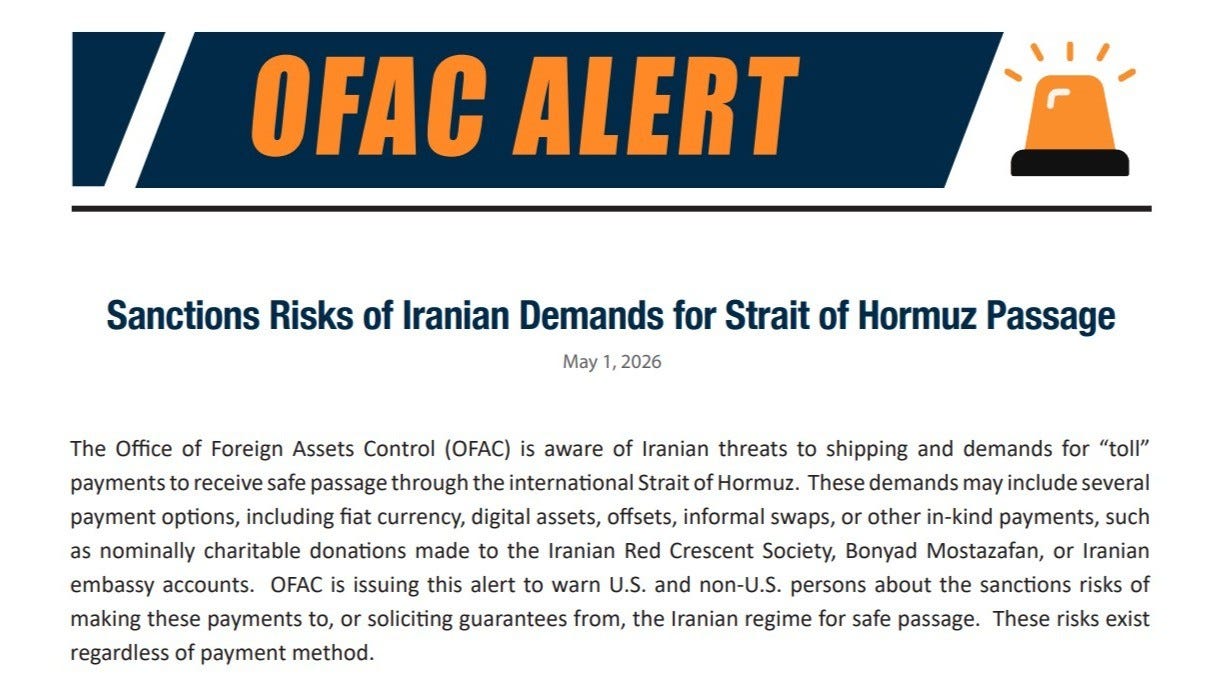
May 1, 2026 – OFAC Alert: A May 1, 2026 Treasury alert warns that demanded payments may take the form of fiat currency, digital assets, offsets, swaps, or “charitable” donations to entities such as the Iranian Red Crescent Society or Bonyad Mostazafan, and confirms that sanctions risk exists regardless of payment method.
Non U.S. persons at risk: OFAC notes that non U.S. persons face significant sanctions exposure for such payments, and Executive Order 13902 authorizes secondary sanctions on those who knowingly engage in significant transactions for or on behalf of designated sectors of the Iranian economy.
IRGC is also an FTO: The Islamic Revolutionary Guard Corps is not only a blocked entity under OFAC programs but also designated as a Foreign Terrorist Organization, so payments that benefit the IRGC can create potential exposure under the material support statute, 18 U.S.C. § 2339B, particularly where there is knowledge that the payment benefits the IRGC.
Insurance and charterparty implications: P&I and Hull and Machinery policies typically contain sanctions limitation and exclusion clauses, and charterparties often include war risk, liberty, and sanctions clauses that may allow a master or owner to refuse orders to transit where doing so would violate sanctions or expose the vessel to exceptional danger.
This is not hypothetical: Treasury has publicly indicated that Iran is demanding payments for safe passage and that payments have already been requested and, in at least one reported instance, made, which means this is an active enforcement and compliance issue, not a theoretical one.
The present situation around Hormuz is a textbook example of commercial coercion meets regulatory hard edge. Iran, in the context of the 2026 conflict and counter‑blockade environment, is reportedly demanding payments, “clearance codes,” or purported tolls to allow ships to pass safely. At the same time, OFAC has now said in primary guidance that such payments “would not be authorized” for U.S. persons and U.S. owned or controlled foreign entities, absent specific authorization.
Because shipping transactions are multi party by nature, the sanctions risk rarely stops with the shipowner. A single voyage can involve an owner, charterer, cargo interests, multiple banks, P&I insurers, hull insurers, and brokers. If any of those parties are U.S. persons, rely on U.S. dollar clearing, use U.S. reinsurers, or otherwise create a U.S. nexus, the prohibition applies. Even non U.S. parties face “significant sanctions exposure” if they make such payments in a way that constitutes a significant transaction or material support for Iran’s sanctioned sectors.
In substance, these demands are not routine “user fees” in a normal regulatory environment. They are payments demanded in a conflict setting for safe passage, described by OFAC as not authorized and therefore prohibited absent a specific license. Calling them tolls, facilitation payments, or donations does not change how OFAC views them.
Iran sanctions rest on statutory authorities such as the International Emergency Economic Powers Act, executive orders, and OFAC regulations. The core regulatory framework is the Iranian Transactions and Sanctions Regulations, 31 C.F.R. Part 560, which broadly prohibit certain dealings with the Government of Iran, Iranian financial institutions, and other blocked persons unless a general or specific license applies.
These prohibitions capture a wide range of conduct: export and import of goods and services, certain financial transactions, and dealings in property or interests in property of blocked persons. Targets can include ministries, state owned enterprises, oil and gas entities, financial institutions, shipping companies, and individuals who act for or on behalf of these actors. Some restrictions apply directly to U.S. persons, while secondary sanctions, including under Executive Order 13902, can reach non U.S. persons who knowingly engage in significant transactions in sectors like Iran’s energy, shipping, construction, and financial sectors.
The most visible tool is OFAC’s Specially Designated Nationals and Blocked Persons List, or SDN List. Once a person or entity is on the SDN List, any property or interests in property they hold that come within U.S. jurisdiction are blocked, and U.S. persons are generally prohibited from dealing with them unless authorized. OFAC also provides a sanctions list search tool and country program pages that identify relevant regulations, executive orders, general licenses, and FAQs.
In the shipping context, the risk is that the “payee” behind a Hormuz toll or safe passage demand may be an Iranian state entity, an IRGC controlled front, or another blocked person that does not appear on the surface of the charterparty or invoice. Beneficial ownership, intermediary banks, and so called “facilitation agents” often determine where the money actually lands. Civil penalties can be imposed on a strict liability basis in many cases, meaning that lack of intent is not a defense if a prohibited transaction occurred without authorization.
OFAC authorizes certain activities in two main ways. General licenses create standing permission for defined categories of transactions, such as some humanitarian exports or personal remittances, provided that conditions are met. Specific licenses are written authorizations granted case by case after an application describes the parties, the proposed conduct, and why it should be allowed.
FAQ 1249 matters because OFAC has now said that payments to Iran or the IRGC for safe passage “would not be authorized” for U.S. persons and U.S. owned or controlled foreign entities. There is no general license that would cover such tolls or donations, and the alert gives no indication that OFAC is inclined to grant specific licenses for that purpose. In practical terms, “not authorized” in this context means such payments are treated as prohibited absent a specific, written authorization that almost no one will receive.
Legal services are an area where OFAC has tried to strike a balance. Under 31 C.F.R. § 560.525(a), certain legal services are authorized, including the initiation and conduct of legal, arbitral, and administrative proceedings in the United States and abroad. That means representing Iranian parties or even blocked persons in litigation or arbitration can be permitted as a matter of providing legal services.
However, § 560.525(d)(1) makes clear that when the client is the Government of Iran, an Iranian financial institution, or any other blocked person under § 560.211, the receipt of payment of professional fees and reimbursement of incurred expenses must be specifically licensed or otherwise authorized. The representation may be allowed, but taking the money often is not, unless and until OFAC issues a specific license allowing the transfer of funds from a blocked person.
This distinction is clearer in practice than in theory. In one matter, my client was listed on OFAC’s sanctions list and simultaneously the subject of an Interpol notice, which meant he could not enter the United States. At the same time, he had intellectual property related business interests in the United States and needed representation in litigation and AAA arbitration to defend those interests.
The legal work itself fell squarely within the authorized category of services described in 31 C.F.R. § 560.525(a), so my client could be represented in court and arbitration on the merits. But because he was a blocked person, I could not lawfully accept fees or expense reimbursements from him without OFAC approval. Under § 560.525(d)(1), a specific license was required for the law firm to receive payment, and the arbitral institution also had to consider licensing issues before holding or disbursing funds connected to deposits or awards.
The lesson is simple but powerful. In sanctions practice, it is not enough to ask whether the underlying service is authorized. One must also ask whether any transfer of value to or from a blocked person has been explicitly licensed.
The Hormuz toll problem fits this framework almost too neatly. OFAC has now said that payments to Iran or the IRGC for safe passage would not be authorized for U.S. persons or U.S. owned or controlled foreign entities, absent specific authorization. There is no general license that covers these tolls, and the alert signals that Treasury views them as a sanctions risk regardless of whether they are labeled fees, donations, or something else.
For U.S. persons, or foreign entities owned or controlled by U.S. persons, participation in such payments without a specific license would likely constitute a prohibited dealing with blocked persons under 31 C.F.R. Part 560, subject to civil penalties and, in willful cases, possible criminal prosecution under IEEPA. For non U.S. parties, the risk is secondary sanctions under Executive Order 13902, blocked funds, loss of access to U.S. correspondent accounts, and being added to the SDN List themselves if their support is significant or sustained.
Because the IRGC is also designated as a Foreign Terrorist Organization, payments that benefit the IRGC raise an additional level of concern. They can create potential exposure under 18 U.S.C. § 2339B, particularly where there is knowledge that the payment supports IRGC controlled activities, though the government would still need to establish the statutory knowledge and intent elements in any criminal case. The point is that this is a higher risk category than a typical commercial counterpart, not that every payment automatically triggers criminal prosecution.
Even if no party is formally a U.S. entity, OFAC jurisdiction can attach through a U.S. nexus. The use of U.S. dollar clearing through U.S. correspondent banks, involvement of U.S. insurers or reinsurers, reliance on U.S. based claims handlers, use of U.S. origin technology or services, or participation of U.S. employees in approving or structuring a transaction can all bring a foreign payment within U.S. reach.
U.S. persons are also prohibited from approving, financing, facilitating, or guaranteeing transactions by foreign persons that would be prohibited if performed by a U.S. person. This facilitation concept matters in practice. A U.S. bank officer who clears a Hormuz payment, a U.S. in house counsel who provides green light advice, or a U.S. reinsurer that supports a risk premised on violating sanctions can all face liability even if the nominal payer is a foreign affiliate.
Insurance is one of the most immediate choke points. P&I clubs and hull underwriters routinely include sanctions limitation and exclusion clauses that allow them to deny cover where providing insurance would breach sanctions or where sanctions prevent reinsurance recoveries. A ship that participates in a prohibited Hormuz payment may find that its cover does not respond to liabilities arising from that voyage. That is an unacceptable risk for most lenders, cargo interests, and port authorities.
Charterparties and related contracts also contain tools that matter here. Many modern forms include sanctions clauses that allow owners and masters to refuse orders that would breach sanctions without being in repudiatory breach. War risk clauses and liberty clauses can give masters discretion to avoid areas where there is a serious risk of war‑like operations, coercion, or detention. When a master refuses to transit Hormuz under these conditions, the resulting dispute in arbitration or court often turns on whether the danger was sufficiently grave and whether the clauses were drafted and invoked properly.
OFAC has long provided general licenses for certain humanitarian trade with Iran, including food, agricultural commodities, medicine, and some medical devices, and has issued guidance about channels for legitimate charitable and humanitarian assistance. Those authorizations are intended to facilitate genuine humanitarian activity, not to provide a back door for coerced payments.
The May 2026 alert makes that point explicit by warning that some Hormuz‑related demands are styled as charitable donations to entities such as the Iranian Red Crescent Society or Bonyad Mostazafan. Coerced payments for safe passage that are routed through nominally humanitarian or charitable entities are not covered by humanitarian general licenses. They are treated as part of the same sanctions risk that OFAC has warned about, not as a humanitarian loophole.
OFAC’s enforcement guidelines explain how penalties are calculated, including aggravating and mitigating factors such as willfulness, management involvement, the presence of an effective compliance program, and voluntary self disclosure. Civil penalties under IEEPA for non egregious, non willful cases can still be substantial, and OFAC has announced multi million dollar settlements in recent years for sanctions breaches involving shipping and financial services.
Treasury has paired its Hormuz guidance with new designations and public statements, signaling that this is a live enforcement priority, not a theoretical policy statement. Companies that discover past payments related to Hormuz should understand that voluntary self disclosure can significantly mitigate penalties, but it does not erase the underlying violation. For willful or egregious cases, criminal referral remains possible.
Because the Strait of Hormuz handles roughly one fifth of global oil trade and a significant volume of liquefied natural gas, any sustained disruption or effective closure has immediate consequences for energy markets. Ships being diverted, delayed, or priced out by sanctions risk add to freight rates and insurance premiums. Those costs flow directly into the price of gasoline, diesel, and jet fuel and indirectly into the cost of almost everything that moves by sea or air.
Analysts have already documented a conflict driven surge in fuel prices and pressure on air travel as jet fuel costs climb and inventories, especially in Europe, tighten. Airlines respond with route cuts, higher fares, or capacity reductions. Manufacturers and retailers absorb higher logistics costs, which can show up as higher prices or reduced availability for consumers. None of that is speculative. It is the predictable result when a critical energy chokepoint is entangled with sanctions risk at the transaction level.
Given the now explicit OFAC guidance, companies should treat this as an immediate compliance and risk management issue.
Conduct enhanced due diligence on counterparties, beneficial owners, and intermediaries involved in voyages that might depend on Hormuz transit, with particular focus on links to Iranian state entities, the IRGC, or entities named in OFAC’s Hormuz related guidance.
Map payment flows, including currency, banks, and intermediaries, to identify U.S. nexus points such as U.S. dollar clearing, U.S. correspondent banks, U.S. reinsurers, or U.S. service providers.
Review and, if needed, update sanctions clauses, war risk clauses, and liberty clauses in charterparties and related contracts so that masters and owners can lawfully refuse orders to make prohibited payments or to transit under conditions that would expose them to sanctions or exceptional danger.
Strengthen AIS and voyage monitoring to detect “dark” behavior, unexplained loitering, or deviations that may reflect coercion or evasion efforts.
Seek pre transaction advice from sanctions counsel for any voyage that could plausibly involve Hormuz toll demands or Iran linked intermediaries, and consider whether a specific license is even theoretically viable in the narrow contexts where OFAC has shown willingness to license.
Establish and rehearse voluntary self disclosure protocols so that if a violation is discovered, the company can move quickly to report, remediate, and present its case under OFAC’s enforcement guidelines.
Payments to Iran or the IRGC for safe passage through the Strait of Hormuz are, according to OFAC’s own FAQ 1249, “not authorized” for U.S. persons and U.S. owned or controlled foreign entities, and should therefore be treated as prohibited absent a specific license.
The May 1, 2026 OFAC alert confirms that sanctions risks exist regardless of payment method, including digital assets, offsets, swaps, and donations to nominally charitable entities such as the Iranian Red Crescent Society or Bonyad Mostazafan. Labels and routing do not change the core sanctions analysis.
Non U.S. persons are not insulated. Executive Order 13902 and related authorities expose foreign shipowners, traders, and intermediaries to secondary sanctions if they engage in significant transactions that support Iran’s sanctioned sectors or blocked entities.
The IRGC’s dual status as a blocked entity and a Foreign Terrorist Organization means that payments connected to its role in Hormuz can create potential exposure under material support statutes, particularly where there is knowledge that the payment benefits the IRGC.
Insurance and charterparty terms are practical enforcement levers. Sanctions exclusion clauses, war risk clauses, and liberty clauses mean that even if a shipowner is commercially tempted to pay, loss of cover and charter disputes may make the risk unacceptable.
In legal and arbitration matters involving blocked persons, the law often permits representation but requires specific OFAC licenses to receive payment, as reflected in 31 C.F.R. § 560.525 and illustrated by cases where every party touching funds in an arbitration had to consider licensing.
The Hormuz situation is already affecting energy prices, travel costs, and supply chains and will continue to do so as long as safe passage is conditioned on payments that OFAC has explicitly characterized as not authorized and high risk.
The Strait of Hormuz crisis is no longer a speculative scenario discussed in think tank papers. It is an active, documented situation in which Iran is demanding payments for safe passage while OFAC is warning that those same payments are not authorized and carry serious sanctions risk for U.S. and non U.S. actors alike.
For companies that move energy, goods, or capital through this region, the lesson is not to search for clever labels or indirect payment paths. The lesson is to recognize that these are transfers of value to blocked persons in a high scrutiny environment and to treat them as such. Whether the context is a tanker in a conflict zone or a blocked client funding AAA arbitration to defend intellectual property, the core question is the same. Is there a clear authorization in the regulations or in a specific license for this transfer of value. If the answer is no, the risk is not just maritime or commercial. It is sanctions risk at the heart of the business model.
This article is published by JJTP Law PLLC as a general-interest news and information service for clients and friends of the firm. Nothing in it is legal advice, and reading it does not create an attorney-client relationship. If you have a question about how this topic applies to your own situation, please reach out to the attorney you normally work with, or schedule a consultation. This is not a solicitation for legal work in any jurisdiction where JJTP Law is not authorized to practice. See our Attorney Advertising & Terms of Use.