
27 August 2026
Insights


New York City has announced the policy The harder legal question is what appropriations, contracts,...

New York City’s municipal grocery initiative may properly face scrutiny over public money, public...
Regulatory change can make a product less commercially secure without making it unlawful to own or...

SaaS Style Gaming and the Legal Erosion of...
New York City has announced the policy The harder legal question is what appropriations, contracts,...
New York City’s municipal grocery initiative may properly face scrutiny over public money, public...
Regulatory change can make a product less commercially secure without making it unlawful to own or...
SaaS Style Gaming and the Legal Erosion of...
May 4, 2026
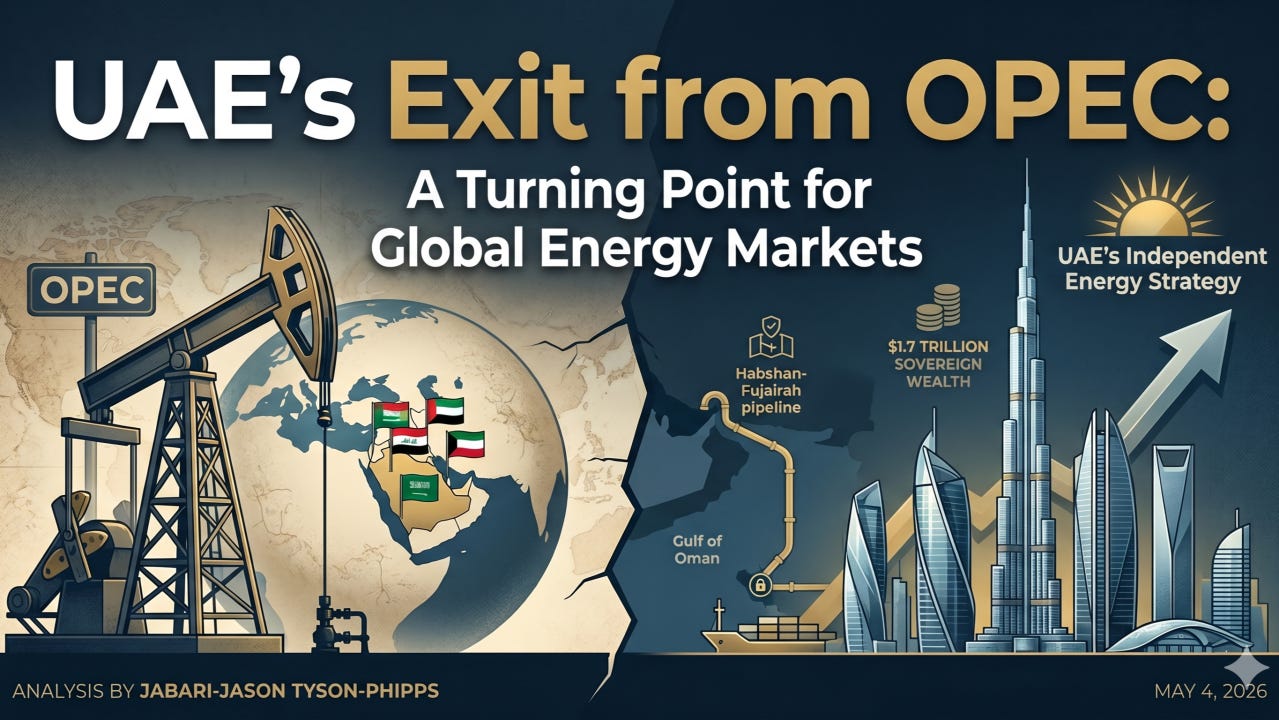
Oil prices shape everything from your weekly gas bill to the cost of groceries and even job opportunities in energy-dependent industries. With the United Arab Emirates’ departure from OPEC effective May 1, 2026, the stability that has long influenced these prices faces new uncertainty, potentially leading to more volatility affecting consumer prices and business costs worldwide.
OPEC, founded in 1960 in Baghdad by Iran, Iraq, Kuwait, Saudi Arabia, and Venezuela, coordinates oil policies among members to stabilize markets and secure fair prices for producers.
Current OPEC members include Algeria, Republic of the Congo, Equatorial Guinea, Gabon, Iran, Iraq, Kuwait, Libya, Nigeria, Saudi Arabia, and Venezuela, totaling 11 nations after UAE’s exit effective May 1, 2026.
OPEC produced approximately 28 to 29 million barrels per day of crude oil (excluding condensates) recently, representing about 37 to 40% of global crude output.
UAE contributed approximately 4 million barrels per day before leaving, despite having capacity to produce 5 million barrels per day by 2027.
The International Energy Agency projects global oil demand in 2026 at approximately 104.87 million barrels per day, with demand growth slowing to less than 1 million barrels per day annually as prices have rallied.
OPEC+ (OPEC plus allies like Russia) historically coordinated production representing closer to half of global supply, though compliance with quotas has been a persistent challenge.
UAE cited quota disputes limiting it to 3.4 million barrels per day despite 5 million barrels per day capacity after significant investments exceeding $150 billion.
OPEC revenues exceeded $550 billion in 2024 from crude exports, funding member economies but remaining vulnerable to price swings.
UAE’s sovereign wealth funds manage approximately $1.7 trillion in assets, far exceeding the value of its annual oil revenues and fundamentally reshaping its economic priorities.
OPEC stands for the Organization of the Petroleum Exporting Countries, an intergovernmental group formed to counter Western oil companies’ dominance and unify production policies among major exporters. It started when five nations met in Baghdad on September 14, 1960, frustrated by unilateral price cuts from firms like the “Seven Sisters.” Today, headquartered in Vienna, the organization works to coordinate petroleum policies among members, aiming to stabilize oil markets and ensure steady income for producers.
OPEC’s primary tool is production quotas, where member states agree to limit crude oil output to balance supply with demand and maintain target price levels. Importantly, OPEC quotas traditionally apply to crude oil production but not to condensates, giving members incentive to maximize condensate output separately. The organization holds regular meetings where ministers negotiate these quotas based on global economic conditions and market forecasts.
OPEC+ represents an expanded coalition that includes the original OPEC members plus 10 additional oil-producing nations, most notably Russia. This broader group, formed in 2016, extends market coordination beyond the original cartel. Russia’s participation gives OPEC+ significantly more influence over global supply, though it also introduces additional complexity to decision-making and enforcement.
Major oil producers outside both OPEC and OPEC+ include the United States (the world’s top producer at approximately 14 million barrels per day), Canada, China, and Brazil, which operate independently and have diluted OPEC’s once-dominant market control.
Understanding OPEC’s influence requires separating three concepts: production share, spare capacity, and pricing power. Production share refers to the percentage of global output controlled by OPEC members, which has declined from over 50% in the 1970s to approximately 37 to 40% today. Spare capacity, the ability to rapidly increase production, matters more during supply disruptions and gives members leverage during market tightness. Pricing power, the ability to move markets through coordinated cuts or increases, depends on both production share and spare capacity, but also on demand elasticity and the behavior of non-OPEC producers.
OPEC’s declining production share has weakened its ability to unilaterally set prices, particularly as US shale production has become more responsive to price signals.
The UAE announced its exit from OPEC and cessation of participation in the OPEC+ coordination framework on April 27, 2026, with the departure taking effect on May 1 after nearly six decades of membership. This marks the first time OPEC’s fourth-largest producer has left the organization, representing a significant challenge to the cartel’s cohesion.
Sultan al-Jaber, the minister who heads state oil giant ADNOC, emphasized that the decision “is not a decision directed against anyone” but rather serves the UAE’s national interests and long-term strategic objectives. He stated the move “aligns with our industrial, economic, and developmental ambitions, and gives us greater ability to accelerate investment, expand, and create value.”
The departure follows months of tensions with Saudi Arabia over production quotas and foreign policy, including a public falling out in December 2025 over Yemen. The UAE has grown increasingly frustrated with OPEC quotas capping Emirati production at 3.4 million barrels per day, far below its targeted capacity of 5 million barrels per day by 2027. ADNOC has pledged to spend $55 billion on new projects over the next two years to expand production capacity.
Regional strains, including maritime security incidents affecting Gulf shipping routes and the perceived lack of Gulf support during heightened US-Iran tensions, accelerated the decision. The UAE has strategically invested in infrastructure to reduce its vulnerability to Strait of Hormuz disruptions, most notably the Habshan-Fujairah pipeline. This 380-kilometer pipeline, which became operational in June 2012 at a cost of $4.2 billion, transports crude directly from Abu Dhabi’s Habshan oil fields to Fujairah on the Gulf of Oman, completely bypassing the Strait of Hormuz. This alternative export route provides the UAE with greater energy security and operational flexibility compared to other Gulf producers entirely dependent on Hormuz transit.
The UAE’s exit from OPEC reflects a fundamental economic transformation that goes far beyond oil production disputes. Abu Dhabi has spent decades converting oil revenues into one of the world’s largest concentrations of sovereign wealth, managing approximately $1.7 trillion in assets through vehicles including the Abu Dhabi Investment Authority, Mubadala, and ADQ.
This portfolio includes large exposures to developed and emerging market equities, private equity, real estate, infrastructure, credit, and government bonds, with most investments concentrated in North America and Europe. The Abu Dhabi Investment Authority reported 20-year and 30-year annualized returns of 6.3% and 7.1%, respectively, as of the end of 2024. Mubadala reported assets under management rose 17% in 2025 to approximately $385 billion, with a five-year rolling internal rate of return of 10.7%.
For a country with this level of global financial exposure, higher oil prices create a complicated tradeoff. While oil revenues increase, sustained high prices can damage equities, slow global growth, disrupt supply chains, and reduce returns across the broader portfolio. As one analysis noted, “A global recession, a tech selloff, a credit squeeze or a spike in real interest rates now matters as much to Abu Dhabi as any OPEC production quota.”
The UAE has also positioned itself as a major capital partner in AI infrastructure, joining Microsoft, BlackRock and Global Infrastructure Partners in a partnership aiming to deploy as much as $100 billion into AI data centers and the power systems behind them. These strategic bets depend on stable global growth, not just oil prices.
These scenarios are not forecasts but illustrative outcome distributions under different geopolitical and supply-response assumptions. Oil market outcomes remain highly sensitive to compliance behavior among OPEC+ members, which has historically varied significantly across cycles.
In this scenario, OPEC+ continues coordinating production among remaining members while the UAE gradually increases output as shipping conditions normalize. Oil prices likely remain in an elevated but volatile range as markets balance ongoing geopolitical uncertainty against potential supply increases. Global economic growth continues at a moderate pace, and UAE sovereign wealth funds benefit from both increased oil sales and relatively stable portfolio returns.
If regional conflicts escalate, particularly in combination with broader OPEC+ fragmentation risks, or maritime security incidents affecting key shipping routes intensify, supply constraints could tighten significantly. Markets could see sustained prices in higher ranges, triggering inflationary pressures, elevated transportation costs, and potential economic slowdowns reminiscent of historical oil shocks. Consumer economies would face significant pressure while remaining OPEC producers might see short-term revenue gains offset by demand destruction as high prices reduce consumption.
Conversely, if the UAE rapidly ramps production toward full capacity, other frustrated producers follow suit, and US shale output continues expanding in response to price signals, global markets could experience significant oversupply. The International Energy Agency already projects global supply could exceed demand by approximately 3.73 million barrels per day in 2026, representing nearly 4% of total world demand. Combined with slowing demand growth of less than 1 million barrels per day annually, such dynamics could pressure prices lower. This would challenge OPEC economies dependent on elevated prices to balance budgets but benefit consuming nations and reduce inflationary pressures.
OPEC faces multiple long-term headwinds beyond the UAE departure. US shale production has proven far more resilient and price-responsive than anticipated, adding supply precisely when OPEC tries to tighten markets. The energy transition toward renewables and electric vehicles, while slower than some projections, continues to create uncertainty about long-term oil demand growth, particularly as the IEA has revised demand growth forecasts downward.
Internal cohesion has weakened as member states pursue divergent national strategies. Saudi Arabia seeks to maintain market stability and maximize long-term revenue, while countries like Venezuela and Iran face sanctions limiting their production capabilities. Historical data shows smaller OPEC members have historically engaged in greater quota violations than larger members, suggesting enforcement challenges have long existed within the cartel. The UAE’s exit exposes these fissures and raises questions about whether other members with expansion ambitions might reconsider their participation.
Recent OPEC+ actions show adaptation efforts, with incremental output adjustments attempting to balance market needs with production discipline. However, analysts note these adjustments highlight the organization’s reduced flexibility amid complex geopolitical pressures.
Without OPEC’s historical role as a coordinating mechanism, oil markets could see increased volatility as individual producers make independent decisions based on national interests rather than collective market management. This uncertainty affects not just pump prices but broader economic planning for businesses, governments, and households seeking to forecast energy costs.
Oil prices remain a significant driver of global inflation. Sustained prices in elevated ranges increase transportation costs, manufacturing expenses, and consumer goods prices throughout the economy. Central banks must balance these pressures against growth objectives when setting monetary policy, complicating macroeconomic management.
The UAE’s decision reflects closer alignment with US interests and a willingness to chart an independent path from Saudi-led Gulf coordination. This shift could reshape Middle East alliances and affect broader energy diplomacy, particularly as countries navigate the transition between fossil fuel dependence and alternative energy development.
OPEC member states with less diversified economies and smaller financial reserves remain highly vulnerable to oil price swings. Countries that have not built substantial sovereign wealth buffers could face budget crises if coordination weakens and prices fall significantly, or if geopolitical instability reduces their ability to export.
The UAE’s exit occurs within a longer-term debate about the petrodollar system, where oil is predominantly priced in US dollars. While not directly caused by the UAE departure, there are ongoing discussions about whether major producers might increasingly conduct bilateral trade in alternative currencies, particularly with BRICS+ partners. Such shifts, if they occur, would likely unfold gradually over years and represent another dimension of evolving energy market structure with implications for currency markets.
The UAE’s exit from OPEC and cessation of OPEC+ participation effective May 1, 2026, represents the first departure of a major producer and signals weakening cohesion within oil coordination frameworks, driven by quota disputes limiting UAE production to 3.4 million barrels per day despite 5 million barrels per day capacity.
UAE’s sovereign wealth funds managing approximately $1.7 trillion in global assets have fundamentally changed the country’s economic calculus, making stable global growth as important as oil revenues and creating different incentives than traditional OPEC members.
The UAE’s strategic infrastructure investments, particularly the Habshan-Fujairah pipeline bypassing the Strait of Hormuz, provide greater operational flexibility and energy security compared to other Gulf producers entirely dependent on Hormuz transit.
Market participants should consider a range of possible outcomes under different supply-response and geopolitical assumptions, recognizing that oil market outcomes remain highly sensitive to compliance behavior among OPEC+ members.
OPEC’s declining production share (approximately 37 to 40% of global crude output) and reduced pricing power limit its ability to unilaterally control markets, particularly as US shale production responds dynamically to price signals.
The UAE’s departure from OPEC marks more than a dispute over production quotas. It reflects a nation that has successfully transformed oil wealth into global financial power and now prioritizes portfolio returns and economic diversification alongside energy revenues. For businesses and policymakers, this shift demands updated risk assessments that account for more volatile oil markets, potential realignments in Middle East diplomacy, and the diminishing influence of traditional cartel coordination. As energy markets navigate this transition, monitoring OPEC+ cohesion, UAE production decisions, regional stability, and the behavior of non-OPEC producers becomes essential for understanding price trajectories and their broader economic implications. The challenge for energy importers, investors, and oil-dependent economies will be adapting to this landscape where individual national strategies increasingly trump collective coordination. How effectively market participants navigate this uncertainty will shape global economic resilience through the remainder of 2026 and beyond.
This article is published by JJTP Law PLLC as a general-interest news and information service for clients and friends of the firm. Nothing in it is legal advice, and reading it does not create an attorney-client relationship. If you have a question about how this topic applies to your own situation, please reach out to the attorney you normally work with, or schedule a consultation. This is not a solicitation for legal work in any jurisdiction where JJTP Law is not authorized to practice. See our Attorney Advertising & Terms of Use.