27 August 2026
Insights


New York City has announced the policy The harder legal question is what appropriations, contracts,...
New York City’s municipal grocery initiative may properly face scrutiny over public money, public...

Regulatory change can make a product less commercially secure without making it unlawful to own or...

SaaS Style Gaming and the Legal Erosion of...
New York City has announced the policy The harder legal question is what appropriations, contracts,...
New York City’s municipal grocery initiative may properly face scrutiny over public money, public...
Regulatory change can make a product less commercially secure without making it unlawful to own or...
SaaS Style Gaming and the Legal Erosion of...
March 26, 2026
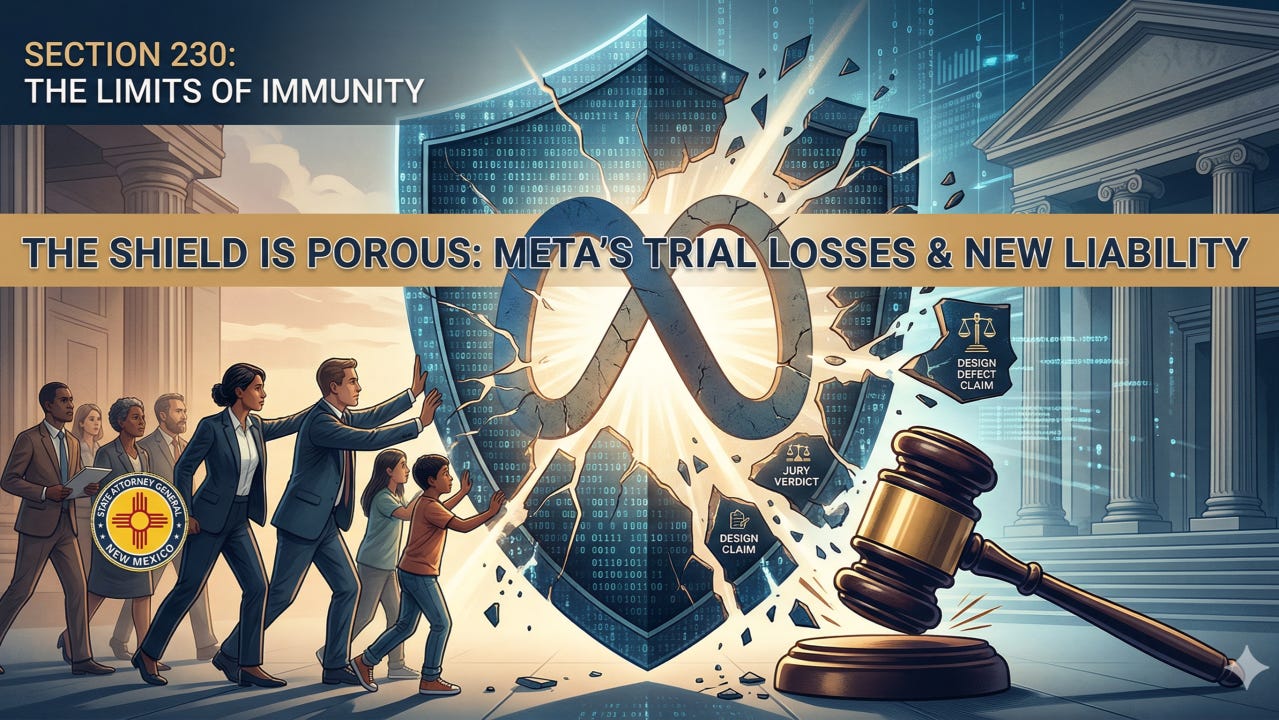
For years, Section 230 functioned as a near case‑ending doctrine at the motion‑to‑dismiss stage. This week, back‑to‑back verdicts in New Mexico and California showed how juries can still reach social‑media defendants by targeting product decisions, safety promises, and warnings rather than classic “publisher” liability for user content.
A New Mexico jury found that Meta violated the state Unfair Practices Act by misleading consumers about the safety of Facebook, Instagram, and WhatsApp and by exposing minors to child‑sexual‑exploitation risks, resulting in $375 million in civil penalties.
The New Mexico award reflects 37,500 willful violations at $5,000 each; the case now moves to a public‑nuisance bench phase in May, where the state is seeking forward‑looking remedies that could include design changes and age‑gating obligations.
A Los Angeles County jury found that Meta and YouTube were negligent in the design and operation of platform features, awarded $3 million in compensatory damages to a young woman, and allocated 70% of responsibility to Meta and 30% to YouTube.
The same California jury found “malice, oppression or fraud,” opening the door to a punitive‑damages phase where jurors later awarded an additional $3 million, for a total of $6 million in the first bellwether social‑media addiction trial.
Many similar youth‑harm cases are consolidated in MDL No. 3047 in the Northern District of California, so this bellwether result will inform bellwether selection, motion practice, and settlement posture across thousands of claims.
The New Mexico case proceeded under the state’s Unfair Practices Act, not as a direct CSAM liability suit. The attorney general alleged that Meta misrepresented how safe its platforms were for children and teens, failed to disclose known risks of child predators and CSAM, and engaged in unconscionable conduct that took advantage of minors’ vulnerabilities. Jurors concluded that Meta’s public assurances about child safety did not match internal knowledge of ongoing exposure of minors to sexual‑exploitation risks and other harms.
Evidence presented at trial included internal documents and testimony indicating that Meta understood the scale of CSAM and youth‑safety issues on its platforms yet continued to market Facebook, Instagram, and WhatsApp as safe environments for young users. New Mexico Attorney General Raúl Torrez said after the verdict that “Meta executives knew their products harmed children, disregarded warnings from their own employees, and lied to the public about what they knew,” calling the decision “a historic victory for every child and family who has paid the price for Meta’s choice to put profits over kids’ safety.” The jury found 37,500 willful violations at the statutory maximum of $5,000, which produced the $375 million civil‑penalty figure now entered by the court.
The case now moves to a separate public‑nuisance bench trial where the state is seeking injunctive relief, including mandatory age‑verification and restrictions on “predatory” algorithmic design that allegedly pushes minors toward harmful content. Public‑nuisance theories, if accepted in this space, can support broad, forward‑looking orders that reshape product architecture for an entire jurisdiction, not just compensate individual plaintiffs.
The California verdict turns on design and duty to warn, not on any single post or video. The plaintiff, referred to as K.G.M., testified that she began using YouTube at age 6 and Instagram at age 9 and that features such as infinite scroll, autoplay, algorithmic recommendations, likes, filters, and push notifications drove compulsive use and coincided with anxiety, depression, body dysmorphia, and suicidal ideation. The jury found that Meta and YouTube were negligent in the design and operation of these engagement‑driven features, that they knew or should have known their products posed dangers to minors, that they failed to provide adequate warnings, and that this negligence was a substantial factor in K.G.M.’s injuries.
Jurors awarded $3 million in compensatory damages, with 70% of liability assigned to Meta and 30% to YouTube, then added $3 million in punitive damages after finding “malice, oppression or fraud,” splitting that amount along the same 70/30 lines. Plaintiffs framed the case as one about “the machine, not the content,” urging jurors to see design choices as deliberate strategies to maximize youth engagement without adequate safeguards or warnings. For the defense, the “turbulent home life” argument and the emphasis on the absence of a formal “social‑media addiction” diagnosis were classic causation plays, but this jury still treated the platforms’ choices as a substantial factor in a multi‑factor harm.
As the first bellwether trial in this line of addiction cases, the K.G.M. verdict now serves as a data point for both sides: it shows what a jury may be willing to award on a single‑plaintiff design‑and‑warning theory and how receptive fact‑finders are to evidence about algorithms and dark‑pattern‑style UX in the youth‑mental‑health context.
Section 230, codified at 47 U.S.C. § 230, provides that providers of interactive computer services shall not be treated as the publisher or speaker of information provided by third‑party content providers and protects certain good‑faith moderation efforts. That protection was never absolute: federal criminal prosecutions, intellectual‑property claims, FOSTA‑SESTA sex‑trafficking suits, and platform‑created content have always been outside its core. Courts have also long held that Section 230 does not immunize a company from its own misrepresentations or securities fraud.
What has changed is the way plaintiffs are pressing on the edges. In New Mexico, the state did not ask to treat Meta as the publisher of specific CSAM posts; it framed its theory as deceptive marketing, unfair practices, and failure to warn under a generally applicable consumer‑protection statute. In California, the focus was on negligent design and failure to warn about foreseeable mental‑health risks from engagement‑maximizing features, with plaintiffs telling jurors to look at code and interfaces instead of the content itself. These are conduct‑based attempts to plead around Section 230 without formally asking any court to cut back the statute.
What juries are effectively being asked to do is treat engagement‑driven design as a form of product defect without calling it that outright. If that line is not policed carefully, nearly any highly engaging digital product could be recast as unreasonably dangerous, which is precisely the concern appellate courts will be weighing.
All of this is happening under the shadow of Gonzalez v. Google LLC and Twitter v. Taamneh. In Gonzalez, families of an ISIS victim argued that YouTube’s recommendation algorithms went beyond passive hosting and therefore fell outside Section 230. The Supreme Court sidestepped the core 230 question by resolving Taamneh on narrow aiding‑and‑abetting grounds and sending Gonzalez back without a sweeping ruling on algorithmic immunity.
That move was widely seen as a punt but also as an invitation for more carefully framed cases. New Mexico and California fit the pattern: they are not framed as “you recommended harmful speech,” but as “you deceived users about safety” and “you designed and marketed a product with foreseeable risks to minors and failed to warn.” While juries are given substantial deference on factual findings, the viability of these legal theories and their fit with Section 230 and the First Amendment will be reviewed de novo on appeal, which is where the next phase of this fight will play out.
The California verdict in particular highlights how traditional failure‑to‑warn concepts are being translated into the digital environment.
Duty: Jurors concluded that once Meta and YouTube design and heavily market products they know will be used by children, they owe those minors and their parents a duty to exercise reasonable care in the design and in the warnings they provide.
Foreseeability: Years of internal research, external studies, and public health warnings about adolescent social‑media use made it increasingly foreseeable that heavy engagement could exacerbate anxiety, depression, negative body image, and suicidality. Trial evidence showed that the companies were aware of those concerns yet continued to lean into engagement‑driven UX for young users.
Breach and causation: The jury found that Meta and YouTube failed to provide adequate warnings or implement reasonable safeguards and that those failures were a substantial factor in the plaintiff’s harm.
Causation, however, is where the hardest legal work remains. Mental‑health outcomes are multi‑factor, and the defense in California emphasized family instability, school stressors, and the absence of any treating provider explicitly blaming social media. Proximate cause doctrine has historically been used to avoid imposing a generalized duty to prevent all user harm from complex life circumstances, and there is a serious argument that, without clear limiting principles, these theories push in that direction.
Even in cases pled as design and deception, the First Amendment is in the background. Platforms will argue that decisions about how to recommend, rank, and present content are part of their editorial and curatorial judgment, which is expressive and entitled to constitutional protection. From that perspective, holding a platform negligent for the psychological impact of recommended content risks creating a form of content‑based liability by another name.
Plaintiffs, by contrast, characterize their claims as targeting commercial conduct: using dark patterns, engagement hacks, and youth‑targeted features without adequate warnings or age‑appropriate safeguards. Appellate courts will need to decide how to distinguish between design choices that are essentially editorial and those that look more like product engineering or commercial conduct, and that line will shape what kinds of design‑based tort claims can coexist with robust First Amendment protections.
Earlier Section 230 cases make the contrast clear. Courts routinely applied the statute to bar claims that treated platforms as publishers of user content, including many suits over harassment, defamation, extremist propaganda, or criminal misuse of platforms. Recommendation and ranking functions were often treated as part of the core publisher role, shielded so long as the platform did not materially contribute to the illegality of the content itself.
At the same time, courts recognized limits: no immunity for federal criminal prosecutions, IP, FOSTA‑SESTA claims, or for situations where the platform created or co‑created the problematic content. New Mexico and California sit in a neighboring gray zone. They do not allege that Meta or YouTube authored the harmful content; instead, they focus on marketing, design, and failure to warn. That is why these suits are better understood as conduct‑based attempts to work around Section 230, not as frontal attacks on the statute itself.
These verdicts are also shaping the broader litigation environment. MDL No. 3047 in the Northern District of California consolidates thousands of youth‑harm suits against multiple platforms, and the K.G.M. result will likely influence bellwether selection, class‑certification strategy, and settlement negotiations. For plaintiffs, a $6 million bellwether with a malice finding is a useful anchor; for defendants, it is a signal that jury exposure on design‑and‑warning theories is real even before any statutory carve‑outs to Section 230.
These theories also raise difficult insurance questions, including whether design‑based harms are more appropriately treated under product‑liability or general‑liability coverage, and how carriers will view punitive‑damages exposure tied to alleged “malice” in platform design. On appeal, expect companies to argue that without clearer doctrinal guardrails, these verdicts risk turning any highly engaging app into a presumed hazard, and that courts should reject open‑ended duties to prevent user harm in favor of narrower, more predictable standards.
Section 230 has always had limits, but these cases show that conduct‑based theories focused on design, misrepresentation, and failure to warn are increasingly effective at reaching trial and verdict without squarely implicating the statute’s core.
New Mexico used its Unfair Practices Act and a public‑nuisance claim to transform internal safety gaps and CSAM‑related risks into a $375 million civil‑penalty award and a looming fight over court‑mandated product changes.
California’s first bellwether addiction verdict asks juries to treat engagement‑driven UX and algorithms as foreseeably dangerous for minors and to apply failure‑to‑warn and negligence concepts to social‑media design, despite complex causation questions.
Appellate courts, guided in part by Gonzalez and Taamneh, will now have to decide how far these design‑based theories can go without collapsing into a generalized duty to prevent user harm or undermining First Amendment and Section 230 principles.
The real fight is shifting to product decisions and safety promises and to whether courts are prepared to treat those decisions as legally actionable. For companies, that means UX, algorithms, and public messaging about child safety now belong on the same risk map as traditional product defects and consumer‑protection exposure.
This article is published by JJTP Law PLLC as a general-interest news and information service for clients and friends of the firm. Nothing in it is legal advice, and reading it does not create an attorney-client relationship. If you have a question about how this topic applies to your own situation, please reach out to the attorney you normally work with, or schedule a consultation. This is not a solicitation for legal work in any jurisdiction where JJTP Law is not authorized to practice. See our Attorney Advertising & Terms of Use.