27 August 2026
Insights

New York City has announced the policy The harder legal question is what appropriations, contracts,...
New York City’s municipal grocery initiative may properly face scrutiny over public money, public...
Regulatory change can make a product less commercially secure without making it unlawful to own or...
SaaS Style Gaming and the Legal Erosion of...
New York City has announced the policy The harder legal question is what appropriations, contracts,...
New York City’s municipal grocery initiative may properly face scrutiny over public money, public...
Regulatory change can make a product less commercially secure without making it unlawful to own or...
SaaS Style Gaming and the Legal Erosion of...
March 26, 2026
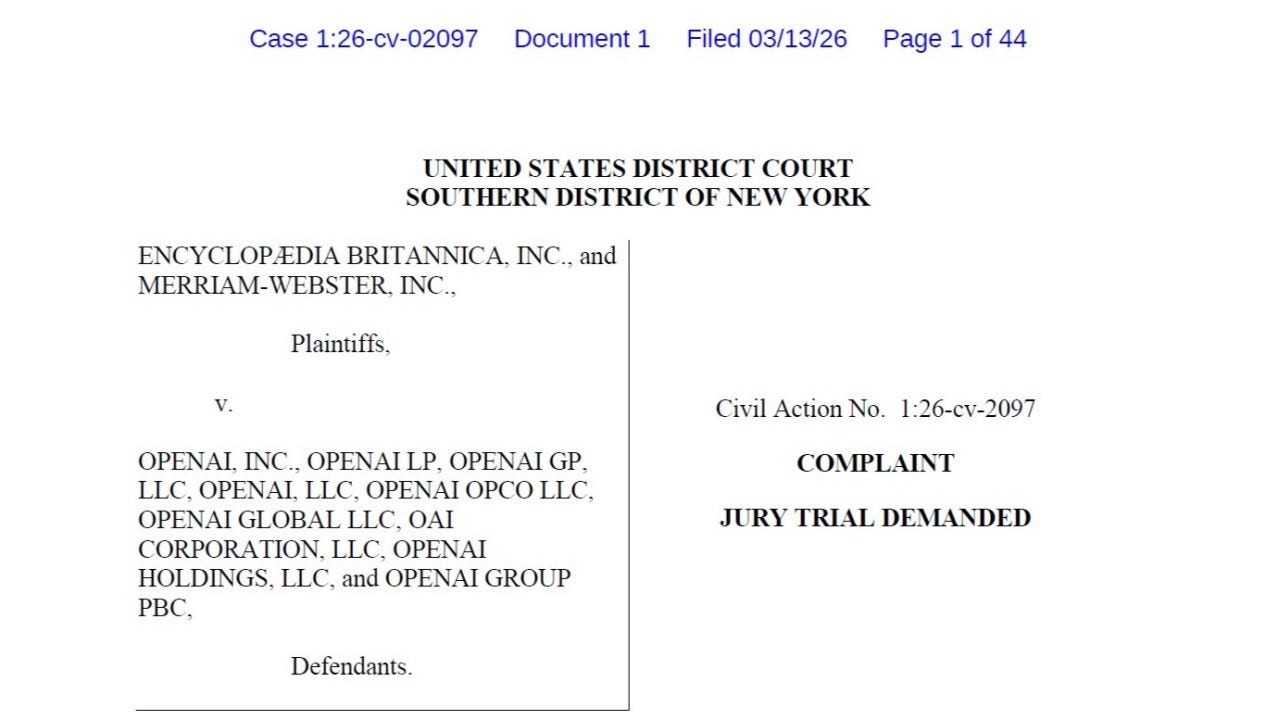
If an AI system could talk in your voice, lift your content, hallucinate facts, and then slap your trademark on the answer, what would you do. That is no longer a hypothetical; it is the reality behind newly filed complaints by Encyclopedia Britannica and Merriam-Webster against Perplexity and OpenAI in the Southern District of New York.
Britannica and Merriam-Webster have sued Perplexity (2025) and, more recently, OpenAI (Case No. 1:26-cv-02097, filed March 13, 2026), alleging that both built answer engines on top of nearly 100,000 copied articles and dictionary entries without permission.
Both complaints describe a three-step pattern: mass scraping and curation, copying that material into training datasets or retrieval indices and outputs that are sometimes copied outright, sometimes lightly rewritten and sometimes reorganized into plaintiffs’ editorial structures.
Perplexity is alleged to run a RAG-based answer engine that uses “PerplexityBot” to crawl plaintiffs’ sites, disregards robots.txt and similar controls, encourages users to “skip the links,” and presents hallucinated or truncated outputs framed as if they were Britannica or Merriam-Webster content.
OpenAI is alleged to have used plaintiffs’ works as GPT training data and again in a RAG-style workflow, with ChatGPT outputs that may reproduce that content verbatim in certain instances, closely paraphrase it, or mirror plaintiffs’ editorial choices, and sometimes attribute fabricated material to those brands.
The OpenAI complaint underscores the economic stakes, pointing out that OpenAI’s valuation has been reported in the neighborhood of $730 billion and arguing that this value was built in part on “cannibalized” publisher content including Britannica’s reference corpus.
It is no coincidence that the OpenAI suit lands just as major platforms are writing nine-figure checks for news and reference content: Meta reportedly struck a large deal with News Corp this month, and Anthropic’s at-least $1.5 billion settlement with authors shows courts and markets are now putting real prices on AI training and answer data. News Corp CEO Robert Thomson has called this strategy “woo and sue” partnering where the price is right and litigating where it is not. Britannica is clearly moving into the “sue” phase, using these filings to set its own market value in an ecosystem where OpenAI sits on a multihundred-billion-dollar valuation.
Both complaints combine copyright theories with Lanham Act false designation claims under 15 U.S.C. § 1125(a) and federal dilution claims under 15 U.S.C. § 1125(c), reframing hallucination and silent truncation as damage to famous information brands, not just technical bugs.
Plaintiffs lean on a “substitution versus referral” theory: traditional search points users to publishers; answer engines keep users inside the AI product and cannibalize traffic and subscription revenue.
These cases arrive in a legal landscape where Judge Stein, in early rulings in the OpenAI MDL (including Ziff Davis), has already signaled that robots.txt circumvention and similar technical claims will be hard to maintain standing alone, but trademark and dilution theories for sufficiently famous marks will get serious attention.
If you have ever had a client send you a ChatGPT answer with the subject line “If this exists, why would anyone visit our site,” you have already seen the theory of liability these complaints try to capture.
To understand why these cases matter, you have to separate copying to learn from copying to answer.
RAG is essentially an open-book exam. When a user asks a question, the system:
Searches a corpus or index that, according to the Perplexity complaint, includes Britannica and Merriam-Webster’s online articles and dictionary entries.
Pulls specific passages into the model as fresh context.
Generates an answer that often tracks those passages closely in substance and structure.
“PerplexityBot” is alleged to crawl and copy plaintiffs’ sites, store that content as RAG inputs, and return answers that are sometimes word-for-word, sometimes lightly rephrased and sometimes compressed into a familiar Britannica-style outline.
The “skip the links” marketing is what turns this from search to substitution: the pitch is that you can get Britannica-level answers without ever visiting britannica.com or merriam-webster.com.
Training-centric models like GPT copy earlier in time. The new OpenAI complaint alleges that:
OpenAI scraped and ingested a large body of Britannica and Merriam-Webster works into GPT training data without any license.
ChatGPT may reproduce that content verbatim in certain cases (including Merriam-Webster’s own definition of “plagiarize”), may closely paraphrase it, and may organize it in ways that mirror plaintiffs’ editorial choices.
ChatGPT also uses a grounding layer that again pulls from plaintiffs’ content in real time.
That creates two layers of risk: intermediate copying in training and visible copying at inference. Even if courts adopt a Google Books–style view that some training uses are fair “intermediate” copying, the live RAG and output layer presents a much more intuitive “this looks like my product” problem for judges and juries.
The substitution paradox is straightforward: the better your model is at answering like Britannica, the less reason there is to actually visit Britannica.
Plaintiffs do not treat Perplexity’s use of their content as an accident. The complaint asserts that PerplexityBot crawls their sites despite robots.txt files and similar controls that, in practical terms, are digital “no trespassing” signs.
They describe three stages of copying:
Curation: copying articles and entries into Perplexity’s own systems via PerplexityBot.
Grounding: using those copies as internal RAG indices whenever a user asks a question.
Outputs: serving answers that often closely match plaintiffs’ language and structure, presented as a one-stop answer rather than as a path to the original page.
Judge Stein’s Ziff Davis ruling suggests that robots.txt circumvention, standing alone, is unlikely to drive liability, but the way those copies are later branded and presented remains very much in play.
On trademark and dilution, plaintiffs allege that Perplexity:
Sometimes fabricates content and displays it next to the BRITANNICA or MERRIAM-WEBSTER marks, or in a presentation that implies those are the sources, leading users to believe the hallucinated material is endorsed or authored by plaintiffs.
Sometimes reproduces large portions of a Britannica article but quietly omits paragraphs and still presents the answer as if it were the complete Britannica entry.
They frame this as:
False designation and false association under Lanham Act § 43(a), 15 U.S.C. § 1125(a), because the combination of UI, citations, and marks allegedly tells users “this is Britannica.”
Dilution by blurring and tarnishment under Lanham Act § 43(c), 15 U.S.C. § 1125(c), arguing that repeated exposure to unreliable AI answers under famous information marks weakens the “Britannica = trustworthy and precise” association.
Perplexity will likely rely on nominative fair use and argue that it must refer to “Britannica” and “Merriam-Webster” to identify sources, and that users understand Perplexity is generating the answer. Plaintiffs’ rejoinder is that the problem is not naming them; it is using their marks as the brand for AI-generated content that is incomplete or wrong.
The OpenAI complaint extends the same mirror theory to the full ChatGPT stack. It alleges that:
Britannica and Merriam-Webster content was used as training data for GPT models without authorization.
ChatGPT may reproduce those works verbatim in certain instances and, more broadly, may answer questions in a way that functionally replaces using plaintiffs’ own sites.
ChatGPT uses web search and grounding that again draws on plaintiffs’ content when constructing responses.
From plaintiffs’ perspective, OpenAI has not just cited their work; it has internalized their editorial judgment to the point that the model behaves like a substitute Britannica.
On the Lanham Act side, the OpenAI complaint alleges the same two themes as Perplexity’s:
Hallucinated or erroneous content attributed to Britannica or Merriam-Webster by name, including the widely noted example of ChatGPT reproducing Merriam-Webster’s own definition of “plagiarize.”
Incomplete or changed versions of Britannica articles presented as if they were faithful reproductions, branded with plaintiffs’ marks and lacking any indication of what has been omitted.
Those are again framed as false association under 15 U.S.C. § 1125(a) and dilution under 15 U.S.C. § 1125(c), tied to both economic harm and long-term erosion of brand equity.
Strategically, the OpenAI suit:
Sits in the same courthouse and factual universe as the In re OpenAI MDL in SDNY, where Judge Stein’s early decisions, including in Ziff Davis, have trimmed some robots.txt and secondary claims while allowing properly pleaded fame-based trademark and dilution claims to proceed into discovery.
Lands in a licensing environment News Corp and others have reshaped. Robert Thomson’s “woo and sue” line captures the moment well: platforms woo some publishers with nine-figure deals and get sued by others. Plaintiffs here are arguing that Britannica’s reference corpus belongs on the “woo and pay” side of that ledger, not the “scrape and see” side.
Against that backdrop, the allegation that OpenAI’s $730 billion valuation was built, in part, by cannibalizing publisher content is meant to sharpen the David-versus-Goliath contrast.
For clients, I find this translation more useful than a doctrinal chart:
Perplexity
.Real-time RAG-based answer engine.
Alleged to walk past digital “no trespassing” signs (robots.txt), crawl plaintiffs’ sites, and market itself as a way to “skip the links.”
Trademark risk focused on explicit misattribution: hallucinated or silently truncated answers presented as Britannica/Merriam-Webster content.
OpenAI / ChatGPT
Training-centric plus RAG across consumer, enterprise, and API products.
Alleged to have memorized plaintiffs’ corpus sufficiently to act as a product substitute, with ChatGPT outputs that users treat as “Britannica, but in chat form.”
Trademark risk focused on brand cannibalization: Britannica-style answers without a Britannica visit, plus branded hallucinations and incomplete reproductions.
Legally, the complaints are siblings: copyright plus Lanham Act misattribution under 15 U.S.C. § 1125(a) and § 1125(c). Factually, they target two different ways an AI can borrow your voice to sell its own product.
Defendants in these and related cases will lean on:
Transformative use: analogies to Authors Guild v. Google Books and similar decisions where large-scale scanning and indexing were upheld because the outputs served search and research functions and did not provide a full substitute for the original books.
Intermediate copying: arguments that training copies are non-expressive and never shown to users and should be treated differently from output-level copying.
Implied license from the open web: claims that publishers who leave content publicly accessible without paywalls or explicit technical restrictions implicitly permit automated analysis and some reuse.
First Amendment: especially for factual material, arguments that generating text “about” public information is speech entitled to protection and that using IP law to tightly regulate AI summarization risks overreach.
Plaintiffs counter that the outputs in these cases are not mere snippets or indexes; they are often complete, self-contained answers that function as replacements for their products, delivered inside a competing commercial interface.
On the Lanham Act side, courts will be asked to decide when “powered by Britannica” becomes “written by Britannica.”
Defendants will argue they need to display “Britannica” or “Merriam-Webster” to identify sources and that citations are classic nominative fair use.
Plaintiffs will point to layout and framing. If the answer looks like a Britannica article, reads like a Britannica article and is labeled as if it were a Britannica article, they say users are entitled to assume it is one.
Judge Stein’s willingness in Ziff Davis to let fame-based dilution claims under 15 U.S.C. § 1125(c) proceed while cutting back on some robots.txt theories suggests that, at least at the pleading stage, courts are open to the idea that repeated AI misattribution can erode a famous mark’s meaning.
Section 230 was never drafted with generative AI in mind, and courts are still working out how far it reaches.
In these cases, plaintiffs allege that Perplexity and OpenAI are not merely hosting third-party posts; their own models are generating, structuring, and labeling the words at issue.
That raises the “material contribution” problem: if the defendant’s system is what makes the content allegedly infringing or misleading, courts are increasingly likely to scrutinize, and potentially narrow, Section 230 defenses.
No court has definitively resolved Section 230’s application to AI outputs yet, but it is difficult to recommend relying on it as a primary shield for a commercial answer engine that looks like a product, not a passive conduit.
There is also a First Amendment tension.
On one hand, AI summarizing facts about history, science, or language looks like speech about matters of public concern.
On the other, these outputs are tightly embedded in commercial products that directly compete with subscription and ad-supported reference services, pushing the analysis toward commercial speech doctrine and giving regulators and courts more room to act.
The line courts draw here will shape not just these cases but the broader future of AI-assisted research tools and answer engines.
For clients building or integrating answer engines, I usually reduce the risk conversation to three questions.
1. What are you actually crawling and caching.
Can you identify your major content sources and their terms of use.
Are you honoring robots.txt and contractual limits, or are you betting that “everyone scrapes” will sound persuasive if a judge asks why your bot walked past a digital “no trespassing” sign
2. How does your product present attribution and truncation.
Does your interface clearly distinguish your AI’s voice from the source’s voice, or are you presenting answers as if they were publisher-authored articles.
When you truncate, reorder, or paraphrase material, do you tell users they are seeing an excerpt or digest, or could a reasonable user think they are seeing the full original text
3. Are you a search helper or a product substitute.
Is your value proposition to help users find and visit authoritative sources, or to keep them inside your interface with “complete” answers.
If it is the latter, have you realistically budgeted for licenses and litigation, in a market where settlements like Anthropic’s and deals like Meta–News Corp are setting expectations.
If your honest answers to those questions are uncomfortable, the Britannica suits are less “tech news” and more an early look at your own risk profile.
The Britannica and Merriam-Webster complaints against Perplexity and OpenAI are among the first to seriously test how copyright, trademark, and platform doctrines apply to answer engines that do not just point to content but stand in for it.
The RAG versus training distinction matters: RAG creates real-time, user-facing copying that is easy to analogize to republication, while training raises more complex questions about intermediate copying and memorization; plaintiffs here are attacking both layers.
The most distinctive move in these cases is the Lanham Act overlay: treating hallucination and silent truncation under another party’s mark as false association under 15 U.S.C. § 1125(a) and dilution under 15 U.S.C. § 1125(c), not just as model accuracy issues.
Recent rulings like Judge Stein’s Ziff Davis decision suggest that robots.txt circumvention claims will be hard to maintain standing alone, but fame-based trademark and dilution theories tied to AI outputs are likely to get serious judicial attention.
Economically, these suits land in a market where “woo and sue” is now a deliberate strategy: platforms woo some publishers with nine-figure licensing deals and get sued by others, and courts are increasingly asked to referee those choices against valuations in the hundreds of billions.
For businesses deploying AI, the path forward is not to avoid these technologies but to treat content sourcing, robots.txt, licensing, attribution, and UX as regulated design decisions. Because the core question these cases force is simple and unavoidable: when your product answers like Britannica, whose product is it.
This article is published by JJTP Law PLLC as a general-interest news and information service for clients and friends of the firm. Nothing in it is legal advice, and reading it does not create an attorney-client relationship. If you have a question about how this topic applies to your own situation, please reach out to the attorney you normally work with, or schedule a consultation. This is not a solicitation for legal work in any jurisdiction where JJTP Law is not authorized to practice. See our Attorney Advertising & Terms of Use.