27 August 2026
Insights
New York City has announced the policy The harder legal question is what appropriations, contracts,...

New York City’s municipal grocery initiative may properly face scrutiny over public money, public...
Regulatory change can make a product less commercially secure without making it unlawful to own or...
SaaS Style Gaming and the Legal Erosion of...
New York City has announced the policy The harder legal question is what appropriations, contracts,...
New York City’s municipal grocery initiative may properly face scrutiny over public money, public...
Regulatory change can make a product less commercially secure without making it unlawful to own or...
SaaS Style Gaming and the Legal Erosion of...
May 13, 2026
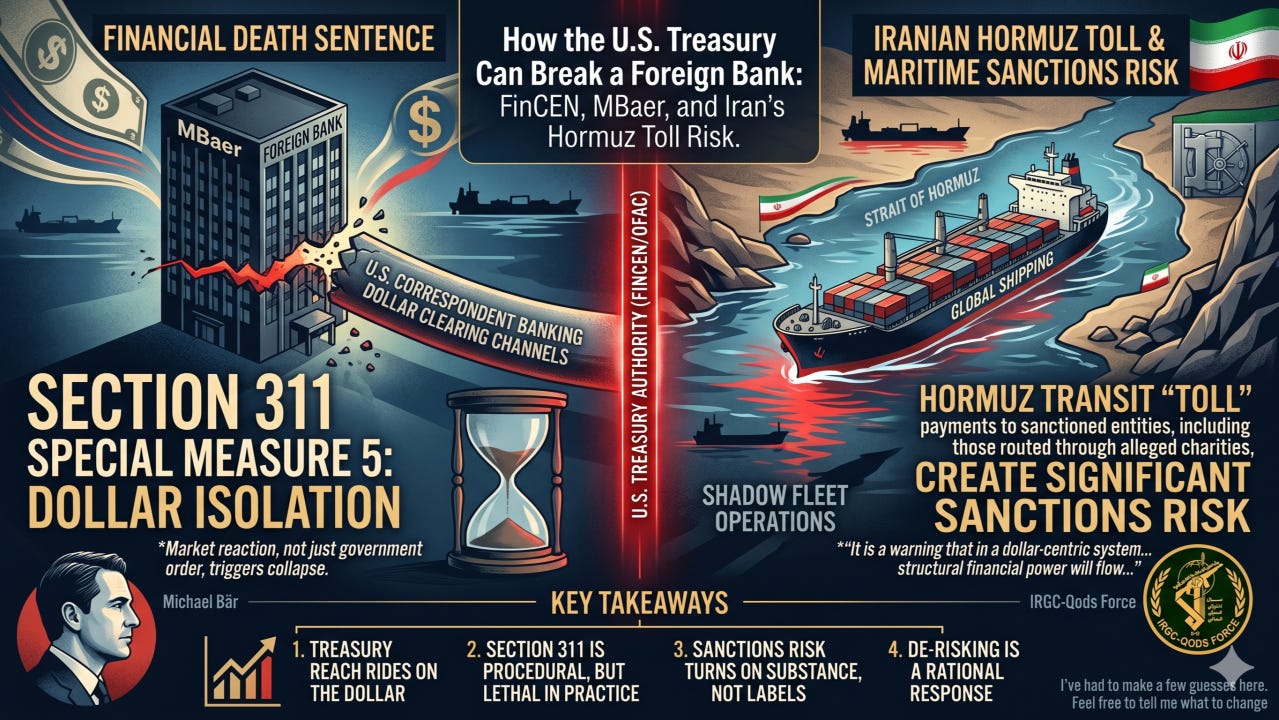
The modern financial system runs on access, confidence, and above all the U.S. dollar. A decision made in Washington can destabilize a bank in Zurich, reshape behavior in the Gulf, and force companies that never see U.S. soil to rethink how they move money, because their transactions ultimately depend on dollar clearing and correspondent banking relationships. The MBaer case shows how that power actually operates, and why every bank, shipping company, and trader touching Iran or other sanctioned jurisdictions must treat sanctions and anti‑money‑laundering controls as core business issues rather than paperwork.
The Financial Crimes Enforcement Network (FinCEN) is a bureau of the U.S. Department of the Treasury that collects and analyzes financial intelligence and administers anti money laundering (AML) rules under the Bank Secrecy Act.
Section 311 of the USA PATRIOT Act, codified at 31 U.S.C. 5318A, allows Treasury to find that a foreign institution is a “financial institution of primary money laundering concern” and, through notice‑and‑comment rulemaking, to impose “special measures,” including prohibiting U.S. banks from maintaining correspondent accounts for that institution.
A Notice of Proposed Rulemaking (NPRM) under Section 311 does not itself freeze assets, but the reputational and correspondent banking impact of a proposed special measure can be devastating before any final rule is adopted.
U.S. sanctions, administered by the Office of Foreign Assets Control (OFAC), can block property, prohibit transactions, and expose non U.S. persons and companies to primary or secondary sanctions when they provide material support to sanctioned actors or sectors, where authorized by statute or executive order.
MBaer Merchant Bank AG in Zurich, founded in 2018 by Michael Bär, a descendant of the well‑known Bär banking family, became among the few Swiss banks to face a proposed Section 311 special measure five, after Treasury alleged that it provided banking access and financial services to networks it described as linked to illicit Russian, Iranian, and Venezuelan actors.
Swiss regulator FINMA found that 80 percent of MBaer’s business relationships involved increased risks and that, most recently, 98 percent of assets received came from high‑risk clients, alongside serious and systematic AML and sanctions‑related failures; FINMA revoked the bank’s license, ordered its liquidation, and opened proceedings against four individuals.
OFAC’s April 30, 2026 alert on Iranian “toll” demands in the Strait of Hormuz warns that payments demanded for safe passage, including those routed through charities such as the Iranian Red Crescent Society or foundations like Bonyad Mostazafan, may create sanctions exposure for U.S. and non‑U.S. persons and foreign financial institutions.
A foreign bank can be organized under Swiss law, serve non‑U.S. clients, and still be deeply exposed to U.S. enforcement because of how dollar payments move. Most sizable cross‑border dollar transactions ultimately clear through U.S. correspondent banks, often in New York, which creates a jurisdictional nexus that U.S. authorities can use to apply sanctions, AML rules, and special measures.
Treasury’s influence operates as a form of structural financial power rooted in the centrality of dollar clearing and correspondent banking. Once a bank is perceived as too risky in that system, correspondent banks often terminate relationships before regulators formally compel them to do so, because no global institution wants to be the last one still providing access. A bank can sometimes survive a large fine or a painful lawsuit. It rarely survives being treated as an unsafe counterparty in the dollar system.
This is where market psychology and legal architecture intersect. Treasury sends a signal through an NPRM. Correspondent banks reassess risk. Home regulators like FINMA apply their own standards. Clients read those signals together and move their money. The statute does not force that entire chain of events, but it sets it in motion.
Because SARs and other Bank Secrecy Act reports are confidential, much of the evidentiary picture behind these actions never becomes public, which adds to the sense that regulators are responding to patterns and intelligence that outsiders can only partly see. That, in turn, makes risk‑averse institutions more likely to de‑risk early rather than wait for the next headline.
FinCEN is the U.S. government’s financial intelligence unit. It administers the Bank Secrecy Act, receives and analyzes Suspicious Activity Reports and other filings, shares financial intelligence with domestic and foreign partners, and issues regulations to protect the financial system from money laundering, terrorist financing, and related threats.
FinCEN is separate from OFAC. OFAC runs sanctions lists and country programs, while FinCEN focuses on the structures and institutions through which illicit finance flows. In cases like MBaer, both worlds converge: alleged sanctions evasion for Russia or Iran is also an AML problem, because it involves disguising beneficial owners, misusing shells, and routing funds through weak controls.
Section 311 authorizes the Treasury Secretary, through FinCEN, to impose one or more of five “special measures” on a foreign institution, jurisdiction, class of transactions, or type of account, if there are reasonable grounds to conclude that it is of primary money laundering concern. Before any measure takes effect, FinCEN generally:
Consults with agencies such as the Federal Reserve, State, and the Attorney General.
Makes a finding that the target is of primary money laundering concern.
Issues a Notice of Proposed Rulemaking in the Federal Register describing the basis for the finding and the proposed special measure.
Receives and reviews public comments before deciding whether to finalize, modify, or withdraw the proposed measure.
Special measure five, the one proposed for MBaer, is the most severe. It would prohibit U.S. financial institutions from opening or maintaining correspondent or payable‑through accounts for the bank and require due diligence to prevent indirect access through foreign intermediaries. For a bank that relies on dollar clearing, that is often commercially fatal, which is why practitioners refer to Section 311 as a “financial death sentence,” even though it is not a criminal sanction and does not itself confiscate assets.
Critically, Section 311 is an administrative tool based on a “reasonable grounds” standard. Treasury does not need to secure a criminal conviction in a court of law to effectively end a bank’s ability to operate in dollars. Financial isolation tools are powerful because they operate faster and often more broadly than criminal prosecutions, and because they trigger market and regulatory reactions that extend far beyond the four corners of the rule.
U.S. sanctions are imposed under authorities such as the International Emergency Economic Powers Act (IEEPA) and program‑specific statutes targeting countries and threats. They can:
Block property and interests in property of designated persons in the United States or within the possession or control of U.S. persons.
Prohibit U.S. persons from providing goods, services, or technology to certain countries, sectors, or actors.
Restrict dealings in debt and equity of targeted entities.
Impose secondary sanctions on non‑U.S. persons and foreign financial institutions that materially support designated programs, such as Iran’s petroleum sector or Russia’s military‑industrial complex, where authorized by statute or executive order.
A non‑U.S. shipping company, trading house, or bank can be exposed if its transactions have a U.S. nexus (for example, being cleared in dollars through a U.S. bank) or if the sanctions program explicitly provides for secondary sanctions against foreign facilitators. That is how large non‑U.S. institutions like BNP Paribas and HSBC ended up resolving major U.S. sanctions and AML cases through deferred prosecution agreements and large fines: their dollar activity provided jurisdictional hooks.
For an international business, the key questions are not limited to “Is there a U.S. citizen in the deal.” They are “Will this touch the dollar system,” “Is any counterparty sanctioned or high‑risk,” and “Can this transaction be defended if a regulator later asks who really benefited and why the structure looks the way it does.”
MBaer Merchant Bank AG, based in Zurich, was founded in 2018 by Michael Bär, a descendant of the prominent Julius Bär banking family, and marketed itself as a boutique merchant bank “by entrepreneurs for entrepreneurs.” That branding made its rapid descent into liquidation all the more striking, because it showed that a prestigious name could not insulate a bank from the consequences of systematic AML failures.
FINMA’s enforcement investigation revealed a business model heavily tilted toward high‑risk relationships:
80 percent of MBaer’s business relationships carried increased risks.
98 percent of the assets it received most recently came from high‑risk clients.
FINMA reported that MBaer repeatedly ignored recommendations from its own compliance department without convincing justification and often failed to adequately investigate the background of clients and their transactions. The regulator concluded that the bank’s structure for combating money laundering was inadequate and that MBaer had, in some cases, enabled clients to circumvent official asset freezes, including by executing transactions on behalf of sanctioned or frozen clients.
These are FINMA’s supervisory findings, made under Swiss law, not criminal judgments. Switzerland has its own AML framework and expectations of “irreproachable business conduct” for licensed institutions; FINMA stressed that MBaer’s deficiencies were “extremely serious” in that context and could not be remedied under the circumstances.
On February 26, 2026, FinCEN issued its Section 311 NPRM proposing to find MBaer a financial institution of primary money laundering concern and to impose special measure five. In its public materials, Treasury alleged that MBaer:
Provided banking access and financial services to networks Treasury described as linked to illicit Russian, Iranian, and Venezuelan actors.
Acted as a critical access point to the U.S. financial system for those networks.
Engaged in practices consistent with sanctions evasion and money laundering, including through the use of shell companies and opaque structures.
Legal and policy analyses summarizing Treasury’s proposal note that the alleged conduct included:
Russian‑related activity supporting sanctions evasion after the 2022 escalation of the war in Ukraine.
Business connected to Venezuela’s state oil company and corruption concerns involving Venezuelan state‑linked actors.
Iranian‑related conduct, including handling payments tied to an Iranian “shadow fleet” tanker network used to move oil despite sanctions and activity Treasury associated with networks connected to the IRGC‑Qods Force.
These descriptions come from an administrative context. They are allegations and risk‑based findings by U.S. authorities, not criminal verdicts by a court. Treasury can act on reasonable grounds and patterns of behavior to protect the financial system without having to prove that every individual transaction violated sanctions laws beyond a reasonable doubt.
On the Swiss side, FINMA’s publications state that MBaer, in some cases, executed transactions for clients included on sanctions lists or whose assets had been frozen by criminal authorities, and that the bank thereby enabled clients to circumvent asset freezes. FINMA’s actions reflect Swiss supervisory standards and are independent of U.S. sanctions law, even though the concerns align.
The timing helps explain why MBaer could not survive. FINMA concluded its enforcement proceedings on February 6, 2026, deciding to revoke MBaer’s license and order its liquidation because licensing requirements, including adequate organization and proper conduct, were no longer met. MBaer initially appealed to Switzerland’s Federal Administrative Court, briefly delaying full effect.
On February 26, 2026, FinCEN issued its NPRM proposing to apply special measure five to MBaer. The next day, FINMA announced that MBaer had withdrawn its appeal and that its license withdrawal and liquidation order had become legally binding, with liquidators appointed to wind down the bank.
In substance:
FINMA, applying Swiss law, determined that MBaer’s AML and organizational failures were extremely serious and that the bank could not be allowed to continue operating.
FinCEN, applying U.S. Section 311 authority, proposed to sever MBaer from U.S. correspondent accounts and payable‑through access as a primary money laundering concern.
Correspondent banks and clients saw both signals and moved to reduce or end exposure.
Treasury turned up the pressure through an NPRM and public designation as a primary money laundering concern. FINMA applied Swiss supervisory standards and pulled the license. Markets, correspondent banks, and clients responded to both signals. Banks can sometimes survive fines or litigation. They rarely survive becoming perceived as unsafe counterparties in the dollar system.
Once FINMA’s liquidation order became effective, MBaer stopped functioning as an active bank. Liquidators, including Prof. Daniel Staehelin as lead liquidator and Dr. Lukas Bopp as deputy, both experienced restructuring practitioners, took control of the wind‑down process under FINMA’s oversight. MBaer’s website now identifies it as “in liquidation,” and provides only limited information for creditors and clients, along with warnings about phishing and fraud attempts.
For clients, this means their dealings with MBaer are now governed by the liquidation process. Services are limited, payouts depend on the liquidation estate and Swiss law, and the bank’s historic relationship value has been replaced by a purely procedural one. For staff and management, the institution’s failure means lost employment and, for some, continuing regulatory exposure.
FINMA also opened enforcement proceedings against four individuals it deemed responsible for or significantly involved in the serious violations. That reflects a broader trend in financial regulation: authorities are increasingly willing to pursue individuals, not just institutions, when AML and sanctions systems fail in ways that suggest governance problems or willful disregard.
OFAC’s April 30, 2026 alert on sanctions risks arising from Iranian demands for “toll” payments in the Strait of Hormuz connects MBaer’s financial story to the real economy of ships and cargo. The alert notes that:
Iranian actors have threatened shipping and demanded payments in exchange for safe passage through the Strait of Hormuz.
These demands may involve a range of value transfers, including fiat payments, digital assets, offsets, informal swaps, or in‑kind transactions.
Payments may be structured as donations or fees to Iranian entities such as the Iranian Red Crescent Society or Bonyad Mostazafan, which sit within the broader Iranian state and IRGC‑linked ecosystem.
OFAC warns that U.S. and non‑U.S. persons, including foreign financial institutions, face sanctions risk if they make, process, or guarantee such payments when they benefit sanctioned Iranian parties or the IRGC. The key point is not that every payment connected to Hormuz is automatically prohibited. The key point is that satisfying Iranian demands for passage when the money reaches sanctioned actors can amount to providing material support for a sanctioned regime.
For a shipowner or charterer, a “safety fee” of fifty thousand dollars can look like a frustrating but manageable cost of doing business. For a bank handling the payment, or an insurer extending cover, the same transaction may appear highly likely to create sanctions exposure if it routes value to a designated Iranian network. That is how an apparently local maritime problem becomes a global financial risk.
This is where the MBaer comparison is instructive. Treasury’s NPRM described MBaer as handling payments linked to Iranian oil shipments and shadow fleet tankers, as well as networks associated with the IRGC‑Qods Force. A bank that processes Hormuz “tolls” for sanctioned Iranian entities is engaged in a similar pattern: moving value for a sanctioned actor under a commercial label. The sanctions analysis does not turn on what the invoice calls the payment; it turns on who benefits and what conduct is being supported.
One of the most important industry consequences of cases like MBaer is de‑risking. Faced with the possibility of Section 311 actions, massive fines, and reputational damage, many banks decide that entire categories of business are simply not worth the risk. These can include:
Smaller foreign banks from high‑risk jurisdictions seeking correspondent relationships.
Private clients with opaque structures and ties to sensitive sectors or jurisdictions.
Shipping and commodity clients involved in complex oil trades with potential Iranian, Russian, or Venezuelan links.
De‑risking has real costs. It can push legitimate customers out of the formal financial system and create pressure in emerging markets. But from the perspective of a mid‑sized bank that has watched MBaer go from licensed institution to liquidation in a matter of weeks after a Section 311 NPRM, de‑risking can look like the only rational choice.
For international companies, the lesson is that sanctions and AML compliance are no longer narrow legal silos. They are central to whether the business can maintain bank accounts, access trade finance, secure insurance, and retain investors. A company that repeatedly brings high‑risk transactions to its banks should not be surprised if those banks eventually decide the relationship is not sustainable.
Treasury’s reach rides on the dollar and correspondent banking. Because most cross‑border dollar payments clear through U.S. banks, foreign institutions that rely on dollar access are subject to U.S. sanctions and AML frameworks, including Section 311 special measures.
Section 311 is administrative on paper but can be commercially lethal. A proposed special measure five does not itself freeze assets, but the combination of administrative findings, correspondent bank reactions, and reputational risk can effectively remove a bank from international finance before any criminal case would ever conclude.
MBaer shows how U.S. and Swiss authorities can converge. Treasury alleged that MBaer provided banking access to risky Russian, Iranian, and Venezuelan networks; FINMA independently concluded that MBaer’s AML and sanctions controls were systemically deficient and revoked its license, leading to liquidation and individual proceedings.
Sanctions risk turns on substance, not labels. A payment described as a transit fee, donation, or service charge can still create sanctions exposure if it benefits a sanctioned actor or circumvents an asset freeze. The legal analysis focuses on the beneficiary and the underlying conduct.
Hormuz “toll” payments are a live risk, not a theoretical scenario. OFAC’s 2026 alert makes clear that meeting Iranian demands for passage payments, including through charities and in‑kind arrangements, may expose shippers and their banks to significant sanctions risk where Iranian state and IRGC‑linked entities are involved.
De‑risking is now a predictable outcome of enforcement. After MBaer, institutions that treat sanctions and AML controls as secondary to client acquisition are misreading the environment. The safer assumption is that a small cluster of high‑risk relationships touching Iran, Russia, or Venezuela can threaten the entire bank, not just an individual account.
For banks, shipping firms, and international businesses, MBaer is not just a Swiss story. It is a reminder that in a dollar‑centric world, financial isolation tools can be faster and more decisive than criminal prosecutions, and that structural financial power will flow through Treasury, home regulators, and markets all at once. Institutions that underestimate that dynamic are no longer just taking a regulatory risk. They are taking a survival risk.
This article is published by JJTP Law PLLC as a general-interest news and information service for clients and friends of the firm. Nothing in it is legal advice, and reading it does not create an attorney-client relationship. If you have a question about how this topic applies to your own situation, please reach out to the attorney you normally work with, or schedule a consultation. This is not a solicitation for legal work in any jurisdiction where JJTP Law is not authorized to practice. See our Attorney Advertising & Terms of Use.