Close
Skip to content
  • Home
  • Insights
  • JJTP Law
    • Careers
    • Contact
    • Make Payment
    • Schedule a Consultation
    • Virtual Office
  • Capabilities
    • AI & Technology Law
    • Alternative Dispute Resolution & Conflict Management
    • Asset Protection and Estate Planning
    • Business Startup and Entrepreneurial Law
    • Civil Rights & Federal Employment Law
    • Consumer Protection, Bankruptcy & Creditor Issues
    • Entertainment & Social Media Law
    • Immigration Law
    • Intellectual Property Law
    • International Law
    • Investigations, Crisis Management & Risk Advisory
    • Nonprofit Law & Pro Bono Legal Services
    • Other Matters
    • Real Estate Law
  • Your Lawyer
    • About JJTP
    • About JJTP Law
    • JJTP Group LLC
    • Prior Engagements
    • Tyson Twins Foundation
  • Services
    • Trademark Search
    • Copyright Search
    • Immigration Visa Type Finder
JJTP Law PLLC logo
  • Home
  • Insights
  • JJTP Law
    • Careers
    • Contact
    • Make Payment
    • Schedule a Consultation
    • Virtual Office
  • Capabilities
    • AI & Technology Law
    • Alternative Dispute Resolution & Conflict Management
    • Asset Protection and Estate Planning
    • Business Startup and Entrepreneurial Law
    • Civil Rights & Federal Employment Law
    • Consumer Protection, Bankruptcy & Creditor Issues
    • Entertainment & Social Media Law
    • Immigration Law
    • Intellectual Property Law
    • International Law
    • Investigations, Crisis Management & Risk Advisory
    • Nonprofit Law & Pro Bono Legal Services
    • Other Matters
    • Real Estate Law
  • Your Lawyer
    • About JJTP
    • About JJTP Law
    • JJTP Group LLC
    • Prior Engagements
    • Tyson Twins Foundation
  • Services
    • Trademark Search
    • Copyright Search
    • Immigration Visa Type Finder

Schedule a Consultation
JJTP Law PLLC logo
  • Home
  • Insights
  • JJTP Law
    • Careers
    • Contact
    • Make Payment
    • Schedule a Consultation
    • Virtual Office
  • Capabilities
    • AI & Technology Law
    • Alternative Dispute Resolution & Conflict Management
    • Asset Protection and Estate Planning
    • Business Startup and Entrepreneurial Law
    • Civil Rights & Federal Employment Law
    • Consumer Protection, Bankruptcy & Creditor Issues
    • Entertainment & Social Media Law
    • Immigration Law
    • Intellectual Property Law
    • International Law
    • Investigations, Crisis Management & Risk Advisory
    • Nonprofit Law & Pro Bono Legal Services
    • Other Matters
    • Real Estate Law
  • Your Lawyer
    • About JJTP
    • About JJTP Law
    • JJTP Group LLC
    • Prior Engagements
    • Tyson Twins Foundation
  • Services
    • Trademark Search
    • Copyright Search
    • Immigration Visa Type Finder
Schedule a Consultation

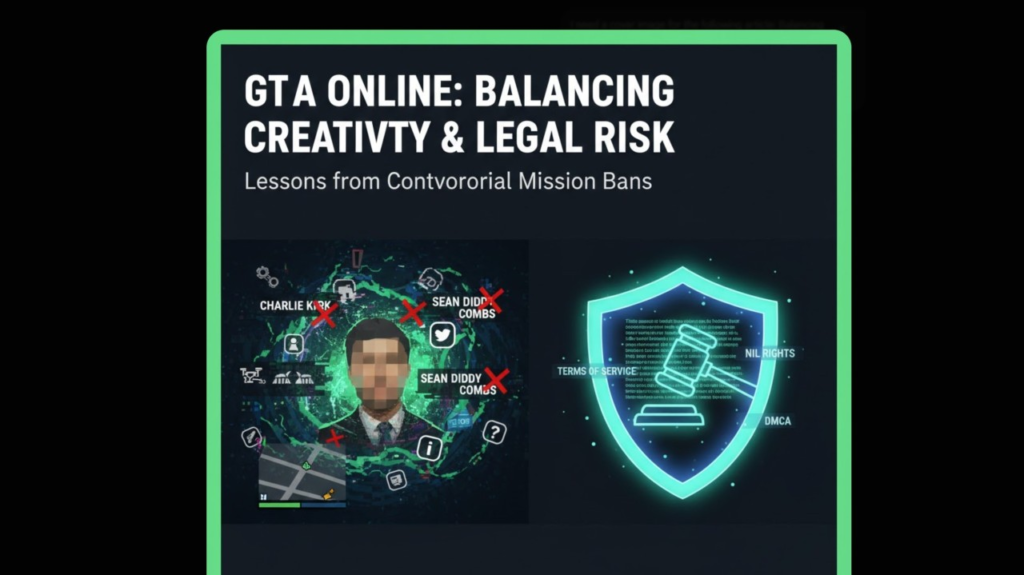
Balancing User Creativity and Legal Risk in Sandbox Games: Lessons from GTA Online

Jabari Tyson-Phipps
19 January 2026
Insights
Email

Originally published on January 19, 2026 on LinkedIn

Key Facts

  • Rockstar Games recently removed user-created GTA Online missions depicting violent scenarios involving real-world public figures, following community reports and internal enforcement decisions.
  • These actions align with Rockstar’s Terms of Service, which prohibit user-generated content using real individuals’ names or likenesses in ways that create legal or reputational risk.
  • PC players in online modes operate under stricter practical modding limitations than console players, reflecting differences in architecture, enforcement tools, and risk allocation.

Sandbox games invite the public to co-create worlds. That freedom is commercially valuable and legally fraught, especially when players use tools to recreate real people and real controversies. For developers, lawyers, and business leaders, the challenge is designing systems that unlock creativity without inviting publicity claims, IP disputes, or platform liability.

First Amendment and Platform Governance

The First Amendment constrains government action, not private companies that moderate their own platforms. That means Rockstar and similar publishers may remove or restrict missions that violate their policies without triggering constitutional speech claims, so long as their decisions are grounded in contract and internal governance rather than state action.

For executives, the practical point is that platform governance is primarily a matter of licensing and policy design, not constitutional law. The legal question is less “Is this speech protected” and more “Does this content violate our terms or create unacceptable risk.”

Licensing Architecture: PC and Console

Rockstar’s End User License Agreement grants players a limited, revocable license to access GTA Online and expressly prohibits unauthorized modifications or content that infringes third-party rights. The online Terms of Service and community rules extend that framework to user-generated content, restricting depictions of real people and forbidding content that is unlawful, harassing, or otherwise harmful.

Console players operate within relatively closed ecosystems where platform-level constraints and certification processes naturally limit modding in online modes. PC architecture is more open, which makes it easier to inject code into online environments and therefore forces publishers to rely more heavily on contractual restrictions, anti-cheat systems, and enforcement to police user-generated content. This disparity reflects not favoritism, but risk allocation: PC architecture enables circumvention, so legal and technical controls have to carry more of the load.

Publicity Rights, AI, and User Missions

User-created missions that depict recognizable public figures implicate the right of publicity, which protects name, image, likeness, and sometimes voice from unauthorized commercial use. California’s right of publicity statutes, including Civil Code § 3344 and § 3344.1, illustrate the modern trend: they provide causes of action for unauthorized exploitation of a person’s identity, including post-mortem rights that reach digital reproductions.

Tennessee’s ELVIS Act (Ensuring Likeness Voice and Image Security), enacted in 2024, goes further by targeting AI-generated replicas and unauthorized digital simulations of a person’s likeness and voice. As AI-driven creation tools migrate from modding communities into first-party sandbox systems, these statutes increasingly affect not just creators, but platform design decisions. For publishers, the legal risk is not only what players build, but what the tools make easy or foreseeable.

Courts use the Transformative Use Test to balance publicity rights against expressive interests. In Hart v. Electronic Arts, the Third Circuit held that a realistic digital avatar of a college athlete was insufficiently transformative and violated the player’s publicity rights. In contrast, Kirby v. Sega of America upheld a stylized character inspired by a musician because Sega added enough creative expression to move beyond a mere digital stand-in. For publishers, these cases function less as bright-line rules and more as risk calibration tools when evaluating user-generated content at scale.

Rockstar has already seen how aggressively these issues can be litigated. In Lohan v. Take‑Two Interactive Software, Inc., actress Lindsay Lohan claimed that the “Lacey Jonas” character and related Grand Theft Auto V promotional art misappropriated her image under New York Civil Rights Law §§ 50 and 51. New York’s highest court ultimately held that the game’s depictions were “indistinct, satirical representations” of a generic young woman and not recognizable as Lohan, so her right of publicity claim failed.

For platforms, the Lohan decision illustrates two points: stylized or satirical characters can receive strong First Amendment protection when they are not clearly tied to a specific individual, but once a depiction crosses the line into a recognizable, name‑linked portrayal, the risk profile changes dramatically. That is precisely the line modern sandbox and AI‑driven tools tempt users to cross when they invite players to build missions around real‑world public figures.

Section 230, DMCA Safe Harbors, and Platform Liability

Section 230 of the Communications Decency Act, codified at 47 U.S.C. § 230, generally prevents treating online services as the publisher or speaker of user-generated content. Game publishers hosting missions or maps can benefit from this protection, provided they remain within the role of service providers rather than co-creators of illegal content. Consistent, neutral enforcement reinforces eligibility by showing that moderation is applied according to policy rather than to advance unlawful conduct.

DMCA safe harbors, codified at 17 U.S.C. § 512, offer a separate shield for copyright claims involving user-generated content. To rely on these provisions, platforms must designate an agent, publish that information, and respond to valid takedown notices in a timely manner. In the sandbox context, that means treating infringing user missions or assets like any other UGC: respond to notices, remove or disable access, and act against repeat infringers.

Operational Guardrails for Sandbox Platforms

  • Define the red lines in the license Make clear that users may not depict real, identifiable individuals in violent, defamatory, or sexually explicit scenarios and that such content is a material breach of the license.
  • Tie tools to legal risk levels Offer more expressive power where the legal risk is lower, such as purely fictional characters, while limiting tools that make it easy to recreate real people or current events.
  • Use AI and human review together Deploy automated systems to detect obvious violations, such as names of public figures combined with violent objectives, then route edge cases to trained human reviewers who understand publicity and IP law.
  • Preserve Section 230 and DMCA protections Maintain documented, content-neutral moderation policies and a functioning notice-and-takedown process, and avoid co-authoring or promoting specific high-risk missions that could blur the line between hosting and creating.
  • Educate creators inside the product Build short, clear explanations into mission editors and creation tools that explain what is off-limits, why it matters legally, and what consequences follow from violations.

In an era of AI-enhanced creativity, sandbox design is no longer just a gameplay decision, it is a legal architecture choice.

Enjoyed this article? Subscribe to Jabari-Jason Tyson-Phipps — it’s free, and you’ll get future articles by email via Substack.

This article is published by JJTP Law PLLC as a general-interest news and information service for clients and friends of the firm. Nothing in it is legal advice, and reading it does not create an attorney-client relationship. If you have a question about how this topic applies to your own situation, please reach out to the attorney you normally work with, or schedule a consultation. This is not a solicitation for legal work in any jurisdiction where JJTP Law is not authorized to practice. See our Attorney Advertising & Terms of Use


Jabari Tyson-Phipps

I’m an attorney, founder, and former U.S. Diplomatic Security Service special agent based in New Rochelle, New York, focused on helping companies, creators, and nonprofits grow while managing risk. I lead JJTP Law PLLC and JJTP Group LLC, boutique, technology‑enabled practices that provide fractional general counsel, intellectual property strategy, and business advisory services to clients in financial services, entertainment, technology, and the nonprofit sector. Earlier in my career, I co‑founded FareHarbor, a cloud‑based reservations and payments platform, serving as General Counsel as we scaled through acquisitions, international expansion, and a successful exit. I’ve advised on complex transactions, cross‑border compliance, and IP strategy, and served as outside general counsel to an SEC‑registered investment adviser and multifamily office with over $100M in assets under management. Before returning full‑time to private practice, I served as a Foreign Service Special Agent with the U.S. Department of State, where I led high‑stakes investigations, developed AI‑enabled investigative tools and policies, and managed protective details for senior U.S. and foreign officials. That mix of legal, entrepreneurial, and national‑security experience shapes how I approach strategy, governance, and risk for my clients today. I’m admitted to practice in New York, Pennsylvania, multiple federal courts including the Supreme Court of the United States, and hold licenses as a New York real estate broker, notary public, and FAA‑certified pilot. I also lead and support several community and alumni organizations, including founding the Tyson Twins Foundation and serving as President of the Brown Club in New York. Outside of work, you’ll usually find me flying, lifting, rock climbing, or on a range practicing marksmanship, and exploring ways to use AI and modern workflows to make legal services more accessible, efficient, and human‑centered.

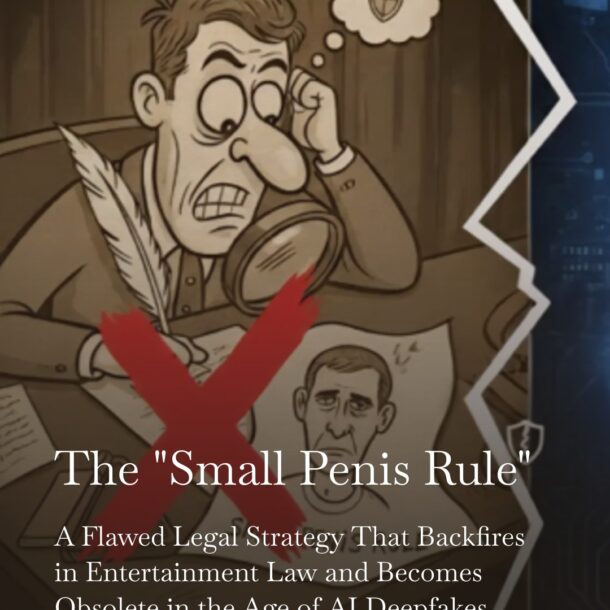
The "Small Penis Rule" A Flawed Legal Strategy That Backfires in Entertainment Law and Becomes Obsolete in the Age of AI Deepfakes
The "Small Penis Rule": A Flawed Legal Strategy That Backfires in Entertainment Law and Becomes Obsolete in the Age of AI Deepfakes
Previous Article
How Trump’s Greenland Move Could Fire the EU’s “Anti-Coercion Bazooka” at Big Tech — Microsoft, Apple, Google, Amazon (MAGA)
Next Article

JJTP Law PLLC logo

JJTP Law PLLC — For a Solutions Based Approach.
New Rochelle, New York

About Us
  • Home
  • About JJTP Law
  • Practice Areas
  • About JJTP
  • Prior Engagements
  • Contact
  • Payments
  • Terms of Representation

Practice Areas

  • AI & Technology Law
  • Alternative Dispute Resolution & Conflict Management
  • Asset Protection and Estate Planning
  • Business Startup and Entrepreneurial Law
  • Civil Rights & Federal Employment Law
  • Consumer Protection, Bankruptcy & Creditor Issues
  • Entertainment & Social Media Law

More Practice Areas

  • Immigration Law
  • Intellectual Property Law
  • International Law
  • Investigations, Crisis Management & Risk Advisory
  • Nonprofit Law & Pro Bono Legal Services
  • Real Estate Law
  • Other Matters
Facebook Linkedin Instagram Youtube Whatsapp Telegram Comment-dots
Phone
+1.212.YES-JJTP (+1.212.937-5587)
Email
hello@jjtpgroup.com
Office
New Rochelle, New York

© 2026 JJTP Law PLLC. All Rights Reserved. JJTP® and the JJTP mark are registered trademarks of JJTP Law PLLC.

Attorney Advertising. Prior results do not guarantee a similar outcome. The information on this website is for general informational purposes only, does not constitute legal advice, and does not create an attorney-client relationship. JJTP Law PLLC is licensed in New York and Pennsylvania and in the federal courts to which its attorney is admitted.

Super Lawyers is a rating service of Thomson Reuters. A description of the selection methodology is available at superlawyers.com. The Super Lawyers designation is a third-party recognition, is not a guarantee of results, and has not been approved by any state supreme court or bar association.

  • Licensed in New York and Pennsylvania
We use cookies to enhance your browsing experience, serve personalized content, and analyze our traffic. By clicking “Accept” you consent to our use of cookies. You may decline non-essential cookies. Learn more in our privacy & terms.

No products in the cart.

JJTP Law PLLC logo
  • Home
  • About
  • Practice Areas
  • Attorney
  • Case Studies
  • Contact
  • Pro Bono Services
Phone
+1.212.YES-JJTP
Email
hello@jjtpgroup.com
Office
New Rochelle, New York
  • Facebook
  • Linkedin
  • Twitter