Close
Skip to content
  • Home
  • Insights
  • JJTP Law
    • Careers
    • Contact
    • Make Payment
    • Schedule a Consultation
    • Virtual Office
  • Capabilities
    • AI & Technology Law
    • Alternative Dispute Resolution & Conflict Management
    • Asset Protection and Estate Planning
    • Business Startup and Entrepreneurial Law
    • Civil Rights & Federal Employment Law
    • Consumer Protection, Bankruptcy & Creditor Issues
    • Entertainment & Social Media Law
    • Immigration Law
    • Intellectual Property Law
    • International Law
    • Investigations, Crisis Management & Risk Advisory
    • Nonprofit Law & Pro Bono Legal Services
    • Other Matters
    • Real Estate Law
  • Your Lawyer
    • About JJTP
    • About JJTP Law
    • JJTP Group LLC
    • Prior Engagements
    • Tyson Twins Foundation
  • Services
    • Trademark Search
    • Copyright Search
    • Immigration Visa Type Finder
JJTP Law PLLC logo
  • Home
  • Insights
  • JJTP Law
    • Careers
    • Contact
    • Make Payment
    • Schedule a Consultation
    • Virtual Office
  • Capabilities
    • AI & Technology Law
    • Alternative Dispute Resolution & Conflict Management
    • Asset Protection and Estate Planning
    • Business Startup and Entrepreneurial Law
    • Civil Rights & Federal Employment Law
    • Consumer Protection, Bankruptcy & Creditor Issues
    • Entertainment & Social Media Law
    • Immigration Law
    • Intellectual Property Law
    • International Law
    • Investigations, Crisis Management & Risk Advisory
    • Nonprofit Law & Pro Bono Legal Services
    • Other Matters
    • Real Estate Law
  • Your Lawyer
    • About JJTP
    • About JJTP Law
    • JJTP Group LLC
    • Prior Engagements
    • Tyson Twins Foundation
  • Services
    • Trademark Search
    • Copyright Search
    • Immigration Visa Type Finder

Schedule a Consultation
JJTP Law PLLC logo
  • Home
  • Insights
  • JJTP Law
    • Careers
    • Contact
    • Make Payment
    • Schedule a Consultation
    • Virtual Office
  • Capabilities
    • AI & Technology Law
    • Alternative Dispute Resolution & Conflict Management
    • Asset Protection and Estate Planning
    • Business Startup and Entrepreneurial Law
    • Civil Rights & Federal Employment Law
    • Consumer Protection, Bankruptcy & Creditor Issues
    • Entertainment & Social Media Law
    • Immigration Law
    • Intellectual Property Law
    • International Law
    • Investigations, Crisis Management & Risk Advisory
    • Nonprofit Law & Pro Bono Legal Services
    • Other Matters
    • Real Estate Law
  • Your Lawyer
    • About JJTP
    • About JJTP Law
    • JJTP Group LLC
    • Prior Engagements
    • Tyson Twins Foundation
  • Services
    • Trademark Search
    • Copyright Search
    • Immigration Visa Type Finder
Schedule a Consultation

Nintendo’s Tariff Lawsuit: When “Emergency” Trade Policy Hits Your Next Console

Jabari Tyson-Phipps
7 March 2026
Insights
Email

Originally published on LinkedIn on March 7, 2026
BLUF

Nintendo’s new lawsuit over Trump’s emergency tariffs shows how a sanctions law was turned into a tariff tool, rejected by the Supreme Court, and then converted into a 175 billion dollar refund fight that will mostly pay out to companies and governments, not to the gamers and households who quietly picked up the tab.


Key Facts

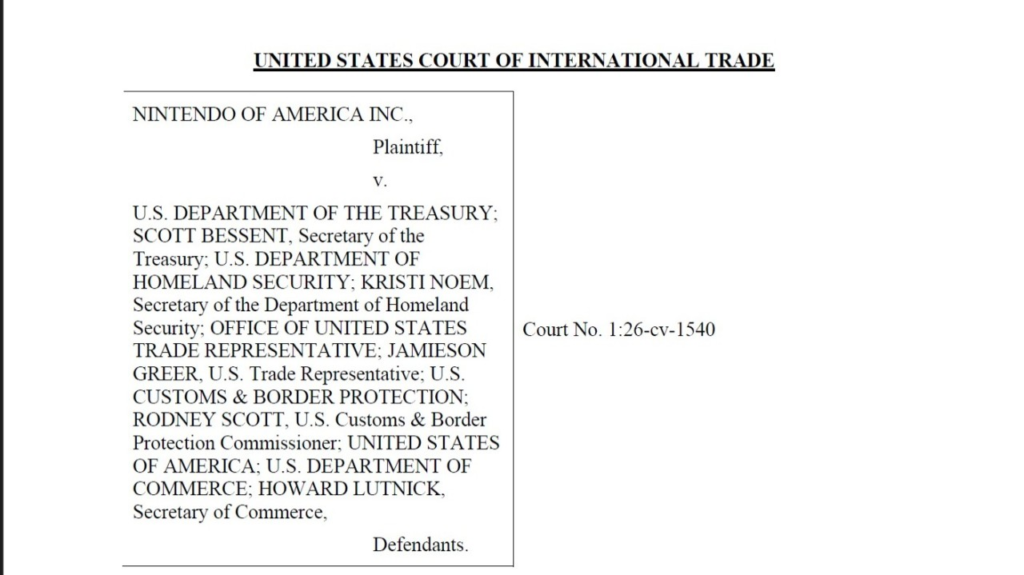
  • On March 6, 2026, Nintendo of America filed a complaint in the U.S. Court of International Trade, asking for refunds with interest of tariffs it paid under Trump’s “IEEPA Duties,” based on the Supreme Court’s February decision in Learning Resources, Inc. v. Trump that those duties exceeded what Congress allowed under IEEPA.
  • The tariffs were imposed under the International Emergency Economic Powers Act, or IEEPA, a 1977 emergency statute designed for targeted sanctions and transaction blocks, and the Court concluded that its “regulate importation” language does not extend to broad, revenue‑raising tariffs on ordinary imports.
  • Nintendo’s lawsuit is about remedies, not about re‑arguing legality, and it asks the Court of International Trade to order reliquidation of entries that are already “final” and to refund all IEEPA duties Nintendo paid, regardless of liquidation status, pointing to prior Justice Department filings where the government told courts it would issue refunds with interest if those tariffs were found unlawful.
  • Customs and Border Protection data and Penn‑Wharton modeling suggest roughly 134 to 175 billion dollars in IEEPA‑related duties are now subject to potential refund, and recent reporting estimates interest costs on delayed repayments at about 700 million dollars per month with the total likely reaching tens of billions of dollars over several years, all funded by taxpayers.
  • In a March 4 order, Judge Richard Eaton held that all importers who paid IEEPA Duties are entitled to the benefit of Learning Resources, even as Customs has told the court it faces “technical limitations” in processing mass reliquidations and refunds and has floated a 45 day timeline to stand up a basic refund system.
  • After losing at the Supreme Court on IEEPA, Trump announced new “Liberation Day” tariffs under Section 122 of the Trade Act, setting a 10 to 15 percent global surcharge and justifying it as a “balance of payments” measure, even though the United States runs a large capital account surplus that New York and other states cite to argue there is no genuine balance of payments emergency.
  • New York Attorney General Letitia James now leads roughly two dozen states in challenging those Section 122 tariffs in the Court of International Trade, arguing they improperly shift Congress’s tariff power to the President and act as a regressive tax on residents, farmers, and small businesses.
  • Tariffs are legally paid by importers at the border but are usually passed into consumer prices, and in the case of Nintendo’s “successor to the Nintendo Switch,” widely called “Switch 2,” that showed up as a delayed U.S. pre‑order window and higher accessory prices while the console stayed at 449.99 dollars.

How This Hit The “Switch 2” Before It Hit The Courts

Nintendo’s complaint is written in careful legal language, but its launch calendar tells the story more bluntly.

In early April 2025, after Trump’s “Liberation Day” tariff package, Nintendo delayed U.S. pre‑orders for the successor to the Nintendo Switch, which players and press were already calling “Switch 2.” In a statement to IGN, Nintendo said:

“Pre‑orders for Nintendo Switch 2 in the U.S. will not start April 9, 2025 in order to assess the potential impact of tariffs and evolving market conditions. Nintendo will update timing at a later date. The launch date of June 5, 2025 is unchanged.”

The console did launch on June 5 at 449.99 dollars, with a Mario Kart World bundle at 499.99 dollars and the game itself at 79.99 dollars. Instead of touching the headline console price, Nintendo raised the cost of the ecosystem around it:

  • the Joy‑Con 2 Pair increased by about 5 dollars from the originally signaled price
  • the Pro Controller increased by about 5 dollars
  • the dock set rose by roughly 10 dollars, from 109.99 to 119.99 dollars.

Nintendo explained that accessory prices would “experience adjustments” due to “changes in market conditions.” In context, that means tariffs and tariff risk were now part of the cost structure that had to be recouped.

For a family that buys the console, one extra Joy‑Con pair, and a dock, that is roughly an extra 15 dollars compared with the pre‑tariff plan. On its own, 15 dollars hurts but does not feel like a policy story. When you multiply that sort of increase across laptops, phones, appliances, and farm equipment, you get the kind of number New York uses in court, about 13.5 billion dollars in added costs for its residents or roughly 1,751 dollars per household.


IEEPA In Plain English

The International Emergency Economic Powers Act was enacted in 1977 to give presidents a defined toolkit for foreign economic crises. After a president declares a national emergency under the National Emergencies Act, IEEPA allows the White House to block or freeze foreign owned assets in U.S. jurisdiction, prohibit U.S. persons from dealing with specified foreign parties, and stop certain imports or exports to or from particular countries or actors.

IEEPA is a sanctions and transaction control law. It is aimed at cutting off specific channels of money and goods when there is an “unusual and extraordinary threat” that originates largely outside the United States. The statute talks about blocking, regulating, and prohibiting transactions. It does not mention tariffs or duties, and historically Congress has used different statutes, such as Sections 201, 232, 301, and 122 of the Trade Act, when it wants presidents to impose or adjust tariffs. The Supreme Court has now treated that silence as significant.


How IEEPA Ended Up In The Tariff Toolkit

Over the last decade, U.S. trade policy has cycled through almost every tool on the shelf. Section 301 has been used to respond to Chinese “unfair practices.” Section 232 has been used to impose “national security” tariffs on steel and aluminum. Section 122 is now the basis for Trump’s new “Liberation Day” surcharges.

In 2025, the administration tried to add IEEPA to that list. It declared a series of national emergencies that cited opioids at the northern border, migration and trafficking at the southern border, the synthetic opioid supply chain in China, global trade deficits, and perceived threats tied to Brazil, India, and Russia. It then used those emergency declarations to impose percentage tariffs on a wide range of imports from those countries.

Consumer electronics were caught in the middle. Nintendo’s consoles and components are produced largely in East Asia, including China and nearby manufacturing hubs, and when you suddenly add an extra 10, 25, or more percent duty on those goods, the math behind a launch changes quickly. Companies can delay, reprice, or absorb the hit. Nintendo did a mix of all three when it paused U.S. pre‑orders, kept the console price steady, and raised accessory prices.

Once the Supreme Court cut off that use of IEEPA, Trump shifted to Section 122 of the Trade Act with a new 10 to 15 percent global surcharge, claiming a balance of payments need. New York and other states now respond by pointing to the capital account side of the ledger and argue that when foreign investors continue to buy U.S. assets in large amounts, it is hard to say there is a balance of payments emergency of the kind Section 122 was designed to address.

Against that backdrop, IEEPA looks like the one bridge that did not hold. Sections 301, 232, and 122 remain live, but IEEPA is the statute the Court has now fenced off from being repurposed as a general tariff law.


What The Supreme Court Said About IEEPA And Tariffs

In Learning Resources, Inc. v. Trump, the Supreme Court consolidated several challenges, including V.O.S. Selections, and asked a focused question: did Congress, by giving the President authority in IEEPA to “regulate” and “prohibit” imports during an emergency, also give him authority to impose broad, revenue raising tariffs under that statute.

A six justice majority concluded that Congress did not. The Court reasoned that:

  • IEEPA’s text is written in the language of sanctions. It speaks of blocking, regulating, and prohibiting transactions with foreign interests. It does not mention tariffs, duties, or other taxes, and historically those powers have been housed in other statutes.
  • The Constitution puts the power to “lay and collect Taxes, Duties, Imposts and Excises” in Congress, and courts are reluctant to assume that Congress handed that power to the President implicitly through an emergency sanctions law.
  • Under the major questions doctrine, turning an emergency sanctions statute into a de facto global tariff engine would be the kind of major policy shift that requires clear authorization from Congress, which IEEPA does not contain.

It is accurate, and consistent with the Court’s language, to say that the Court concluded IEEPA does not authorize broad revenue raising tariffs on ordinary imports. After the decision came down on February 20, Trump issued Executive Order 14389, stopping collection of IEEPA Duties for the future but remaining silent about repayment of past collections.


Nintendo’s Case: From Duties Paid To Duties Refunded

Nintendo’s complaint starts where the Supreme Court left off. It does not ask whether the IEEPA Duties were lawful. It takes Learning Resources as settled law and asks what relief importers who paid those duties are entitled to receive.

The company alleges that it is an importer of record for goods from countries subject to the IEEPA Duties, that it paid those duties on entries between February 2025 and late February 2026, and that some of those entries have already liquidated while others have not.

Liquidation is the customs step that finalizes duty liability on an import entry. Once an entry liquidates, the assessed duty amount is treated as final unless a protest, reliquidation, or court order changes it. Under the government’s current approach, many entries that liquidated before the Supreme Court’s decision could be treated as beyond normal refund mechanisms, even though they include duties the Court has now said IEEPA could not support.

Nintendo invokes 28 U.S.C. § 1581(i), which gives the Court of International Trade exclusive jurisdiction over civil actions that arise out of laws providing for tariffs and related administration, and 28 U.S.C. §§ 1585 and 2643, which allow that court to enter money judgments and equitable relief. It asks the court to:

  • declare that the IEEPA Duties were unlawful and void from the beginning
  • stop Customs from collecting or liquidating any remaining IEEPA Duties
  • order reliquidation of entries that included IEEPA Duties
  • strip IEEPA Duties out of unliquidated entries
  • refund all IEEPA Duties Nintendo paid, with interest, or enter an equivalent money judgment.

Nintendo supports this by quoting the government’s own prior filings. In a motion for a stay in V.O.S. Selections, Justice Department lawyers told the Federal Circuit that if the tariffs were ultimately held unlawful, “the government will issue refunds to plaintiffs, including any post judgment interest that accrues.” That is a clear representation to a federal court about how the government itself understood the consequences of an adverse ruling.

Judge Eaton’s March 4 decision adds another layer, holding that all importers who paid IEEPA Duties are entitled to the benefit of Learning Resources and that the government cannot treat that Supreme Court victory as belonging only to the initial plaintiffs. Customs has told the court that it accepts the need to refund unlawful duties in principle but faces “technical limitations” in doing so quickly at scale, and it has suggested a roughly 45 day timeline to stand up a basic refund system. The longer it takes, the more interest taxpayers will owe on money that, in the Court’s view, should never have been collected under IEEPA in the first place.


Who Paid, Who Gets Paid Back

On the government’s books, the IEEPA Duties came from importers such as Nintendo. In customs records, the importer of record writes the duty check. In the real world, most importers do what basic economics predicts. They raise their prices to cover higher costs. Wholesale prices go up, retailers adjust shelf prices, and the final bill is paid by consumers and downstream businesses.

Work cited by Fortune and other outlets indicates that a large share of tariff costs, often more than half, ends up embedded in consumer prices for core goods and durable items. No one sees a separate “IEEPA duty” on the receipt. There is just a slightly higher total whenever someone checks out with a console, a laptop, or a piece of machinery.

Now the flow is reversing. Customs and Penn‑Wharton estimates suggest that about 134 to 175 billion dollars in IEEPA‑related duties are subject to potential refunds. Those funds have been sitting with the Treasury, and because the government must pay interest when it refunds unlawful exactions, the interest bill is mounting. Recent coverage puts interest costs at about 700 million dollars a month and warns that if delays continue, total interest could reach into the tens of billions over several years. That is a self inflicted cost and it comes from the same taxpayers who already paid the tariffs once through higher prices.

Former Commerce Secretary Wilbur Ross has described the situation in recent interviews as “an immense litigation mess” and has pointed out that working out refunds “product by product” across “tens of thousands, maybe hundreds of thousands” of tariff lines will be extremely complex. Treasury Secretary Scott Bessent, in press comments, has been even more direct, saying “I got a feeling the American people will not see it,” meaning that the household level refunds many people would expect are not coming.

Nintendo is one of many importers now in the Court of International Trade seeking refunds of IEEPA Duties. The court has become the main forum for sorting out who receives money from a pot that was filled, in economic terms, by millions of individual purchases.


States Like New York And The Section 122 Fight

While importers work through the IEEPA refund process, New York and about two dozen other states are trying to prevent Section 122 of the Trade Act from becoming the next open ended tariff authority.

Attorney General Letitia James’s lawsuit argues that Trump’s new “Liberation Day” tariffs exceed the limited balance of payments authority that Congress granted in Section 122. That statute is meant for true foreign exchange crises, for example when a country is losing reserves and needs to slow imports to protect its currency. New York’s filings point to the United States capital account surplus as evidence that global investors are still sending money in rather than pulling it out, which undercuts the idea of a balance of payments emergency.

New York estimates that earlier Trump tariffs have already cost state residents about 13.5 billion dollars and warns that the new global surcharges will continue to function as a stealth tax on households, farmers, and small businesses if they are allowed to stand. Attorneys general in Minnesota, California, and other states have joined or filed similar cases, stressing that Section 122 was not meant to be a permanent replacement for congressional debate and legislation on trade policy.

At the same time, Section 232 “national security” tariffs and older Section 301 duties remain active. IEEPA is the one statute where the Supreme Court has now drawn a clear boundary, holding that emergency economic powers cannot be used to create general revenue raising tariffs on ordinary imports.

Key Takeaways

  • IEEPA is a sanctions and emergency transactions law, and the Supreme Court has now said that its “regulate importation” authority does not allow the President to impose broad revenue raising duties on everyday imports.
  • Trump’s IEEPA Duties collected an estimated 134 to 175 billion dollars before the Court shut them down, and much of that burden was passed into higher prices on products such as consoles, controllers, docks, and other everyday goods.
  • Nintendo’s lawsuit in the Court of International Trade is about turning a constitutional ruling into concrete relief. It asks the court to reopen liquidated entries, remove unlawful IEEPA Duties, and compel the government to honor its own earlier promise to refund those duties with interest.
  • Judge Eaton has confirmed that all importers hit by IEEPA Duties benefit from Learning Resources, but Customs is moving slowly, citing technical limits, and that delay is costing taxpayers roughly 700 million dollars a month in interest on money the government should not have collected under IEEPA at all.
  • New York and other states are separately challenging Trump’s new Section 122 “Liberation Day” tariffs, arguing there is no genuine balance of payments emergency in a country with strong capital inflows and that the administration is using Section 122 as an improper substitute for congressional tariff authority.
  • For the public, the through line is simple. Tariffs under IEEPA and Section 122 arrived quickly in the form of higher prices and delayed launches, not as separate line items on receipts. The refunds, years later, will mostly flow to entities with lawyers and detailed import records. Courts can police the boundaries of presidential power, but they cannot easily send the money back to every gamer and household that unknowingly helped fund this round of trade experimentation.

Jabari Tyson-Phipps

I’m an attorney, founder, and former U.S. Diplomatic Security Service special agent based in New Rochelle, New York, focused on helping companies, creators, and nonprofits grow while managing risk. I lead JJTP Law PLLC and JJTP Group LLC, boutique, technology‑enabled practices that provide fractional general counsel, intellectual property strategy, and business advisory services to clients in financial services, entertainment, technology, and the nonprofit sector. Earlier in my career, I co‑founded FareHarbor, a cloud‑based reservations and payments platform, serving as General Counsel as we scaled through acquisitions, international expansion, and a successful exit. I’ve advised on complex transactions, cross‑border compliance, and IP strategy, and served as outside general counsel to an SEC‑registered investment adviser and multifamily office with over $100M in assets under management. Before returning full‑time to private practice, I served as a Foreign Service Special Agent with the U.S. Department of State, where I led high‑stakes investigations, developed AI‑enabled investigative tools and policies, and managed protective details for senior U.S. and foreign officials. That mix of legal, entrepreneurial, and national‑security experience shapes how I approach strategy, governance, and risk for my clients today. I’m admitted to practice in New York, Pennsylvania, multiple federal courts including the Supreme Court of the United States, and hold licenses as a New York real estate broker, notary public, and FAA‑certified pilot. I also lead and support several community and alumni organizations, including founding the Tyson Twins Foundation and serving as President of the Brown Club in New York. Outside of work, you’ll usually find me flying, lifting, rock climbing, or on a range practicing marksmanship, and exploring ways to use AI and modern workflows to make legal services more accessible, efficient, and human‑centered.

AI Chatbots and Corporate Liability: The Gavalas Case Signals Rising Risks
Previous Article
Did ChatGPT Practice Law? The Lawsuit That Could Redefine AI Legal Assistance
Next Article

JJTP Law PLLC logo

JJTP Law PLLC — For a Solutions Based Approach.
New Rochelle, New York

About Us
  • Home
  • About JJTP Law
  • Practice Areas
  • About JJTP
  • Prior Engagements
  • Contact
  • Payments
  • Terms of Representation

Practice Areas

  • AI & Technology Law
  • Alternative Dispute Resolution & Conflict Management
  • Asset Protection and Estate Planning
  • Business Startup and Entrepreneurial Law
  • Civil Rights & Federal Employment Law
  • Consumer Protection, Bankruptcy & Creditor Issues
  • Entertainment & Social Media Law

More Practice Areas

  • Immigration Law
  • Intellectual Property Law
  • International Law
  • Investigations, Crisis Management & Risk Advisory
  • Nonprofit Law & Pro Bono Legal Services
  • Real Estate Law
  • Other Matters
Facebook Linkedin Instagram Youtube Whatsapp Telegram Comment-dots
Phone
+1.212.YES-JJTP (+1.212.937-5587)
Email
hello@jjtpgroup.com
Office
New Rochelle, New York

© 2026 JJTP Law PLLC. All Rights Reserved. JJTP® and the JJTP mark are registered trademarks of JJTP Law PLLC.

Attorney Advertising. Prior results do not guarantee a similar outcome. The information on this website is for general informational purposes only, does not constitute legal advice, and does not create an attorney-client relationship. JJTP Law PLLC is licensed in New York and Pennsylvania and in the federal courts to which its attorney is admitted.

Super Lawyers is a rating service of Thomson Reuters. A description of the selection methodology is available at superlawyers.com. The Super Lawyers designation is a third-party recognition, is not a guarantee of results, and has not been approved by any state supreme court or bar association.

  • Licensed in New York and Pennsylvania
We use cookies to enhance your browsing experience, serve personalized content, and analyze our traffic. By clicking “Accept” you consent to our use of cookies. You may decline non-essential cookies. Learn more in our privacy & terms.

No products in the cart.

JJTP Law PLLC logo
  • Home
  • About
  • Practice Areas
  • Attorney
  • Case Studies
  • Contact
  • Pro Bono Services
Phone
+1.212.YES-JJTP
Email
hello@jjtpgroup.com
Office
New Rochelle, New York
  • Facebook
  • Linkedin
  • Twitter